IMG 20240524 WA0027
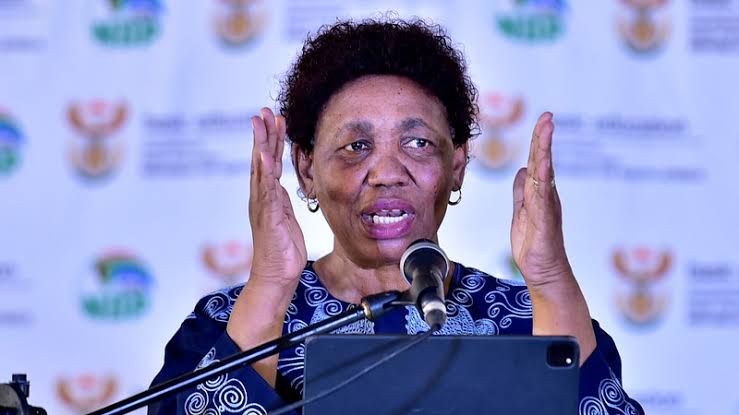
Picture courtesy: (IOL) Basic Education Minister Angie Motshekga ready to roll-out plans for Mother-tongue bilingual initiative.
(The Post News)– Amid growing recognition of the vital role of home languages in education policy, a groundbreaking change is on the horizon for Grade 4 learners in 2025: assessment will now be conducted using a native language-based bilingual approach.
In an historic announcement, Minister of Basic Education, Angie Motshekga, unveiled plans for a transformative shift in education. Her department is gearing up to implement a revolutionary initiative where learners will receive instruction in their native language starting from Grade 4 in 2025.
Speaking to education stakeholders in Bloemfontein, on Tuesday about the benefits of children learning in their native language.
“Even our research has proven that this is not working. The results are also confirming. Language in education is a big issue,” said Motshekga.
Motshekga said assessment in the native language-based bilingual approach will be a new feature for the Grade 4 pupils in mathematics, science, and technology starting in 2025.
She emphasised that teaching and learning in one’s native language lead to consistent and favorable learning results. She further noted that the performance of English and Afrikaans-speaking students in subjects like mathematics and science within the basic education system validates this assertion.
On International Mother Language Day, celebrated on February 21, 2024, Motshekga had announced significant steps toward ensuring that learners have the right to be educated in their home languages.
These languages namely English, isiZulu, isiXhosa, Afrikaans, Sepedi, Setswana, Sesotho, Xitsonga, siSwati, Tshivenda, and isiNdebele recognized as official languages of the Republic of South Africa according to Section 6 of the Constitution.
She emphasised the importance of using these languages not only as subjects but also as mediums of instruction for Mathematics, Science, and Technology beyond grade 3 by the year 2025.
To meet constitutional obligations and plan systematically, January 2025 has been designated as the starting point for this initiative.
This means that learners will take their first Mathematics, Science, and Technology exams in their home languages, which are official languages of South Africa.
This marks a crucial moment in the country’s history, ensuring that children no longer have to learn subjects in a language other than their native language to fully comprehend the content.
In addition, South Africa Sign Language, recognized as the 12th official language, will also benefit learners when explained to them in their home languages first.
This is expected to enhance the quality of learning outcomes by making teaching, learning, and assessment more meaningful, ultimately fostering a love for learning and reading for understanding.
Drawing from a successful case study in the Eastern Cape, where Native Language-based Bilingual Education was piloted over the past decade, the Minister emphasized that the home languages of South Africa should never be sidelined.
Together, with the support of expertise and technical innovation, the roll-out of the Native Language-based Bilingual Education campaign in 2025 will be ensured.
This initiative aligns with UNESCO’s efforts to promote linguistic and cultural diversity and multilingualism, as initially announced on November 17, 1999, and later recognized by the United Nations General Assembly in 2002.
About the Author