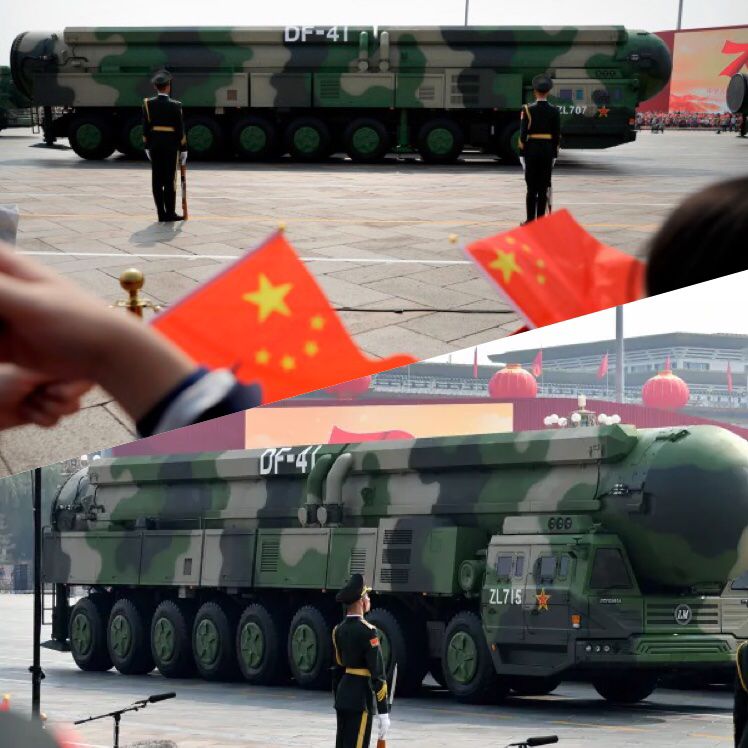
DF-41 ballistic missiles on display, highlighting China’s growing military presence.
(The Post News)- China has conducted a rare intercontinental ballistic missile (ICBM) test in the Pacific Ocean, marking its first public test in the region since 1980. The move has sparked concerns among neighboring countries and the United States, amid heightened tensions in the East China Sea, Taiwan Strait, and South China Sea.
The ICBM, carrying a dummy warhead, was launched at 8:44 a.m. Beijing time on Wednesday and landed in a designated area in the high seas of the Pacific Ocean. China’s Defense Ministry described the test as “routine” and part of its annual training plan, claiming it was not directed at any country or target.
However, analysts view this test as a demonstration of China’s military strength and nuclear capabilities. Experts believe China’s move is intended to send a powerful signal to its neighbors and the US, showcasing its ability to launch a nuclear-capable missile that can reach the US mainland.
Tensions have escalated between China and neighboring countries, including Japan, the Philippines, and Taiwan. Recent incidents include Japanese protests over Chinese and Russian military aircraft incursions into its airspace and collisions between Chinese and Philippine vessels in disputed waters. Taiwan’s defense ministry reported intensive missile firing and military drills by China.
China’s nuclear ambitions are also raising concerns. The Pentagon estimates China has over 500 operational nuclear warheads and is expected to reach 1,000 by 2030. China’s rapid nuclear expansion could soon elevate it to the same league as the US and Russia, the globe’s top nuclear forces, by the dawn of the 2030s.
The test’s timing is significant, coming ahead of a scheduled call between Chinese leader Xi Jinping and US President Joe Biden. China’s increasing assertiveness in the region and its nuclear ambitions are likely to be key discussion topics.
China typically conducts ICBM tests within its territory, but experts note that this test demonstrates China’s expanding military capabilities. The international community is watching closely for any signs of escalation as tensions continue to rise.
China suspended nuclear arms control talks with the US in July, citing concerns over US arms sales to Taiwan. The move has sparked debate in Washington on whether and how the US needs to expand and adjust its own nuclear capabilities and posture.
Regional neighbors, including Japan, the Philippines, and Taiwan, are closely monitoring China’s military activities. The test has sparked concerns, and the international community awaits the outcome of the Xi-Biden call.
About the Author