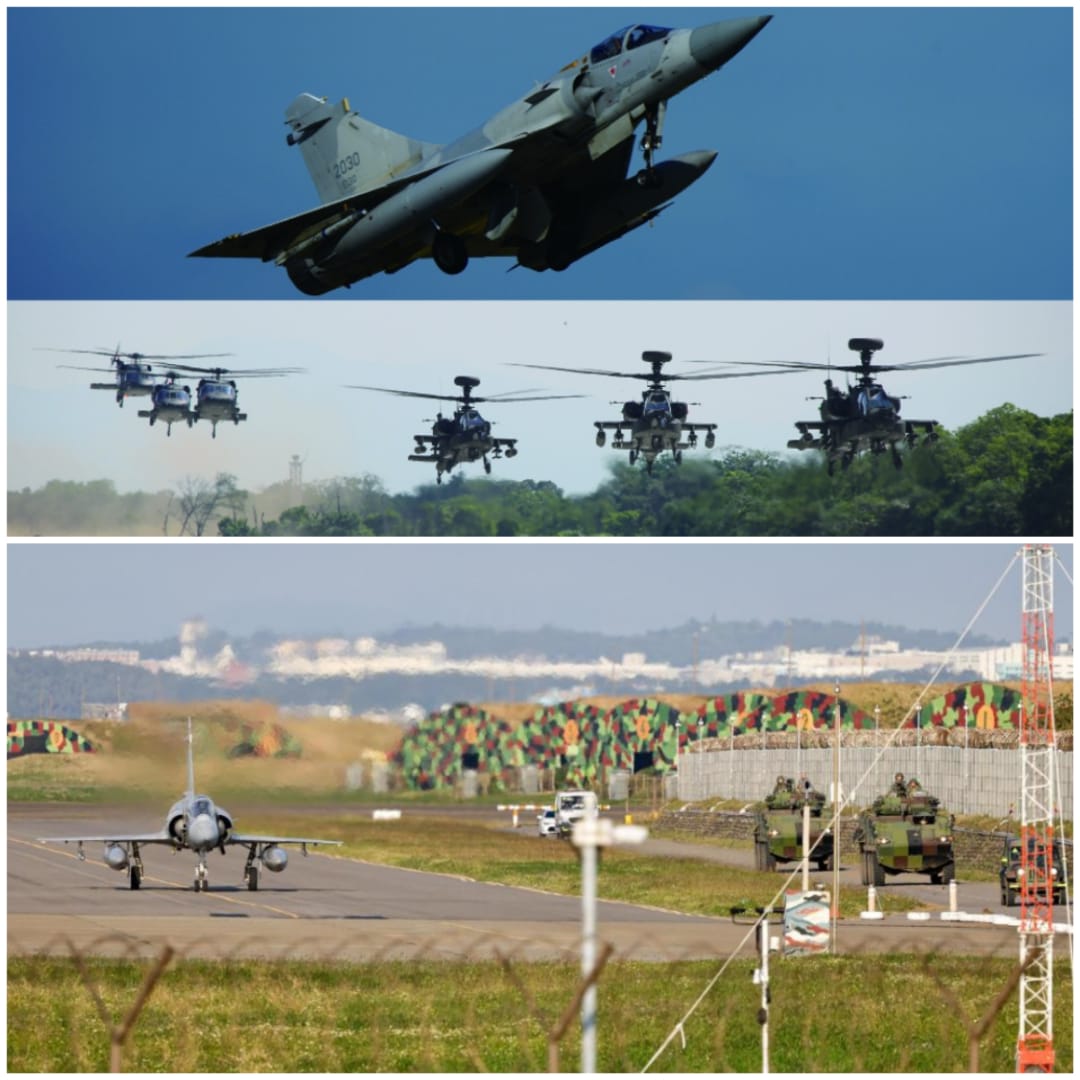
Taiwan’s Defense Ministry has launched battle preparedness training in reaction to the large mobilization of Chinese military units near Taiwan.
(The Post News)- Chinese naval and coast guard vessels are mobilizing in substantial formations near the Taiwan Strait and the Western Pacific, as reported by Taiwan’s Defense Ministry on Monday. This surge in activity signals the potential for military drills by Beijing and escalates regional tensions.
Taiwan’s armed forces are closely monitoring ships from China’s Eastern, Northern, and Southern Theater Commands, alongside coast guard vessels, entering critical zones around the island. In response to these provocative maneuvers by the PLA, Taiwan has initiated combat readiness exercises, reinforcing its commitment to national defense.
The ministry said in a post on X that unilateral provocations will not be accepted and may seriously jeopardize Indo-Pacific peace and stability. We are fully prepared to address all gray zone incursions and will defend our national security vigorously,” the ministry stated.
This escalation follows a weeklong tour of the South Pacific by Taiwan’s President Lai Ching-te, who made unofficial stopovers in Hawaii and Guam. Beijing sharply condemned Lai, labeling him a “separatist” and denouncing his actions as a direct affront to Chinese sovereignty.
Simultaneously, the United States has approved new arms sales to Taiwan, provoking China to threaten “strong countermeasures.” Any interaction between Taiwan and the U.S. is viewed by Beijing as a direct challenge to its territorial claims over the self-governing democracy, which China seeks to “reunify” by force if necessary. However, Taiwan categorically rejects China’s sovereignty claims. In an address to the overseas Taiwanese community during his stopover, Lai urged democracies to “never bow down to totalitarianism.”
A senior Taiwan official informed CNN that the current deployment of Chinese naval forces is larger than that of recent drills. While past exercises, like the “Joint Sword” maneuvers in May and October, were focused on encircling Taiwan, the current operations assert China’s intent to control the first island chain—a strategic area encompassing Japan, Taiwan, and parts of the Philippines and Indonesia.
Moreover, China has reserved seven airspace zones near its eastern Zhejiang and Fujian provinces, indicating a significant readiness for military engagement. These developments reflect Beijing’s ongoing attempts to pressure Taiwan and send a clear message to the United States and its allies. Taiwan remains a critical flashpoint in U.S.-China relations, with Washington maintaining a strategically significant partnership with Taipei.
As tensions continue to rise, Taiwan’s Defense Ministry remains resolute: “We are on high alert, continuously monitoring PLA movements to safeguard our national security.” This situation underscores the precarious state of peace in the Indo-Pacific, as China’s assertive posture poses a growing challenge to regional stability.
About the Author