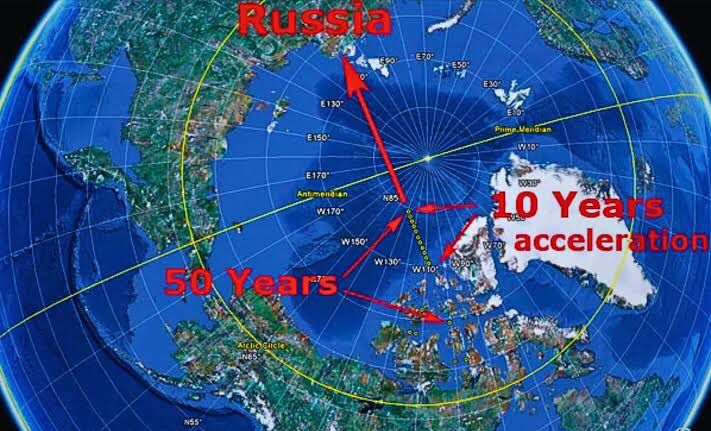
Earth’s magnetic pole gets a major update as scientists track the planet’s magnetic pole to its new location. Image: The Daily Galaxy
(The Post News)- Scientists have released a new model tracking the position of the magnetic north pole. It revealed that the pole is now closer to Siberia than it was five years ago. The position of the magnetic north pole is continuously drifting towards Russia.
The magnetic north pole’s location changes due to Earth’s constantly shifting magnetic field’s movement and fluctuations. Magnetic North’s movement has been unusually erratic, accelerating then rapidly slowing, with scientists baffled by the cause.
Global positioning systems along with those used by planes and ships find magnetic north using the World Magnetic Model. The British Geological Survey and the National Oceanic and Atmospheric Administration named and developed it in 1990. This model predicts the magnetic north’s future path based on its current position and recent movement patterns slowly. To preserve GPS measurements’ accuracy, researchers revise the WMM every five years. This resets the official position of magnetic north and introduces new predictions for the next five years of drifting.
Delaying model updates increases error, says Dr Arnaud Chulliat, a senior research scientist at the University of Colorado Boulder. According to Chulliat, their forecast is mainly an exploration given their current knowledge of the Earth’s magnetic field, based on how the model is built.
The magnetic north pole is the convergence point of the earth’s magnetic field at the northernmost tip. Scientists have recorded that though the magnetic north pole is never still, there is a highly unusual behavior of the magnetic north. The magnetic north has drifted from Canada to Russia ever since it was discovered.
There is uncertainty, although scientists expect the drift toward Russia to slow down. Earth’s magnetic field has exhibited erratic behavior, even reversing the polarity, numerous times throughout the planet’s history suddenly. This then turns the magnetic poles, and the changes can last for years. Typically, these turns are hard to predict. Weakened magnetic fields not only disrupt animal migration patterns but also impact weather, radio signals, and navigation systems.
The Earth has encountered several magnetic flips and reversals, but all of them happened before humans started using modern technology.
About the Author