Migrants make their way to a Border Patrol van in San Diego- Imag credit: EMSN
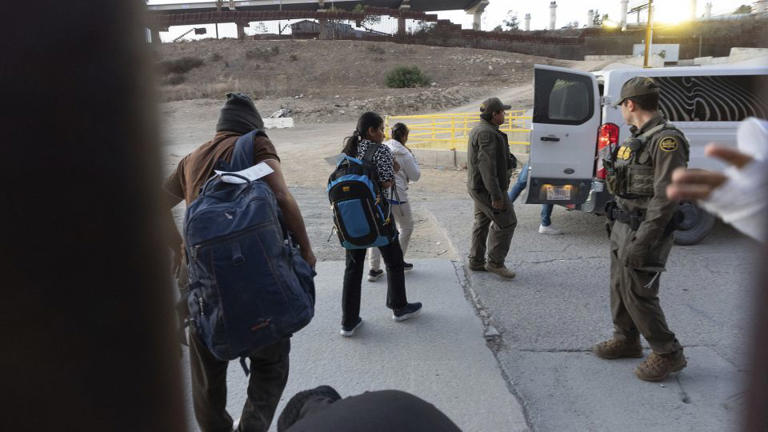
Migrants make their way to a Border Patrol van in San Diego- Imag credit: EMSN
(The Post News)- On his inauguration-day president Donald Trump promised to enforce mass deportations of “millions and millions” of undocumented immigrants set an ambitious tone for U.S. immigration policy. However, achieving these goals heavily depends on securing significant funding and resources for immigration detention centers, raising questions about feasibility and cost.
At the core of Trump’s administration’s strategy is Immigration and Customs Enforcement (ICE), which currently has the budget to detain about 41,000 individuals at any given time. With an estimated 11.7 million undocumented immigrants in the U.S., the existing infrastructure falls drastically short of the scale needed to support mass deportations. The daily cost of housing one adult in detention is estimated by the Department of Homeland Security (DHS) at $165, highlighting the financial challenges of ramping up detention efforts.
One proposed solution is the Laken Riley Act, named after a Georgia nursing student whose tragic murder by an undocumented Venezuelan man became a key point in Trump’s campaign rhetoric. This legislation, already passed by Congress, seeks to expand the capacity of immigration detention facilities by adding 110,000 new beds. DHS estimates this expansion would require at least $26.9 billion in funding. The act also broadens ICE’s authority, mandating the detention of any undocumented individual accused of theft or violent crimes, a significant shift in policy focus.
The administration’s broader approach includes deploying troops to the southern border to curb illegal crossings and invoking laws such as the Alien Enemies Act to bolster enforcement efforts. While these measures aim to create a more robust immigration system, they also spotlight the logistical and financial challenges of executing such a sweeping plan.
Critics argue that the administration’s focus on detention and deportation risks overburdening the U.S. immigration system, straining federal resources, and escalating humanitarian concerns. As the Trump administration continues to push for its immigration agenda, the debate over its costs, efficacy, and moral implications remains at the forefront of national discourse.
One notable action was invoking the Alien Enemies Act of 1798, a rarely used legal provision. This law enables the president to deport non-citizens from countries with which the United States is in a state of declared war or facing an attempted invasion. Its application highlights the administration’s stringent approach to combating illegal immigration and cartels.
Additionally, President Trump eliminated the “catch and release” policy, which had previously allowed some migrants to remain in the U.S. while awaiting court proceedings. This policy change increased pressure on the immigration detention infrastructure, which now faced heightened demand for holding migrants during legal processes.
The reliance on local prisons and jails through contracts with state and city governments expanded ICE’s capacity. However, the lack of facilities specifically designed for detaining immigrant families, who represent a significant portion of arrivals at the southern border, posed challenges.
The declaration of a national emergency at the U.S.-Mexico border further escalated these measures. The U.S. military was tasked with supporting mass deportation efforts, providing logistics, and expanding detention space. The Pentagon was reportedly involved in offering air transportation support to the Department of Homeland Security (DHS).
Under the Trump administration, Homeland Security plans to expand immigrant detention capacity significantly, potentially involving military bases, as it seeks to detain more individuals. Congress controls funding for detention infrastructure, and the Pentagon’s involvement under Trump’s emergency measures raises concerns. Immigrant rights advocates warn of a hyper-militarized police state and the expansion of an already problematic detention system.
About the Author