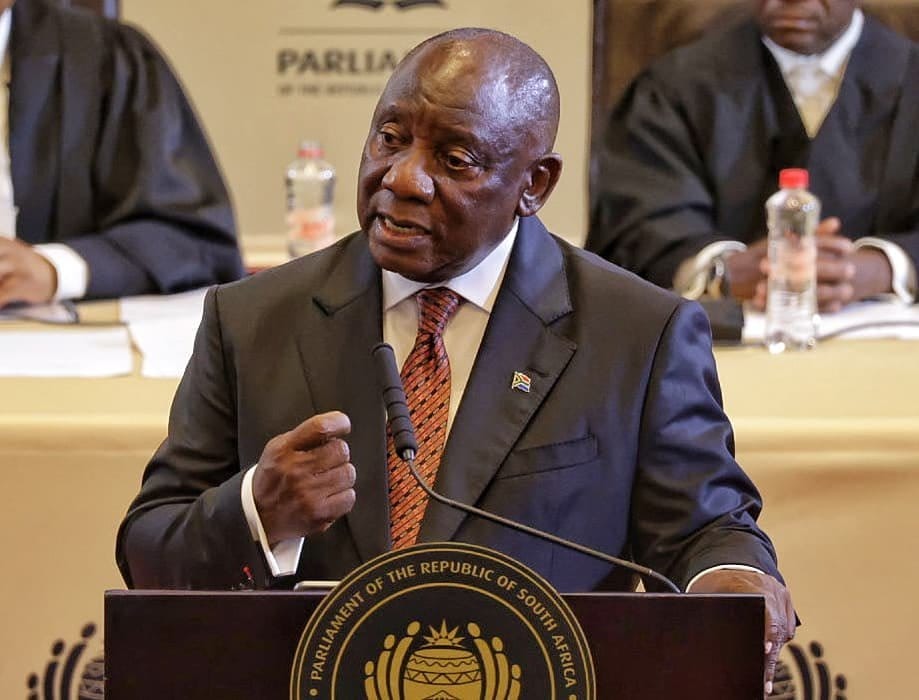
Pesident Cyril Ramaphosa delivered his first GNU State of the Nation Address, saying the country would not be “bullied” in response to U.S. Foreign Policy.
President Cyril Ramaphosa’s 2025 State of the Nation Address (SONA) marked his most challenging speech since taking office, as he confronted local and international pressures head-on. He gave the speech on Thursday night at a critical juncture for South Africa, which is facing seemingly insurmountable obstacles like a deteriorating crisis in the Democratic Republic of the Congo (DRC) and increased tensions with the United States.
Different political parties had differing opinions about Ramaphosa’s first SONA under the Government of National Unity (GNU). Some were dissatisfied, while others viewed the address as a symbol of development and hope.
The terrible deaths of 14 South African National Defence Force (SANDF) soldiers in the Democratic Republic of the Congo (DRC), which represent the nation’s greatest military defeat since the Battle of Bangui in 2013, were conspicuously omitted from Ramaphosa’s speech. This omission, despite the national outcry, raised questions about the government’s priorities and handling of military engagements abroad. The soldiers’ bodies are expected to be repatriated soon, following delays. The SABC subsequently reported that Ramaphosa confirmed that South Africa would withdraw its peacekeeping forces from the DRC.
The speech also discussed expanding global concerns. Most notably, US President Donald Trump’s mounting pressure, since he recently threatened to stop help to South Africa due to the Expropriation Act. “We will won’t be deterred,” Ramaphosa said sharply, expressing the country’s dedication to its own ideals of justice, equality, and non-racism. Many interpreted his remarks as a defiant rejection of Washington’s hostile tone, particularly in view of Trump’s recent foreign policy and climate change measures.
The speech, nevertheless, did little to appease critics. Disappointed, political leaders from a number of opposition parties charged that Ramaphosa had made ambiguous promises devoid of specifics. The speech was attacked by uMkhonto Wesizwe Party deputy president John Hlophe for being unclear on economic strategies, especially the matter of borrowing money without specifying sources. He also expressed displeasure with the government’s disregard for rural infrastructure development and systematic racism.
Economic Freedom Fighters (EFF) leader Julius Malema echoed these views, claiming that Ramaphosa’s pledges to build infrastructure and create jobs were only “waffle” in the absence of concrete plans. Athol Trollip, the leader of ActionSA, referred to the speech as a “missed opportunity,” pointing out that it did not accurately represent the actual problems that South Africans confront.
However, some GNU partners were more upbeat, especially those from the Democratic Alliance (DA). The speech was praised by DA leader John Steenhuisen, who pointed out that it included a number of DA programs and objectives. Steenhuisen’s speech, which reflected a more cooperative approach inside the GNU, highlighted the party’s significance in forming local and national governance.
Ramaphosa’s leadership was once again tested on a global scale as South Africa prepared to host the G20. Foreign policy analysts believe that this could be an opportunity for South Africa to establish itself internationally as countries seek for new alliances in response to the evolving US foreign policy. Ramaphosa stated that South Africa would strengthen its ties with countries in the Middle Eastern nations as well as new global powers like China and India.
About the Author