Ramaphosa gives a firm response to the recent U.S actions emphasizing the country’s resilience and commitment to national sovereignty.
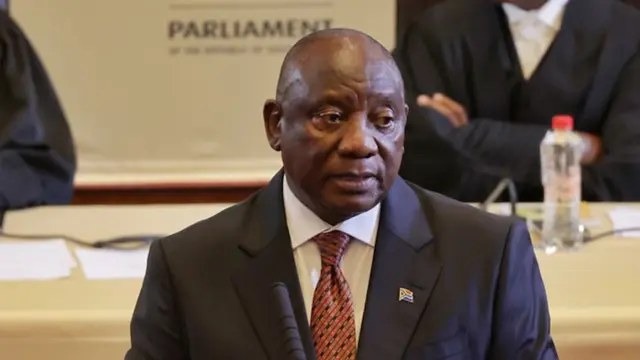
(The Post News)- South African President Cyril Ramaphosa issued a strong response during his State of the Nations Address over the actions taken by the U.S., drawing attention to the grit of his country while standing up for the country’s national sovereignty. “We won’t be deterred, we are resilient, we will not be bullied. We shall stand together in defense of our national interest and our sovereignty,” he said, affirming South Africa’s position amid growing tensions with the United States.
The statement comes amidst strained diplomatic relations between South Africa and the U.S. on issues such as land reform policy and geopolitical alignment. U.S. President Donald Trump announced the suspension of financial aid to South Africa due to its approach to land expropriation policies, which he described as a “human rights violation.” He said he would prevent all further funding until an investigation was complete.
Meanwhile, U.S. Secretary of State Marco Rubio has already acted in raising ante by announcing a boycott of the G20 Foreign Ministers’ Meeting slated for Johannesburg. Rubio accused South Africa of pushing an “anti-American” agenda, criticising the country’s leadership within the G20 for focusing on issues such as climate change, economic equality, and Global South solidarity.
President Ramaphosa has continued to defend the policies of his administration against the U.S. claims of land “confiscation” as ill-informed. The Expropriation Act signed into law in January allows land redistribution where the public interest so dictates. The South African government has said the law is constitutional and cannot allow arbitrary seizures.
He further denied that the country’s foreign policy is “anti-American” and reasoned that the leadership in the G20 is one for inclusive global development, not to feed into geopolitical rivalries. “South Africa remains committed to multilateralism and constructive engagement with all nations,” he said.
The US-led boycott of the G20 meeting calls into question Washington’s position on world diplomacy. Rubio’s decision, for one, was a key development in the ties between Washington and Pretoria that may change high-stakes discussions over global economic policies as influence in the region heats up, with China pushing hard for gains across the African continent.
China, one of South Africa’s key allies, has already signaled support for the leadership under Ramaphosa, reinforcing the diplomatic ties as disengagement from the U.S. grows. Chinese officials reiterated commitments toward the G20 Presidency of South Africa and larger cooperation in trade and investment.
About the Author