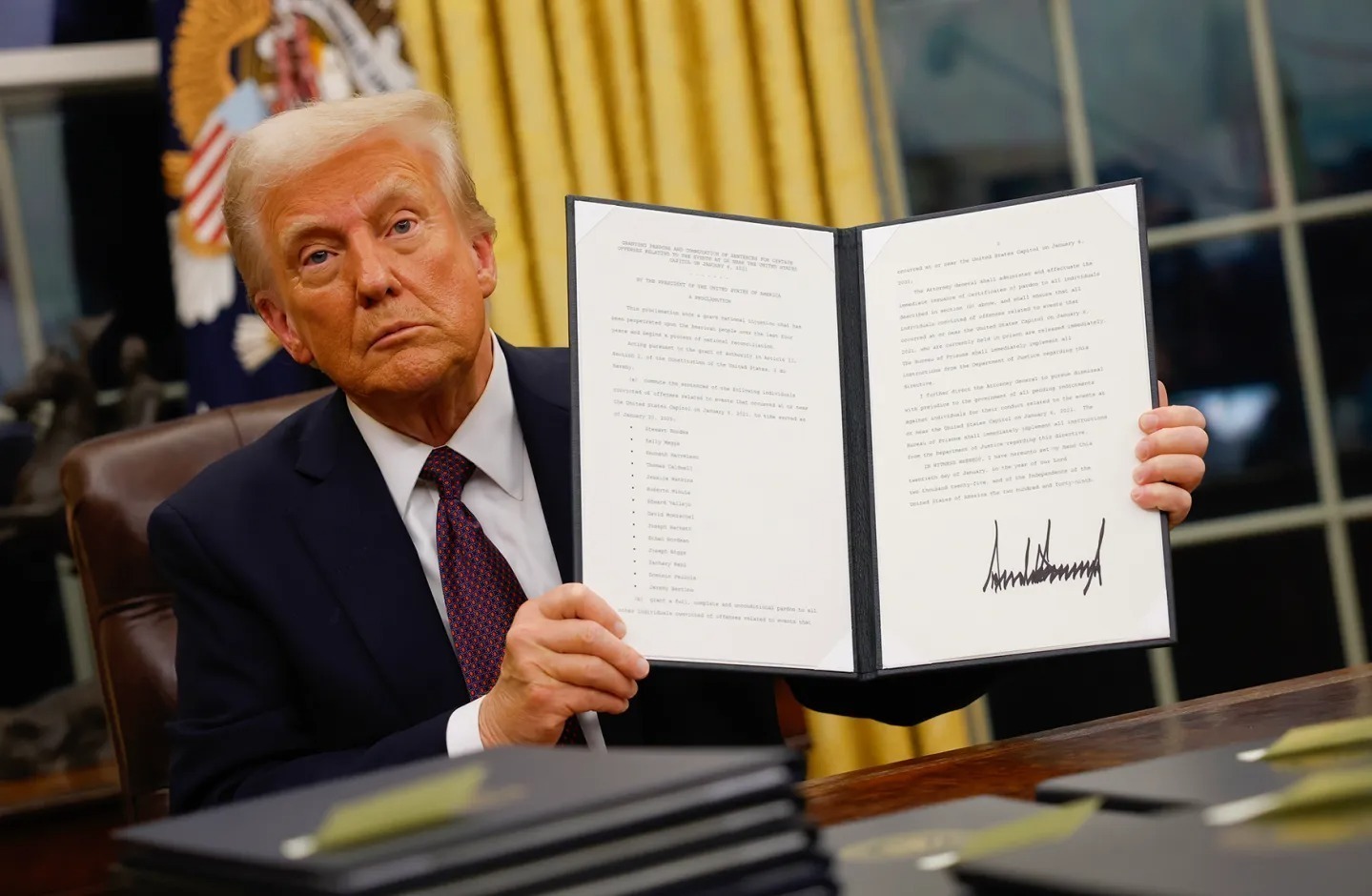
President Donald Trump has said he will announce a 25% import tax on all steel and aluminium imports, a move that will have a negative impact on South Africa. Image: Getty Pictures.
(The Post News)– Concerns have been raised regarding the possible economic repercussions of U.S. President Donald Trump’s proposal to impose a 25% tariff on all imports of steel and aluminium, especially for nations like South Africa. Trump has implemented a number of trade policies since taking office in January 2025, and the new tariff, which is scheduled to be unveiled on Monday, is the most recent.
Numerous countries, including South Africa, Canada, Brazil, Mexico, and South Korea, will be impacted by the blanket tariff. According to Trading Economics data, the United States bought around $400 million worth of aluminium and $518 million worth of iron and steel from South Africa in 2024. South African exporters may face serious difficulties as a result of these levies.
Trump underlined the new measure’s seriousness by announcing that the 25% charge will apply to all steel and aluminium entering the United States. Additionally, he affirmed that reciprocal tariffs, which would be similar to the tariff rates that other nations charge the United States, will be applied on Tuesday or Wednesday. Trump told reporters on Air Force One, “If they charge us, we charge them.”
While steel and aluminium tariffs were first implemented during Trump’s first term, when the United States levied a 25% steel levy and a 10% aluminium levy, duty-free exemptions were granted to a number of trading partners, including Canada, Mexico, and Brazil. However, it appears that these tactics are being reinstated on a larger scale by the new tariffs.
Global market reactions to the announcement have been mixed, with steelmaker stocks in Asia experiencing a significant decline while shares of U.S.-based companies remained resilient, the U.S. dollar strengthening, and Treasury yields rising. Senior market analyst Kelvin Wong of OANDA, Singapore, explained that the new round of tariffs, dubbed “Trade War 2.0,” could disrupt global trade flows and dampen economic growth, potentially creating a “stagflation environment,” where economic growth slows while inflation rises.
He warned that such disruptions could lead to a “stagflation environment,” a scenario where economic growth slows while inflation rises.
The new rates may be a negotiation technique, according to Vasu Menon, Managing Director of Investment Strategy at OCBC in Singapore. Given its reliance on imported steel and aluminium from significant suppliers like Canada and Mexico, he said that the tariffs will have a detrimental effect on the United States as well as on nations like South Africa and South Korea.
The United States imports the majority of its aluminium from Canada, which supplies almost 80% of the nation’s primary aluminium imports. The U.S. government had previously permitted certain exemptions during Trump’s first term, but it is unclear whether those exemptions will continue under the new measures. South African exporters may see a significant change in trade relations as a result of the new tariffs. The United States’ top suppliers of steel and aluminium are South Africa, Brazil, and Mexico.
About the Author