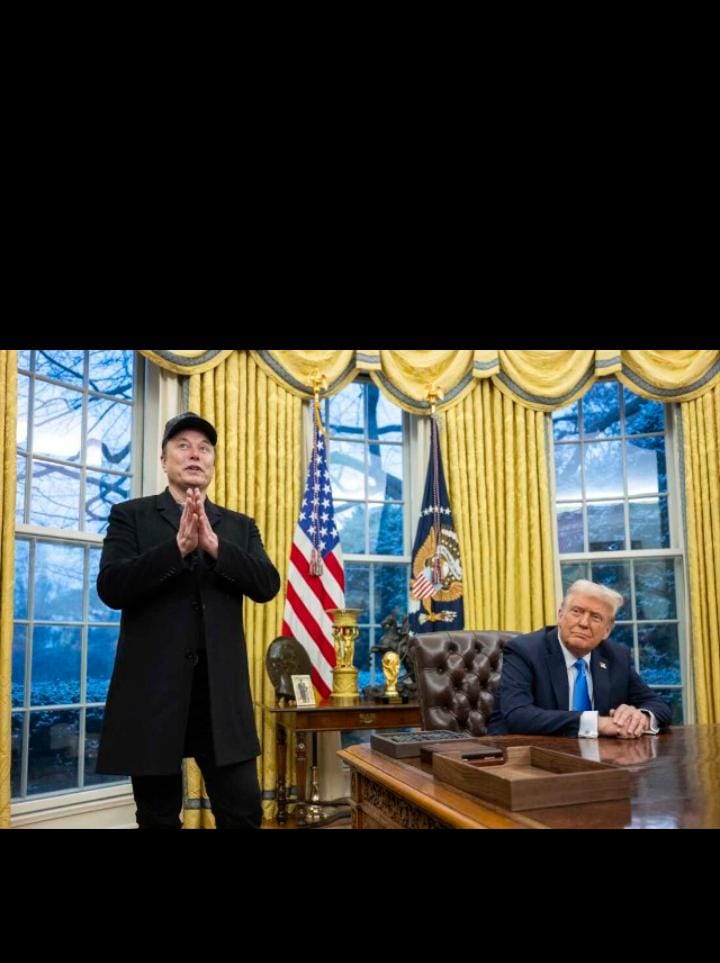
Elon Musk has demands federal employees to justify their recent accomplishments or face termination, despite government agencies clarifying that compliance with Musk’s directive is voluntary. Image credit: NPR
(The Post News)– President Donald Trump has rallied his wholehearted backing to Elon Musk’s call for federal workers to justify their recent achievements or face firing, as government agencies went on to say that adherence to Musk’s mandate was voluntary.
The action has ignited widespread misunderstanding, internal pushback, and new lawsuits challenging the legality of the threat. Musk, chief of the new Department of Government Efficiency, required federal employees to submit a list of their top five career achievements by Monday’s close. The Office of Personnel Management then went on to tell agency managers, however, that employees did not have to comply, opening the door for potential conflict between Musk’s assertive reconfiguring of the federal workforce and entrenched federal staff.
Speaking from the Oval Office during a meeting with French President Emmanuel Macron, Trump praised Musk’s approach as a step in the right direction toward government accountability.
“What he’s doing is saying, ‘Are you actually working?'” Trump said. “And then, if you don’t answer, like, you’re sort of semi-fired or you’re fired, because a lot of people aren’t answering because they don’t even exist.”
Trump also claimed, unsubstantiated, that Musk’s agency had found “hundreds of billions of dollars in fraud,” purportedly meaning that taxpayer dollars were going to imaginary employees.
Musk, known for his assertive management style, dismissed criticism of his directive, accusing federal employees of resisting straightforward monitoring.
“Federal employees hate even the slightest hint of responsibility,” Musk wrote on X, the company he owns. Within hours of OPM clarifying that the order was voluntary, Musk doubled down, threatening to terminate anyone who didn’t follow again for a second time—at the discretion of the president.
Labour unions, consumer groups and government watchdogs quickly moved to object to Musk’s move, adding an amendment to a pending suit in federal court in California. The lawsuit, led by the State Democracy Defenders Fund, labeled Musk’s directive “one of the greatest employment deceptions in the history of this nation.”
Reacting, White House deputy press secretary Anna Kelly dismissed the lawsuit. “In the time it took these employees drawing taxpayer-funded paychecks to bring a frivolous lawsuit, they could have summarized their accomplishments briefly for their managers, as is typical in the private sector, 100 times over,” she said.
Despite attempts by Trump and Musk, internal resistance has grown within the federal government. Several agencies, including the Departments of Justice, Homeland Security, and Defense, told employees not to respond, citing privacy and security concerns.
FBI Director Kash Patel, a Trump loyalist, was reported to have directed employees to hold off on reporting their work tasks, noting that agencies have protocols for performance rating. “When and if we require more information, we will coordinates the responses. For now, please hold off on any responses,” Patel wrote in a company memo.
While some agencies instructed employees to ignore Musk’s demand, others requested that they comply. The Department of Education’s chief of staff, Rachel Oglesby, directed staff that the email was real and that “frontline supervisors will evaluate responses and non-responses.”
At the Health and Human Services Department, employees were instructed it was optional to reply but warned to be cautious. “Assume that what you write will be read by malign foreign actors and tailor your response accordingly,” an internal email said.
The conflicting messages have left federal employees in a quandary, unsure if declining to cooperate might land them in trouble.
Trump’s second term has already seen gigantic efforts at restructuring the federal workforce. Thousands of federal employees have been fired or placed on “deferred resignations” since Trump took office last month. It is difficult to state exactly how many have been fired, but reports suggest hundreds of thousands of jobs are in danger.
The government’s deep-cutting measures have also created economic ripple effects, forcing companies that rely on government contracts to lay off employees or delay payments.
Adding to the uncertainty, a federal judge on Monday barred Musk’s government cutting team from gaining access to sensitive information stored by the Department of Education and OPM.
Meanwhile, a group of labour unions has filed in court to have Musk’s email directive ruled illegal.
Despite the mounting legal and bureaucratic hurdles, Trump continues to stand by Musk.
“I thought it was great,” Trump said of the email demand. “There was a lot of genius in sending it. We’re trying to find out if people were working.”
As the dust begins to settle, there is one question that still remains: Can Musk actually follow through on his ultimatum, or will the pushback from bureaucrats and the courts neutralize his decree? With cases clogging the courts and agencies in disarray, the war over federal workforce accountability is not near its end.
About the Author