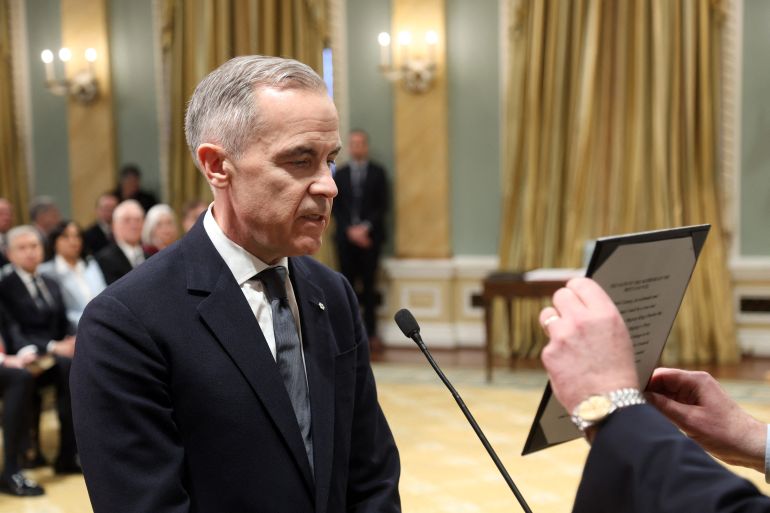
(The Post News)– Mark Carney, who had no previous political experience and is a former central banker, was formally sworn in as Prime Minister of Canada on Friday, replacing Justin Trudeau amidst growing tensions with the United States.
Carney, who has headed the Bank of Canada and the Bank of England, is confronted with a series of issues, including negotiating a trade war with Canada’s biggest trading partner and navigating Canada’s sovereignty in the face of US President Donald Trump’s constant intimations that Canada should be the 51st state.
In his first speech as Prime Minister, Carney made his distance from the US clear and unmistakable in remarks directed pointedly at President Trump’s public hints of ambitions for annexing Canada. As reported by Associated Press, this comes after President Trump has consistently brought up for months the thought of annexation. Carney’s words directly indicated a tough approach against these provocations, and he further stated that he had no plan to visit the US immediately, but would meet leaders in Europe, including the UK and France.
Carney’s rise to the top is a sea change for Canada, arriving as he does in a position held previously by Trudeau, whose time in office was marked by stress with Trump. Carney addressed the difficult economic times ahead, stating his two most pressing tasks in the near future were to protect Canadian workers and their families from what he described as “unjustified foreign trade actions,” and to get the economy going in Canada through investment in infrastructure projects, beginning with housing.
The new Prime Minister also suggested a more budget-conscious way, emphasizing the need to cut government expenditure to facilitate more investment in Canadian society. “We are going to invest more in our people, build millions of homes, and make sure Canadians have more money in their pockets,” Carney stated.
Carney, who became Liberal Party leader in a rout last month through an election, now must do the daunting challenge of leading the party into federal election by Oct. 20. Although not having political experience, Carney’s three decades of work on international finance gives him a clear set of skills to tackle issues of the nation. His ascension to the role came after Justin Trudeau, in office for close to ten years, resigned after polls had predicted defeat of the party in the next election.
At a press briefing after his oath of office ceremony, Carney also presented his new cabinet, which reflects his priority to confront the challenges offered by the US. Key individuals such as Chrystia Freeland, ex-deputy prime minister, and Dominic LeBlanc, recently Minister for International Trade, retained their positions. Finance Minister François-Philippe Champagne, previously handling the portfolio for trade, will now remain as Finance Minister.
“Canada is at a crossroads, and it needs a government that works for Canadians,” Carney stated. “This is a team eager to get to work right away and dedicated to standing up for Canadian workers, their families, and building this great nation.”
The cabinet shuffle also involved the reduction of ministerial positions, something Carney hopes will streamline the government. During the discussion of the overhaul, Carney stated, “Our government is united, and we are getting right to work.”
Justin Trudeau, the previous prime minister, gave a goodbye speech, thanking Canadians for entrusting him and putting their confidence in him for his time in office, conceding the challenges ahead for the country but feeling proud of the progress of Canada.
With Carney at the helm, the country faces an uncertain political and economic future. The Liberals are now to face the Conservative opposition, who had been rallying for years against the likes of the carbon tax, which Carney immediately proceeded to scrap in his first cabinet meeting, keeping a promise among those he made during the elections.
As the anxiety about the health of Canada-US relations continues to grow and the federal election looms, Mark Carney’s mettle will be tested as he tries to navigate these troubled waters while positioning Canada on the international stage.
About the Author