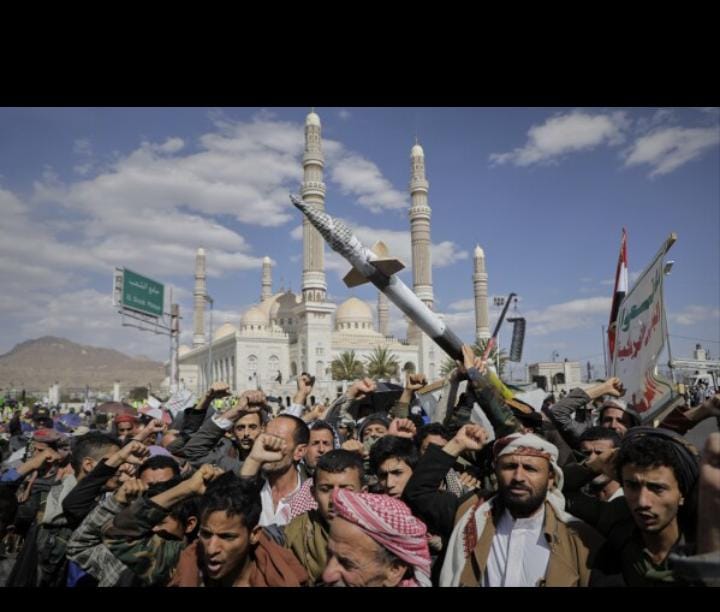
Image by AP News US President Donald Trump has issued a stern warning to Iran, declaring that the country will face "dire consequences" if Yemen’s Houthi rebels continue their attacks on international shipping lanes. Image: AP News.
(The Post News)- US President Donald Trump has issued a warning to Iran, stating that the country will face “dire consequences” if Yemen’s Houthi rebels continue to attack international shipping lanes. The warning comes after a series of Houthi drone and missile strikes on Red Sea ships, including a failed bid to hit the USS Harry S. Truman.
In a posting on his Truth Social site, Trump made it plain that he holds Iran responsible for the activities of the Houthi rebels, who have been supported by Tehran for years. “Each shot fired by the Houthis will be considered, from today forward, as a shot fired from the weapons and guidance of Iran,” Trump wrote. “Iran will pay a price, and the price will be big!”
The Houthis, a Shiite rebel group controlling large parts of northern Yemen, have escalated their attacks on commercial ships in the Red Sea, citing their opposition to Israel’s blockade of Gaza. The group has claimed responsibility for sinking two vessels and seizing another since November 2023, raising concerns over the security of international shipping routes in the region.
In the past few days, the Houthis have conducted a series of attacks against the USS Harry S. Truman as it was traversing the Red Sea. While some of the incoming missiles were deflected by American fighter jets, one of the rebel-fired ballistic missiles went wide of the ship by over 100 miles. While all these attempts were futile, the Pentagon has counterattacked against Houthi rebel positions in Yemen through air raids and killed at least 53 people, including civilians, according to Houthi claims.
Trump’s Monday threat was a sharp escalation of tone from Washington, with the president accusing Iran of arming the Houthis with weapons, intelligence, and funding — allegations that Iran has rejected. Iran’s ambassador rejected the accusations in a letter to the United Nations Security Council, stating that it was not violating any arms embargo or destabilising the region.
Pentagon officials have also increased US military operations against Houthi targets, with over 30 airstrikes carried out since Saturday in what has been described as the largest US military operation in the Middle East since President Trump’s return to office. The airstrikes targeted Houthi drone experts and war machinery, said Lieutenant General Alex Grynkewich, while adding that the US was not seeking regime change in Yemen.
“We will use the crushing force of death until we have achieved our objective,” Pentagon spokesperson Sean Parnell said, reiterating the US commitment to defend its interest and safeguard international shipping lanes.
The Houthis, for their part, vowed to continue targeting, saying they would attack any vessel that is allied with Israel, the US, or the UK as retaliation for the blockade of Gaza. Their leader, Abdul-Malik al-Houthi, warned that they would escalate the retaliation if the US continued its military activities.
Trump’s hardliner policy towards Iran and his equally strong stance against the Houthis are just part of his overall strategy for pressuring Tehran over its nuclear ambitions. Although Trump pulled the US out of the Joint Comprehensive Plan of Action (JCPOA) in 2018, he has not wavered in his determination to get a new deal that will address Iran’s nuclear program. This week, Trump informed Iran’s Supreme Leader Ayatollah Ali Khamenei that the US will use the military if attempts are not made to achieve a nuclear deal.
Although there are some experts guessing that the heightened rhetoric from Trump could possibly be meant to try to make Iran negotiate, others see this as a breakdown of his original plan of bringing American forces home from the Middle East. His election campaign vow to reduce foreign entanglements now appears counter to his steadily more aggressive policy against both Tehran and the Houthis.
As the events develop, the world is watching in order to determine whether the US will follow through with its threats or attempt to dial down tensions with Iran and Yemeni allies.
About the Author