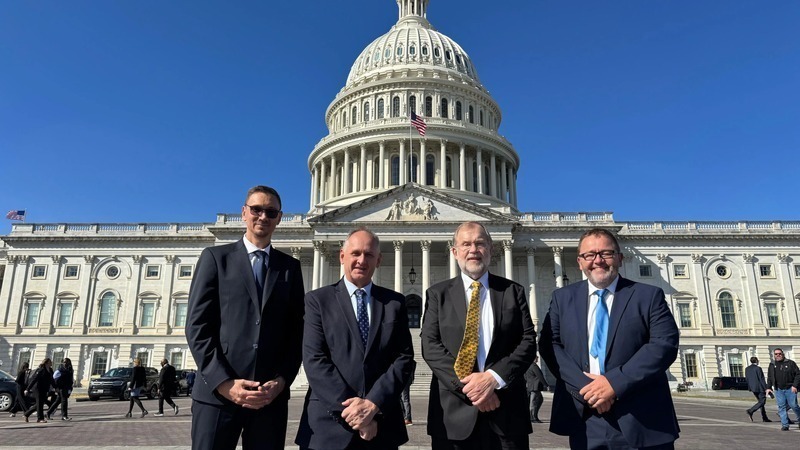
Afriforum and Solidarity movement claim to have met with U.S. President Trump's administration in the US. Image: Afriforum shared via X.
(The Post News)– The Solidarity Movement, a coalition of Afrikaner rights groups and unions, sparked significant attention during its February lobbying trip to Washington.
In South Africa, the delegation, which included CEO Kallie Kriel, Dirk Hermann, Chair Flip Buys, and Jaco Kleynhans, attracted media interest. Although they frequently appeared on television to tout their purpose, there was little information available about their meetings in Washington.
Kriel claimed to have spoken with both Republican and Democratic MPs, posting on social media about meeting “senior members of the House of Representatives, Committee on Foreign Affairs.” He implied that the African National Congress’s (ANC) policies, especially those pertaining to property rights, had angered U.S. authorities. These assertions, however, are not independently verified.
Citing confidentiality, Solidarity declined to identify the officials they met with when pressed for further information. Although this secrecy is common in lobbying, it raises questions when contrasted with other international organizations, such as the Democratic Alliance (DA) of South Africa, which was more open about its meetings.
The DA had clear documentation of discussions with U.S. officials, including advisors to the U.S. National Security Council and Senate Foreign Relations Committee members, whereas Solidarity’s evidence consists solely of social media posts. These included photos of the group at the White House and a casual meeting with right-wing journalist Joel Pollack in Los Angeles.
The effectiveness of Solidarity’s lobbying efforts depends on its capacity to persuade American legislators of the pressing nature of the issue. But there is still scepticism. Washington lobbyists say it is very difficult to have a meeting with a U.S. senator or congressman, particularly as a foreign interest group. Such a feat is “virtually impossible”, according to one expert.
Furthermore, there is no documentation of Solidarity’s meeting with the Foreign Affairs Committee of the House of Representatives, and the members of the committee have not responded to the group’s visit. This absence of involvement calls into further doubt the veracity of Solidarity’s assertions.
The group’s focus on property rights and dissatisfaction with ANC policies does not align with the broader American discourse on South Africa. Most U.S. political attention has centered on South Africa’s foreign policy, particularly its ties to Iran and the African Union’s stance on the Abraham Accords. Republican lawmakers, such as Representative Joe Wilson, have criticized South Africa’s foreign relations, but these criticisms do not match Solidarity’s narrative.
Meanwhile, the Orania Movement, which advocates for the establishment of an Afrikaner Volkstaat, arrived in the U.S. for its lobbying efforts. This marks the first public acknowledgment of their visit, which includes advisor Dr. Ernst Roets. The group’s activities add another layer to the growing interest in Afrikaner-related lobbying in the U.S.
About the Author