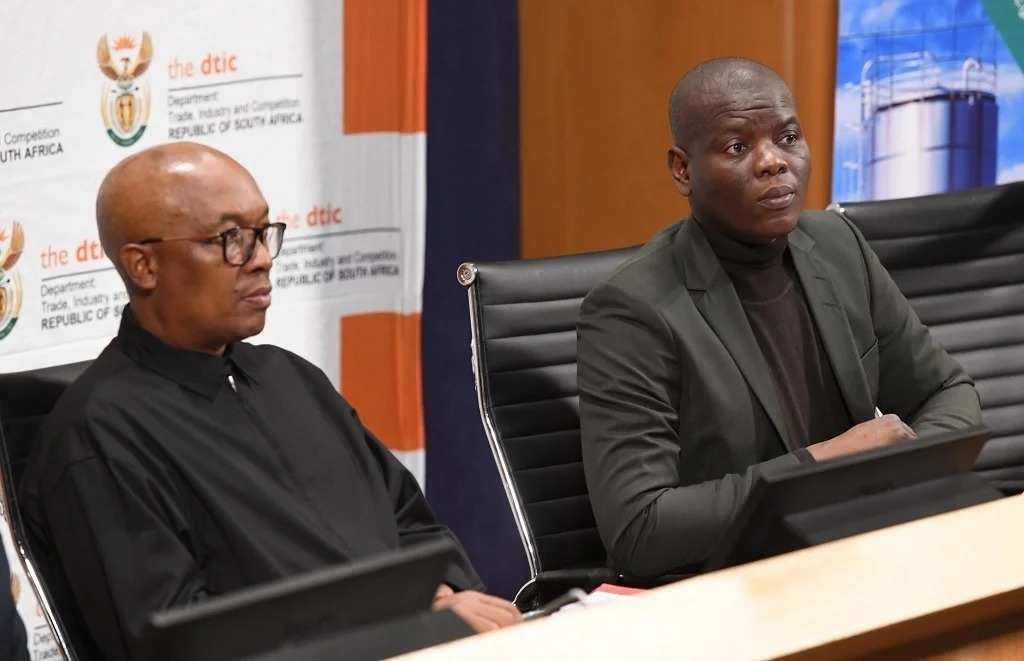
International Relations Minister Ronald Lamola (right) and Trade and Industry Minister Parks Tau (left) briefed the media in Midrand on Friday on the US tariff hikes, photo: X@/DIRCO_ZA
The United States’ decision to impose a new 30% import duty on South African commodities has caused a stir in the South African economy and international trade markets, and President Cyril Ramaphosa has expressed alarm over the move. President Donald Trump’s latest tariffs target more than 60 nations, including South Africa, which now has to deal with higher trade expenses.
The South African presidency released a statement expressing the government’s worry over the punitive nature of these tariffs. “South Africa remains committed to a mutually beneficial trade relationship with the United States,” the statement read. “However, unilaterally imposed and punitive tariffs are a concern and serve as a barrier to trade and shared prosperity.” The presidency emphasized that South Africa is determined to negotiate new trade terms with the US, but the abrupt imposition of tariffs could undermine those efforts.
Trump’s administration’s larger plan to fix trade imbalances includes his tariffs, which are scheduled to go into effect on April 9, 2025. Citing its 60% tariffs on US goods, the US president called South Africa one of the “worst offenders” in terms of trade deficit. Both local companies and market analysts were alarmed by the US’s 30% tariff on South African exports in retaliation. Despite the significant impact on trade relations, Trump said the tariffs will be cut in half and described the move as a “kind” gesture.
Businesses in South Africa are alarmed by the tariffs and worry about how they will affect their sectors in the long run. Particularly at risk are the manufacturing, automotive, and agricultural industries, which account for a sizable portion of the nation’s exports. The government is hesitant to retaliate against the US, warning that doing so may result in a “race to the bottom,” according to Parks Tau, the trade minister for South Africa. Tau underlined that enforcing reciprocal tariffs would harm the local market and reduce South Africa’s competitive advantage, which would be detrimental to the country’s economy.
South Africa has pledged to maintain its national interests and seek strategic solutions to protect its economy in spite of these obstacles. Plans to negotiate advantageous deals, obtain exemptions from the new tariffs, and fortify alliances with other countries were detailed in a joint statement released by the South African Ministries of International Relations and Trade. In order to broaden trade options, the South African government is also aggressively looking for new markets for its products, utilizing accords like the Southern Africa Development Community (SADC) and the Africa Continental Free Trade Area (AfCFTA).
About the Author