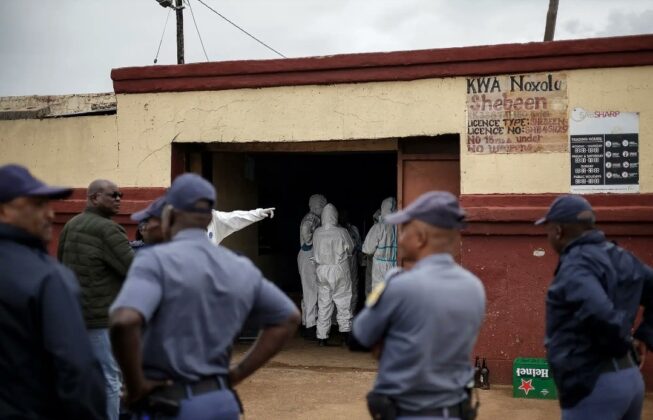
On February 15, 2025, white South Africans congregated outside the US Embassy in Pretoria to talk about the country's problems, including unemployment, land confiscation, their safety, and President Donald Trump's offer to grant farmers refugee status in the US. Image: Nigel Sibanda.
(The Post News)– A new bill introduced in the U.S. Congress aims to provide a pathway to residency for South African Afrikaners facing persecution. The “Asylum for Farmers and Refugees in Crisis and Necessary Emigration Resettlement Act,” also known as the “Afrikaner Act,” was introduced by Representative Troy Nehls on Wednesday.
The bill aims to make South African Afrikaners, who belong to a Caucasian minority group, Priority-2 refugees a unique classification for those who have legitimate concerns about being persecuted because of their race, ethnicity, or heritage. According to Nehls’s plan, this refugee status would be extended to the parents, wives, and kids of Afrikaners who currently reside in South Africa. Additionally, it contains clauses allowing applications to be processed in a third country or within South Africa.
Importantly, applicants would not be denied solely based on politically motivated arrests or other government actions linked to their race, ethnicity, or ancestry, the bill states. Additionally, any individuals granted refugee status under the Afrikaner Act would not count toward the annual numerical cap for U.S. immigration admissions.
The proposal follows a statement made in March 2025 by President Donald Trump, who promised to fast-track U.S. citizenship for South African farmers, specifically those facing land expropriation under the country’s Expropriation Act. However, as reported by The New York Times on Sunday, only 100 Afrikaner farmers are currently being considered for refugee status.
The article further noted that more than 8,200 individuals have expressed interest in resettling in the U.S., with the teams involved already identifying 100 potential candidates for refugee status. A phase-one initiative known as “Mission South Africa” has led to the deployment of U.S. teams to establish temporary refugee centers in Pretoria, documents obtained by the Times show.
Three priority groups are used to categorise refugees under the U.S. Refugee Admissions Program (USRAP). Individual referrals are part of Priority 1 (P-1), frequently for people in urgent need of protection. Group referrals, like the Afrikaner case, are permitted under Priority 2 (P-2), which may expedite the procedure for individuals who fit particular requirements. Finally, Priority 3 (P-3) addresses family reunifications.
By designating Afrikaners as a persecuted group under the P-2 programme, the Afrikaner Act would simplify the application process. This designation would permit direct applications, bypassing the need for referrals from the UNHCR or U.S. embassies.
The measure mandates that the Secretaries of State and Homeland Security submit reports every ninety days as part of its transparency and oversight provisions. These reports would keep tabs on wait times, applications that are still processing, and the reasons behind any rejections. These reports would be posted publicly on the U.S. Department of State’s website. The House Committee on the Judiciary is currently reviewing the Afrikaner Act.
About the Author