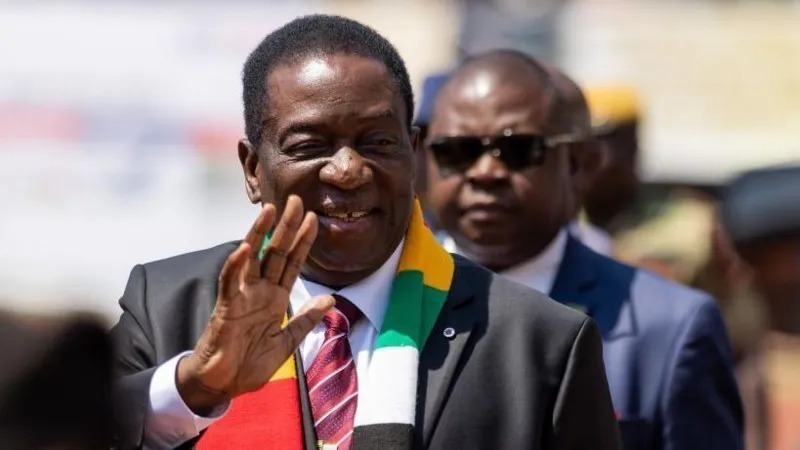
Critics say Zimbabwe's president Emmerson Mnangagwa is trying to "appease" the Trump administration. Getty Images.
President Emmerson Mnangagwa of Zimbabwe declared that his administration will temporarily remove import duties imposed by the United States. After President Donald Trump’s administration recently imposed an 18% tariff on Zimbabwean exports to the United States, this action attempts to improve relations with the U.S.
Mnangagwa announced X, stating that the measure seeks to “facilitate the expansion of American imports within the Zimbabwean market, while simultaneously promoting the growth of Zimbabwean exports destined for the United States.”
Only a few days have passed since the United States levied a new tariff on the country’s exports, which may put additional pressure on the already limited trade between the two nations.
According to U.S. official data, trade between Zimbabwe and the United States was worth $111.6 million in 2024. Zimbabwe’s exports to the United States fell 41% to $67.8 million, while U.S. exports to Zimbabwe reached $43.8 million, a 10.6% gain from the previous year.
For many years, the country and the United States have had a tense relationship, especially following the contentious land reform program that former President Robert Mugabe started in the early 2000s, that resulted in the confiscation of farms owned by white people. Relations have deteriorated further as a result of government crackdowns on political opposition and human rights issues.
In reaction to the land reform program and claims of human rights violations, the United States placed sanctions on their government under Mugabe’s leadership. The Biden administration loosened these sanctions by substituting targeted actions against 11 people, including Mnangagwa, for broad penalties, citing “democratic backsliding” and “human rights abuses.” Mnangagwa has consistently denounced the sanctions, calling them “illegal and unjustified.”
Mnangagwa emphasized that Zimbabwe’s foreign policy strategy is centered on “fostering amicable relations with all nations, and cultivating adversarial relationships with none” when he announced the tariff suspension. He presented the action as a component of a larger initiative to advance “equitable trade” and strengthen bilateral ties.
However, Hopewell Chin’ono, who is critical of Mnangagwa’s leadership, suggested that Zimbabwe’s president should take a more collective approach to the U.S. issue. “As the current chairman of the Southern African Development Community (SADC), Mnangagwa should be encouraging a unified regional response to the U.S. rather than pursuing a unilateral path,” Chin’ono commented. He argued that coordinated regional actions could offer better leverage and stability in the face of global economic shifts.
The impact of Trump’s new tariffs is being felt beyond Zimbabwe. Lesotho, another southern African nation, has been hit with a 50% tariff, the highest on the list. Lesotho’s government has announced plans to send a delegation to Washington to negotiate a new trade deal while also seeking alternative markets for its goods.
About the Author