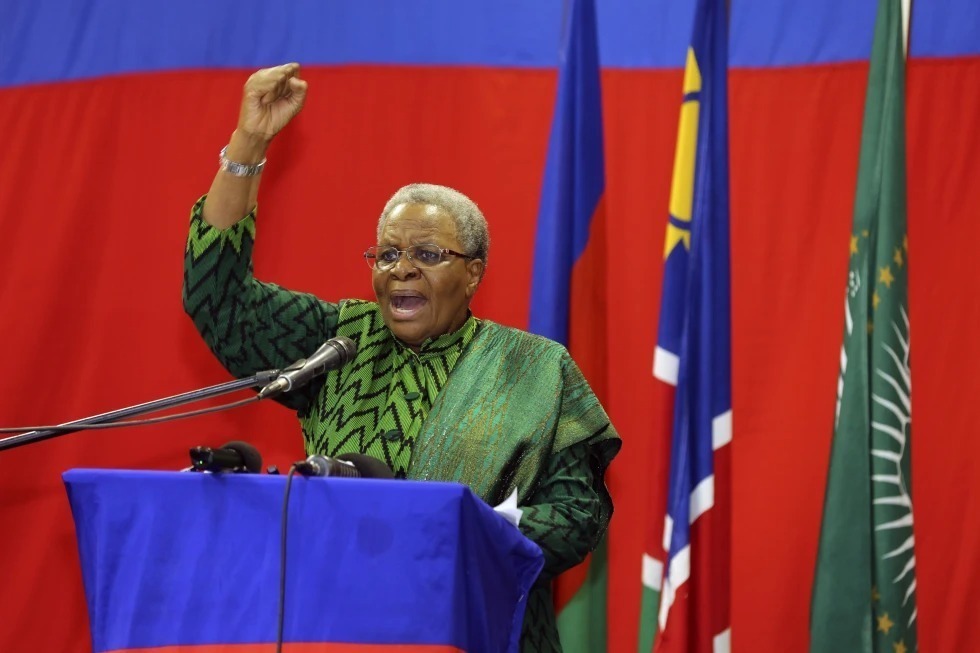
Namibian President Netumbo Nandi-Ndaitwah has announced free university education, she says the free education scheme will be phased in gradually. Image credit: AP
(The Post News)- Namibia’s president, Netumbo Nandi-Ndaitwah, has announced that public university and technical college fees will fall away from 2026, making higher education free for the first time in the country’s history.
In her first State of the Nation address, the president; also Namibia’s first woman to hold the office, said students would no longer pay registration or tuition fees at any public tertiary institution. It’s a major policy shift that speaks directly to years of student activism and growing frustration over education costs. “We have heard your cries: ‘The Fees Have Fallen’,” she told parliament, referencing student-led movements across southern Africa, including the #FeesMustFall protests in South Africa. But even with the applause, not everyone’s convinced.
Nandi-Ndaitwah said the government won’t be injecting much additional money into the plan. Instead, it will draw from existing subsidies to universities and the Namibia Students Financial Assistance Fund (NSFAF), which already receives around N$2.4 billion annually. NUST and UNAM, Namibia’s main public universitiesare allocated N$505 million and N$1.4 billion respectively.
She also made it clear the roll-out would be gradual, and that families would still be responsible for accommodation and other living expenses. The lack of clear funding details, though, has raised eyebrows. Tannen Groenewald, an economist interviewed by the Windhoek Observer, warned that without a significant budget increase, universities may have to cap student intake to manage costs. “Capacity constraints could lead to stricter entry requirements, which might exclude those it aims to help,” he said. He added that the benefits may end up limited to low-income households, similar to what happened in South Africa after free education was introduced in 2017.
Groenewald noted that while the president’s speech was optimistic, much depends on the practicalities. “It’s a positive move for those who can’t afford it, but how the country funds it long-term remains the big question.” Some student organizations share those concerns. The Affirmative Repositioning Student Command told the BBC the announcement lacked clarity. “There is no plan, just a confused statement,” the group said, questioning whether the promise would cover postgraduates or only undergrads.
Others, though, have welcomed it as a long-overdue win. William Minnie, a prominent student activist, said it marks a turning point after years of protest. “Education is a public good, not a commodity. This is what we’ve been fighting for.” The Namibia National Students Organization (NANSO) echoed that. Spokesperson Jessy Abraham called it “a dream defended across generations” and urged government to fast-track the roll out.
But concerns remain over sustainability. Former Higher Education Minister Itah Kandji-Murangi has previously argued that current university subsidies aren’t even enough for research and innovation. Without new funding, some fear quality may suffer.
The leader of the Affirmative Repositioning movement, Job Amupanda, provided a domestic solution. He proposed establishing a social security-style education fund to which employers and workers would both contribute. According to his calculations, it might raise N$2 billion in two years and, with governmental assistance, N$7 billion. The promise of free university education is now official government policy, not just a student slogan, even though the practicalities argument is still ongoing.
About the Author