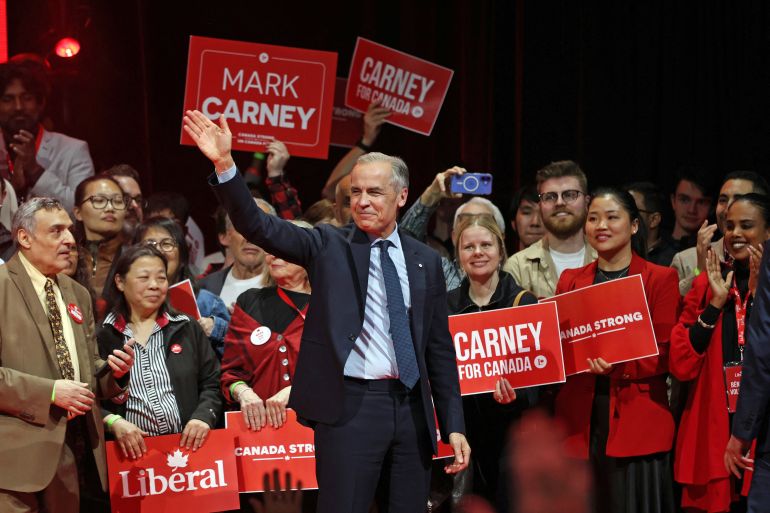
Canada’s governing Liberal Party has defied months of dismal polling to secure a remarkable fourth consecutive term in national elections overshadowed by escalating tensions with the United States and incendiary comments from President Donald Trump. Image: Al Jazeera.
(The Post News)– Canada’s governing Liberal Party has fought off months of negative opinion polling to secure a surprise fourth consecutive term in national elections shrouded by increased tensions with the United States and divisive comments from President Donald Trump.
While delivering his victory speech, Carney stated that Canadians decide what happens in Canada. He also noted that as America seeks to take over Canada—its land, resources, and water—Trump’s efforts are to break them, and that is never going to happen.
The vote came after months of tension ignited by Trump’s decision to slap deep new tariffs on Canadian products and a string of incendiary comments, topped by an eleventh-hour exhortation that Canada join the United States as the “cherished 51st” state. His comments overshadowed the campaign and seemed to spectacularly backfire, buoying the Liberals and crippling the Pierre Poilievre-led Conservative Party.
When the year began, Carney’s Liberals were trailing by more than 25 points in the polls, tipped universally to be swept out of office. However, Trump’s threats galvanised the electorate, making the election a referendum on national sovereignty and identity. The outcome was that the Liberals reversed their fortunes in record time.
Responses from across the globe poured in, with international leaders quick to congratulate and reaffirm support for Canadian independence. President of the European Commission Ursula von der Leyen praised the victory, calling for a strengthening of ties between Canada and Europe. British Prime Minister Keir Starmer complimented Carney’s leadership, and French President Emmanuel Macron discussed common values. In sharp contrast to the present U.S. administration’s silence, even former President Joe Biden expressed his congrats.
The election is also a devastating loss for Poilievre, who lost his Ontario riding. His strategy of copying Trump’s rhetoric while trying to pivot to home-ground domestic cost-of-living issues did not ultimately appeal to a majority of Canadians. Though the Conservatives did increase their national vote share, they captured only 144 seats—far short of what would be needed to govern.
Minor parties were crushed, with the New Democratic Party dropping from 24 seats to fewer than 10, and its leader, Jagmeet Singh, announced that he would step down after losing his seat. The separatist Bloc Québécois found its support eroded by fears of U.S. influence in Quebec, and other fringe parties could make no progress in an election that was dominated by the U.S.-Canada clash.
While the Liberals did not secure a majority, the result represents a historic shift in momentum and a powerful rejection of American interference. Carney now faces the challenge of governing in uncertain times, with strained relations across the border and a volatile global landscape.
“I’m most useful in a crisis,” Carney has said—and in this crisis, Canadians appear to have agreed.
About the Author