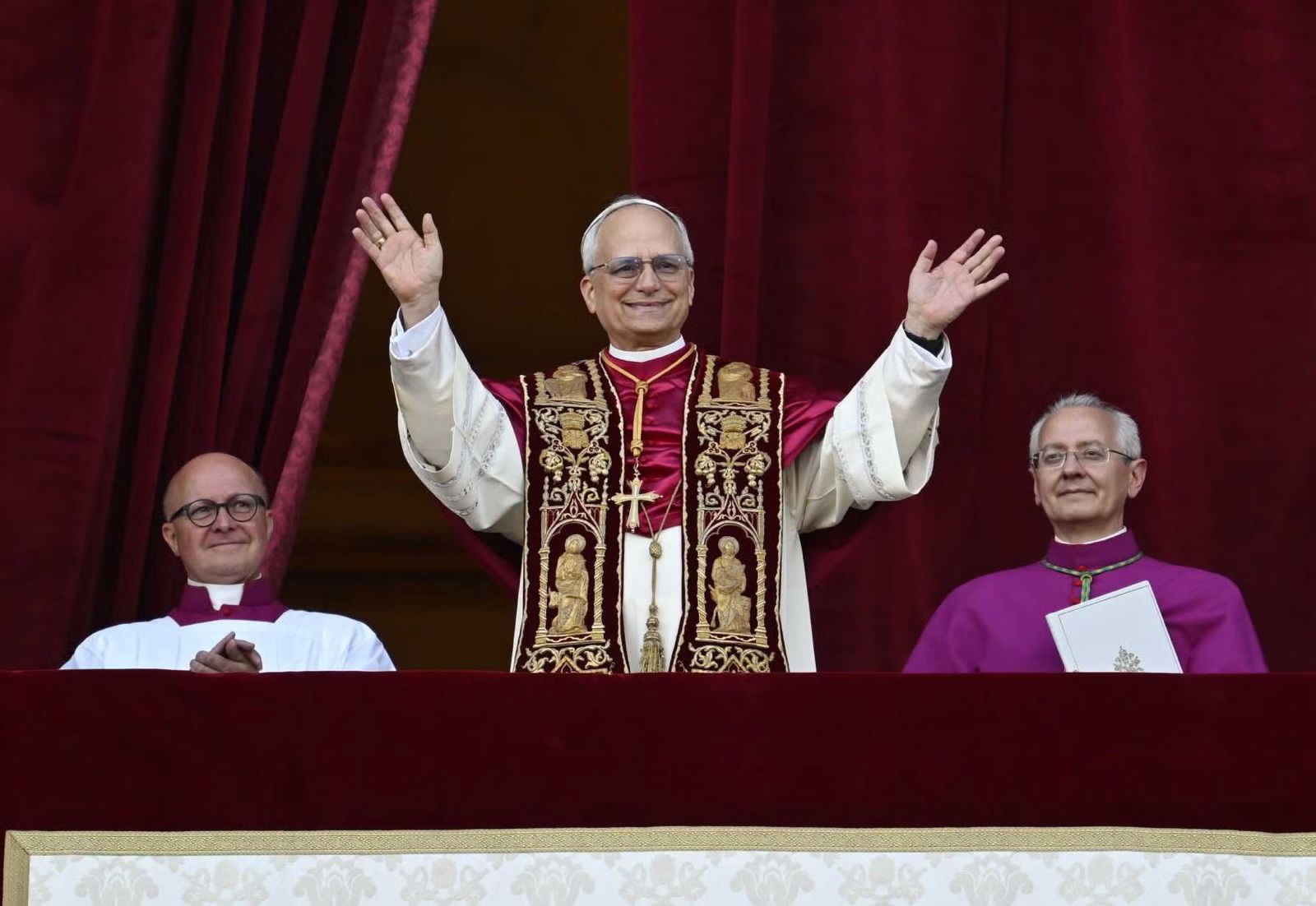
Pope Leo XIV, the former Cardinal Robert F. Prevost, waves to the crowds in St. Peter's Square at the Vatican after his election as pope May 8, 2025. The new pope was born in Chicago.
(The Post News)- In a historic development, Cardinal Robert Francis Prevost has been elected as the 267th pope of the Roman Catholic Church, assuming the name Pope Leo XIV. This marks a significant turning point for the Church, as he becomes the first American-born pontiff in its 2,000-year history.
The conclave, convened following the death of Pope Francis on April 21, concluded swiftly on the fourth ballot, with 133 cardinal electors participating. Cardinal Prevost secured the necessary two-thirds majority to be elected pope.Born in Chicago, Illinois, on September 14, 1955, Robert Prevost is a member of the Order of Saint Augustine.
He holds degrees in mathematics, theology, and canon law. His ministry has taken him across the globe, most notably to Peru, where he served as a missionary and later as the Bishop of Chiclayo. In 2023, Pope Francis appointed him as Prefect of the Dicastery for Bishops, and he was elevated to cardinal later that year.
In his first address to the faithful, Pope Leo XIV reflected on the legacy of his predecessor, Pope Francis. “We are all indebted to Pope Francis, who led with humility, tenderness, and courage,” he said. “Evil will not prevail, because Christ is with us.”
The election of Pope Leo XIV signifies not just a personal milestone for Cardinal Prevost but a broader shift in the global landscape of the Catholic Church. With dual citizenship in the United States and Peru, Pope Leo XIV brings a unique blend of North American pragmatism and Latin American pastoral sensitivity to his new role. His diverse background places him in a position to bridge the gap between the Church’s historical European heart and its increasingly diverse global following.“
Leo XIV’s election represents a new chapter for the Church, one that emphasizes inclusion, social justice, and the voice of the Global South,” said Cardinal João de Andrade of Brazil. “His extensive experience in Latin America makes him uniquely suited to lead the Church into the future.”
Pope Leo XIV’s name choice honors Pope Leo XIII, known for his work on Catholic social teaching. The decision signals continuity with Pope Francis’ emphasis on justice and service to the marginalized.
As the bells of St. Peter’s rang out, marking the beginning of this new papacy, Pope Leo XIV’s call for unity was clear: “May we walk together, not in fear, but in faith and in service.”
The election of Pope Leo XIV stands as a defining moment in the history of the Church, heralding a papacy that could redefine the direction of the Catholic faith in the modern world.
About the Author