United States President Donald Trump announced the lifting of economic sanctions on Syria, marking a dramatic shift in American foreign policy in the Middle East. Image source: Al Jazeera
President Donald Trump announced Tuesday that the United States will lift economic sanctions on Syria, a dramatic shifting of American foreign policy in the Middle East that gives the war-ravaged country what Trump called “a chance at greatness.”
Addressing Riyadh’s Saudi investment forum, Trump mentioned that the step was taken upon advice of Saudi Crown Prince Mohammed bin Salman and Turkish President Recep Tayyip Erdogan. “Syria, they’ve had their fair share of tragedy, war, murder in many years,” Trump said. “That’s why my administration has already taken the initial steps towards returning to normal relations between the United States and Syria for the first time in over a decade.”.
The move is a significant win for President Ahmed al-Sharaa’s new administration, who came to power following the collapse of the Assad regime in December of the Biden administration. Al-Sharaa, once the leader of hardline extremist group Jabhat al-Nusra, defected from al Qaeda in 2016 and has since been working to redefine himself as an uniting presence in post-Assad Syria.
The Trump administration has not yet formally recognized the al-Sharaa regime or re-established diplomatic relations, but Tuesday’s action shows growing engagement. Trump will speak informally with al-Sharaa on Wednesday, a White House official said, in what would be the highest-level interaction between the two governments so far.
U.S. Secretary of State Marco Rubio will meet Syria’s foreign minister, Asaad Al-Shaibani, in Turkey later this week to follow up on negotiations for normalization and rebuilding.
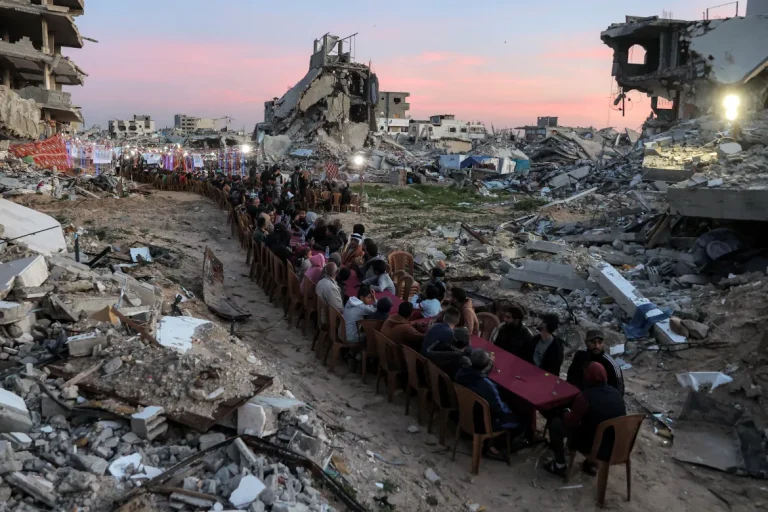
The action caused jubilation in Syria. In Homs and Latakia, citizens were observed waving Syrian and Saudi flags among crowds, chanting slogans in support of King Salman, and setting off firecrackers in town squares.
This is the beginning of the healing process,” declared one revolution activist, Osaid Basha, in celebration in Homs. “One of the biggest objectives of the revolution — the overthrowing of the regime — is already in the bag. Now focus must be placed on pushing the country forward.”.
Syria’s economy and economy minister, Mohammad Nidal al-Shaar, was reduced to tears providing live TV interview with Saudi television news channel Al Arabiya, saying, “Syria’s rebirth will begin. We are heading towards an economic renaissance, since the world has now opened its doors for us.”.
Al-Shaar emphasized that the lifting of sanctions will pave the way for Syria’s return to international financial networks like SWIFT, and investment and trade can be resumed. “The door is now open for anyone who wants to invest in Syria,” he added.
The United Nations special envoy to Syria, Geir Pedersen, also appreciated the U.S. move, saying it was essential to revive Syria’s health, education, and economic infrastructure.
European nations such as the UK and EU had previously relaxed some of the sanctions earlier this year. On Capitol Hill, however, there was bipartisanship with some misgivings. Senator Jeanne Shaheen called the move a “long-awaited window of opportunity,” while Senator Lindsey Graham warned, “We should recall that today’s leadership in Syria ascended to power with force of arms, not because of the desire of its people.”
Graham, based in Turkey, said that he is in regular contact with Israel, which has been concerned by the new Syrian leadership and what the reduced Western pressure implies for Damascus.
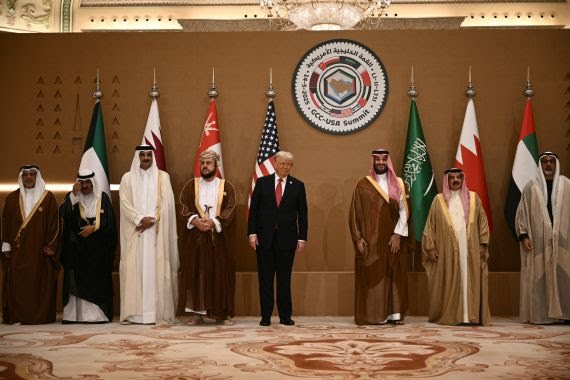
Trump announced this during his four-day Gulf trip. On Tuesday, he received a flashy welcome in Riyadh where the U.S. and Saudi Arabia entered a 142 billion defense agreement as part of a broader $600 billion investment deal.”.
The GCC summit, also held in Riyadh, provided a platform for Trump to outline a vision of Middle East stability. Addressing Gulf leaders, he said, “The Gulf nations are at the forefront of creating a stable, peaceful and prosperous Middle East,” adding, “I’ve seen such progress. It’s really incredible.”
Trump also mentioned ongoing fights in Gaza, Yemen, and Sudan, and denounced Iran’s actions in the region, calling for an end to proxy wars and nuclear ambitions before talks could restart.
Crown Prince Mohammed bin Salman welcomed the U.S.–Gulf coalition, anticipating further cooperation. “We look forward to opening new horizons in all domains, in the interest of all our states,” he stated.
While the U.S. has not yet officially normalized relations, Trump’s move has been received by Syria’s new regime as a breakthrough. “We regard the lifting of sanctions as a new beginning on the path to reconstruction,” Foreign Minister Al-Shaibani wrote on X. “Thanks to the stances of our Arab brothers — above all Saudi Arabia — we are opening a new page toward a future worthy of the Syrian people.”
Whether this is the beginning of permanent recovery and stability in Syria remains to be seen. But for now, jubilant Syrian street scenes and reserve hope among regional leaders suggest a hesitant hope is finally beginning to develop.
About the Author