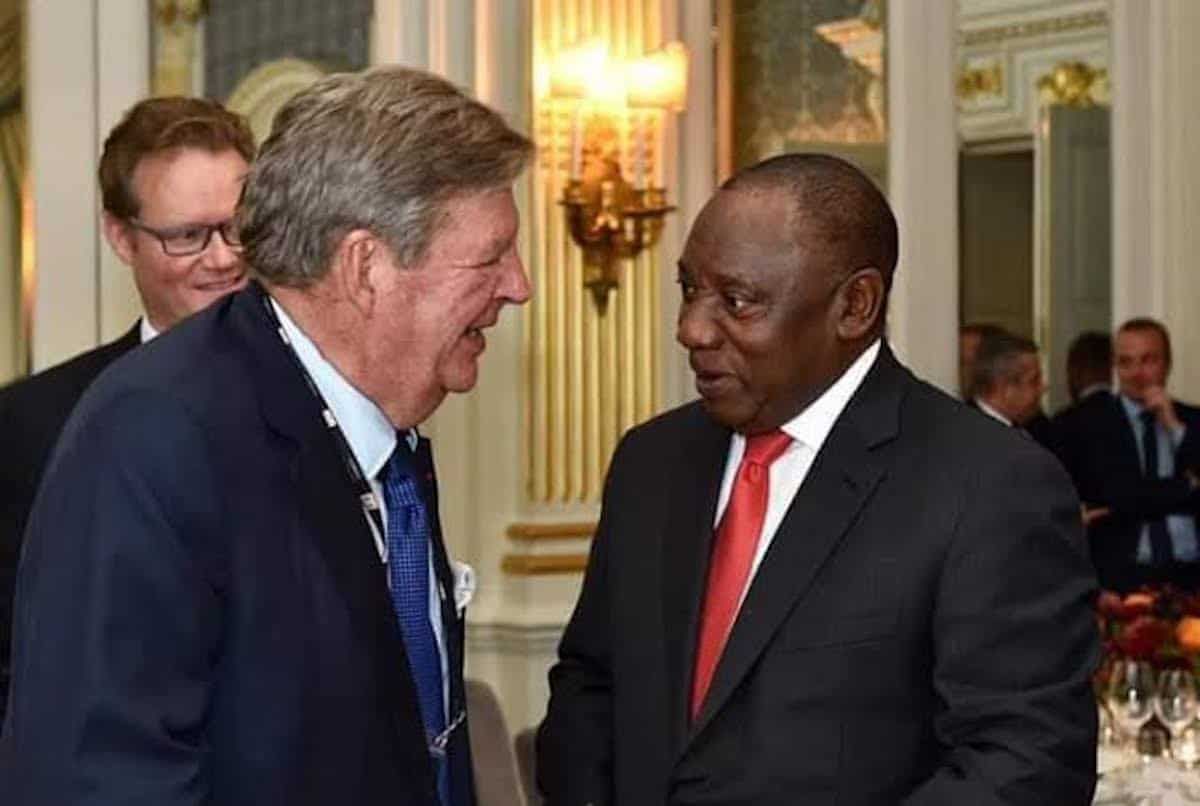
Billionaire, Johan Rupert, and South African President Cyril Ramaphosa in Washington D.C. on a diplomacy visit to the White House to meet United States President Donald Trump. Image: CapricornFM shared via X @CapricornFM.
(The Post News)– South African billionaire and the chairman of Richemont Johann Rupert has refuted claims of racially targeted violence against white farmers in the country.
Rupert expressed that SA needs technology, like drones, commenting amid renewed international scrutiny over violent crime in South Africa, particularly in rural farming communities.
Trump has previously alleged that white farmers were being deliberately targeted, a claim that has been widely contested by local experts and human rights groups.
Rupert further emphasized the need for modern technology to combat the country’s escalating criminality. He advocated for the rollout of Elon Musk’s Starlink satellite internet service as a tool to aid law enforcement and improve surveillance in high-crime areas.
Addressing domestic political tensions, Rupert acknowledged that he is a frequent target of Economic Freedom Fighters (EFF) leader Julius Malema, who has repeatedly criticized the billionaire as emblematic of white monopoly capital. “I am easily one of the biggest targets of Malema’s attacks,” Rupert stated.
In a rare comment on the Democratic Alliance (DA), Rupert turned his attention to DA leader John Steenhuisen, noting that while the party may not publicly acknowledge it, the Cape Flats in the Western Cape—governed by the DA— remain a hot spot for violent crime.
Rupert also pointed out systemic challenges faced by provincial authorities and attributed a portion of South Africa’s crime woes to the unchecked flow of undocumented migrants.
“We have a serious problem with illegal aliens,” he said, echoing a growing concern among some sectors of the population regarding border control and immigration policy.
His wide-ranging comments have sparked debate across the political spectrum, with critics calling for a more nuanced and fact-based approach to South Africa’s complex social issues, while others welcome Rupert’s frank assessment of the country’s most pressing challenges.
About the Author