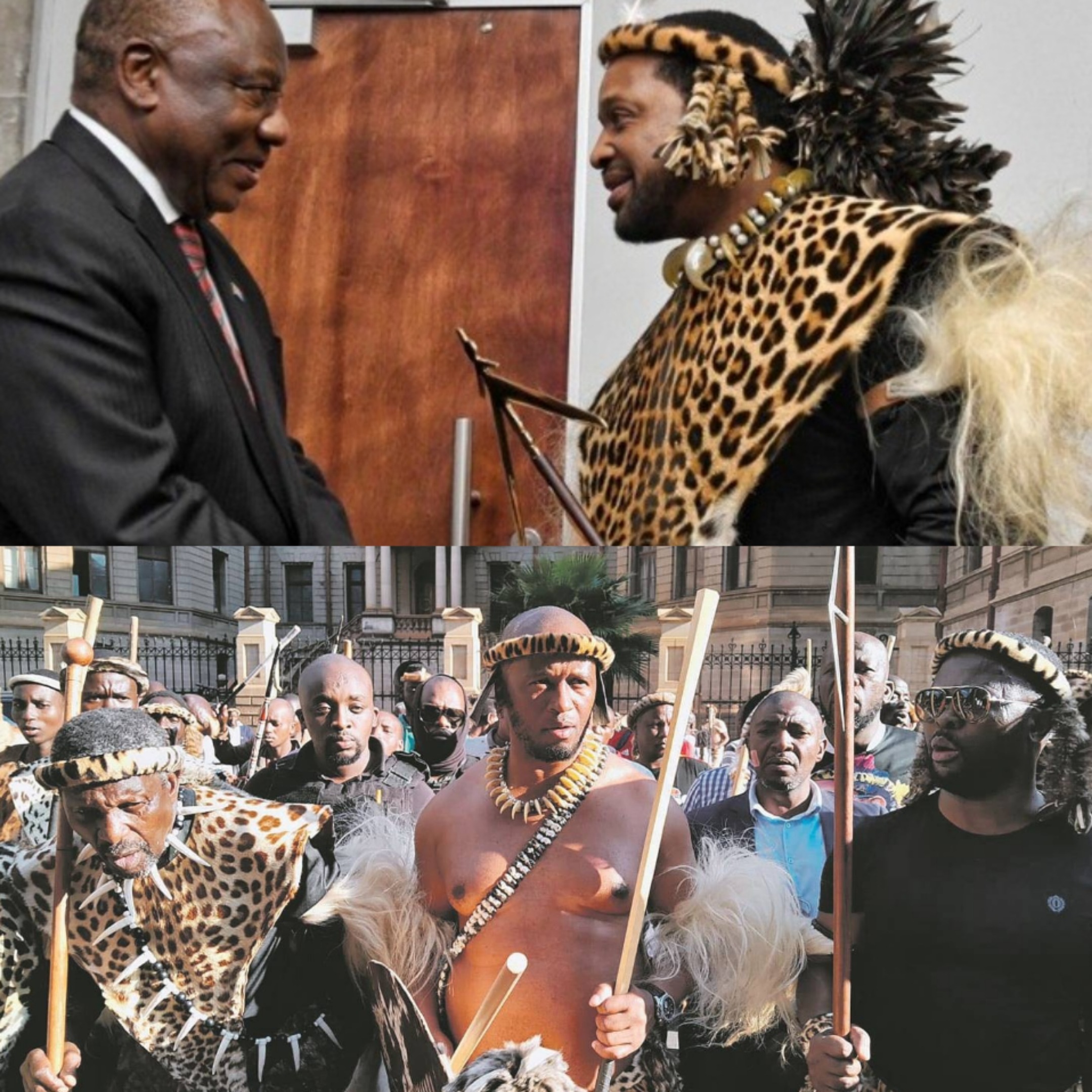
Zulu regiments (Amabutho)gather outside the court in Bloemfontein showing their support for King Misuzulu amidst the on going legal battle for the throne.
(The Post News)– The future of the revered AmaZulu throne hangs in a delicate balance as the Supreme Court of Appeal (SCA) in Bloemfontein has reserved judgement in the highly anticipated legal battle over the succession of King Misuzulu kaZwelithini. With arguments concluded earlier this week, the AmaZulu nation now enters a period of intense anticipation, awaiting a verdict that could redefine the monarchy’s leadership.
The Weight of Judgement Reserved
The SCA’s decision to reserve judgement means the court has heard all presented arguments and will now deliberate, with a ruling expected at a later stage—typically within approximately three months. During this period of legal limbo, King Misuzulu remains in his officially recognized position, continuing to fulfil his duties as monarch. The waiting period highlights the case’s significant relevance, which puts ancient customary traditions against modern legal interpretations, with direct implications for the AmaZulu nation’s unity and direction.
A Throne Contested: Unpacking the Arguments
At the heart of the dispute is President Cyril Ramaphosa’s appeal, seeking to overturn a December 2023 Pretoria High Court ruling that invalidated his recognition of King Misuzulu. Ramaphosa’s legal team, which included notable people such as Advocate Temba Ngcukaitobi, contended that the president’s recognition was a lawful administrative act that correctly confirmed a king already established by Zulu custom. King Misuzulu’s lawyers similarly asserted that custom dictates his position on the throne, urging the court not to apply common law to traditionally governed matters.
However, dissenting factions within the royal family presented fervent counterarguments. Prince Simakade Zulu, represented by Advocate Alan Dodson SC, laid claim to the throne, asserting he is the rightful heir by virtue of ukufakwa esiswini – a traditional custom where a son is traditionally adopted by the Great Wife, Queen Mantfombi Dlamini-Zulu. His legal team argued that crucial due processes to identify the next king were not followed, leading to him being “cheated” of the throne.
Prince Mbonisi Zulu, another prominent contender, also challenged the legitimacy of King Misuzulu’s ascension. Prince Mbonisi, through his spokesperson Mkhulu Ntsingiza, contended that the concept of a “Great Wife” was being misapplied in this context and that the meeting where King Misuzulu was chosen was held prematurely, with certain cleansing ceremonies unobserved.
He highlighted his attendance at a parallel family meeting on May 5, 2021, to identify an alternative candidate and urged the court to refer the matter back to the Zulu royal family for proper traditional resolution. The central tension in court thus revolved around whether the state’s recognition process adhered to or incorrectly interpreted deeply ingrained Zulu customary law.
Voices from the Kingdom: Custom, Law, and Unity
The court proceedings laid bare the emotional and cultural weight of the kingship dispute. Prince Zuzifa Buthelezi, chairperson of King Misuzulu’s council, spoke poignantly of the “emotional two days”, reflecting on the profound disunity within the royal family and the legacy of his late father, Prince Mangosuthu Buthelezi, who played a central role in the kingdom’s affairs.
From King Misuzulu’s camp, spokesperson Prince Thulani Zulu affirmed the King’s unwavering position, stating that “irrespective of the conclusion of the Supreme Court appeal, King Misuzulu remains the King of Amazulu.” He underscored the primacy of custom, arguing that the court should not use common law to override traditional practices.
This stance finds strong backing from cultural experts like Prof. Ngubane from the University of KwaZulu-Natal, who, in a recent interview with Newzroom Afrika, affirmed Prince Thulani’s statement as “100% correct”. Prof. Ngubane emphasized that all traditional protocols, culminating in the “highest point of sealing his position as the king of Amazulu”, were meticulously followed. He further argued that court involvement risks “overriding the authority of traditional practices” and “undermining the significance of culture and cultural heritage”, maintaining that the King’s legitimacy stems fundamentally from his birthright.
Despite the legal and familial rifts, a semblance of unity was observed outside the court, where supporters from various factions, including Zulu regiments (amabutho), joined in song and chants about the sovereignty of the Zulu Royal family, showcasing a shared devotion to the institution itself, even amid disagreements over its leadership.
What Verdict Awaits: A Path to Finality?
As the AmaZulu nation awaits the SCA’s verdict, two primary outcomes loom large. The court could uphold President Ramaphosa’s appeal, thereby validating King Misuzulu’s recognition and bringing a degree of legal finality to his reign. Alternatively, the SCA could dismiss Ramaphosa’s appeal, which would uphold the High Court’s ruling and compel the president to establish an investigative committee to re-examine the succession process— potentially prolonging the legal saga significantly.
Crucially, even after the SCA’s judgement, the legal battle may not be entirely over. Legal experts predict that the losing party, whoever it may be, will probably file a last appeal with the country’s highest court, the Constitutional Court. As a result, the definitive legal conclusion for the Zulu throne may still be some time away. The ultimate resolution will not only determine the leadership of the Zulu nation but also set a precedent for the delicate interplay between traditional authority and the country’s constitutional legal framework.
About the Author