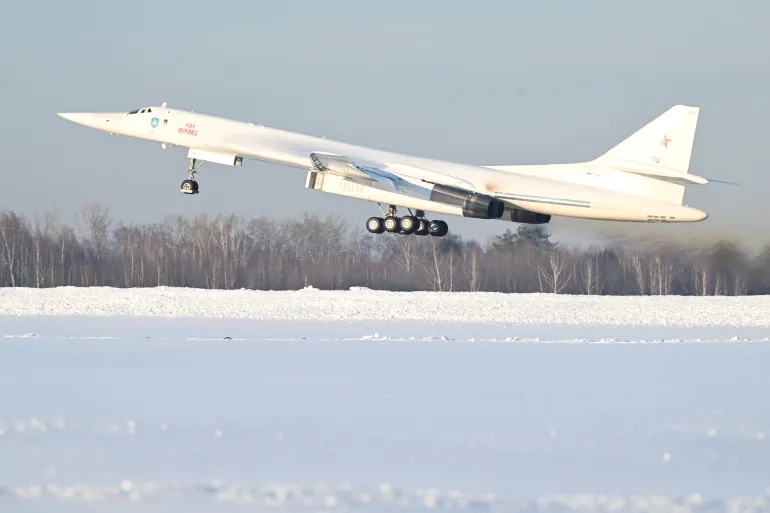
More than 40 Russian aircraft were hit across four airbases in a drone operation that caused $7 billion in damage. Source image: Pool via Reuters
(The Post News)- On June 1, the SBU estimated the total damage caused by the operation at more than $7 billion, claiming that 34% of Russia’s cruise missile carriers were disabled in a single coordinated strike. Experts say this could dramatically reduce Russia’s ability to conduct long-range missile assaults in the near future.
“It’s one of the most cost-effective blows ever delivered in modern warfare,” said Oleksandr Musiyenko, a Kyiv-based defense analyst, during an interview on June 1. “The destruction of high-value bombers by cheap drones is a complete disruption of the old military balance.”
Later on June 1, 2025, Russian authorities confirmed aspects of the incident. Irkutsk Governor Igor Kobzev said that a drone had struck a military facility in the village of Sredny and confirmed that “the source of the drones was a truck.” Murmansk Governor Andrey Chibis also acknowledged drone activity in his region but withheld further details.
Russia’s Defense Ministry issued a statement calling the attack a “terrorist act”, admitting that “several units of aircraft caught fire” during the drone strikes.
The operation was reportedly supervised at the highest level, with Ukrainian President Volodymyr Zelensky and SBU Chief Vasyl Malyuk directly overseeing the mission, according to sources who spoke on June 1. The same sources emphasized that all personnel involved in the planning and execution of the strike remain within Ukrainian territory.
“Those behind the operation have been in Ukraine for a long time,” the SBU source said. “If the Putin regime detains someone, it will be a staged performance for domestic optics.”
The strike came just months after Ukraine publicly announced the development of a new long-range drone capable of flying 3,000 kilometers. Though officials did not confirm whether the newly developed drone was used in Operation Spider Web, analysts see the timing as significant.
“This attack tells Moscow that even the heart of its air power is no longer safe,” said Hanna Shelest, a Ukrainian security expert, speaking on June 1. “It also signals that Ukraine will continue adapting faster than Russia anticipates.”
As the war between Russia and Ukraine enters a new phase in mid-2025, the drone strike may mark a historic turning point in the evolution of modern warfare, where low-cost technology, covert tactics, and asymmetrical planning can disrupt even the most established military powers.
About the Author