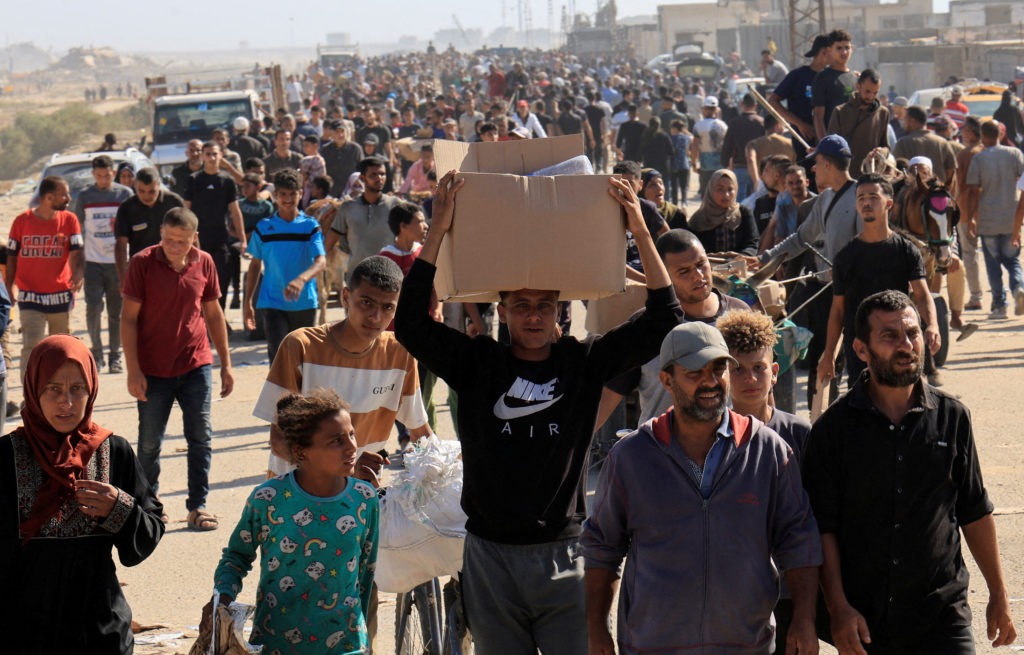
Palestinians seeking aid gather near an aid distribution site run by the U.S.-backed Gaza Humanitarian Foundation, in Rafah, in the southern Gaza Strip, May 27, 2025. REUTERS/Hatem Khaled TPX IMAGES OF THE DAY
(The Post News)- A humanitarian tragedy unfolded in the southern Rafah governorate of the Gaza Strip on Tuesday morning when at least 27 Palestinians were killed and dozens more wounded by Israeli airstrike as they attempted to collect food aid near the al-Alam roundabout, according to local officials.
Eyewitnesses and relief workers on the ground describe a scene of carnage and chaos as civilians, including many displaced and starving people, were fired upon by Israeli tanks, helicopters, and drones just a kilometre away from an aid distribution centre operated under the Gaza Humanitarian Foundation (GHF), an Israel- and United States-funded organisation.
“This was utter carnage,” one foreign medic in the area told the BBC, on condition of anonymity. “We were overwhelmed with casualties since 03:48. They had been shot in the chest and head—many didn’t make it to hospital alive.”
At Nasser Hospital in the nearby Khan Younis, its director Dr. Atef Al-Hout said he had received 24 dead and 37 wounded, all from gunshot wounds. “Israeli soldiers opened fire on crowds of civilians waiting for aid,” he stated.
A spokesman for Gaza’s Hamas-ruled Civil Defence department, Mahmoud Basal, said the attack was by live fire from multiple directions, including sniping and aerial bombardment.
Videos and testimonies of survivors point to an indiscriminate and unexpected attack.
Palestinian civilian Nadeem Zarab recounted how he and his uncle were heading towards the aid centre at around 2:00 a.m. when the attack began. “There was firing from all directions. We started taking shelter behind the wall. people began falling in front of us.”
One other witness, who described what happened to BBC Arabic, told of being shot at from “all sides” just 200 metres after passing a checkpoint. “Hundreds were killed or wounded. It was a disastrous situation.”.
Rania al-Astal, 30, out to purchase food with her husband, described “intermittent shooting” as early as 5 a.m. “Whenever people tried to approach the roundabout, they were shot at,” she told AFP. Another witness, Mohammed al-Shaer, said Israeli drones and a helicopter fired on the crowd “to prevent them from approaching the tank barrier.”
The Israel Defense Forces (IDF) has denied firing at civilians directly. In a statement, it said troops took action against “suspects who deviated from the authorized access routes” and were liable to cause damage, and that they had fired warning shots some 500 metres from the aid point.
“The troops are not preventing the entry of Gazan civilians to the areas of humanitarian aid distribution,” the IDF asserted.
This description is in sharp contrast with the reports of civilians, aid workers, and hospitals of mass casualties. The denial of access to international journalists to Gaza has also made independent verification more difficult.
GHF, which replaced the United Nations as the primary aid distributor in Gaza, has come under severe criticism for forcing Palestinians to travel to access aid centres in Israeli-controlled territory. Unlike the old UN system, where the aid was dispersed at 400 community-based centres, GHF’s first-come, first-served policy has forced civilians to travel miles in unsafe conditions.
Since GHF centres opened last week, at least 102 Palestinians have been killed and more than 460 injured while attempting to get food, Gaza’s Health Ministry has reported. The sites have been called “death traps” by civil defence teams.
In its own statement, the GHF said Tuesday’s incident occurred “well outside our secure distribution site,” and faulted victims for having entered a “closed military zone.”
The UN human rights commissioner, Volker Türk, condemned the recent fatalities: “For a third day in a row, civilians have been killed close to an aid distribution centre. Palestinians have been presented with the darkest of choices: die from starvation or risk being killed trying to get to food.”
The latest killings fit into a broader military intensification. Israeli attacks killed a minimum of 58 Palestinians across Gaza on Tuesday alone, bringing the overall fatalities since October 7, 2023, to 54,510, and the injured to more than 124,000, according to Gaza’s Health Ministry. Nearly the entire 2.3 million populace has been displaced, and Israel’s blockade has resulted in famine conditions.
Israel launched its Gaza operation following Hamas’s October 7 attack which killed 1,139 people and led to the abduction of over 200. The hostilities have ratcheted up since the end of a brief ceasefire in March, with three Israeli soldiers killed in the northern Gaza district of Jabalia this week.
UN Secretary General António Guterres has called for an “immediate and independent investigation” into the fatalities. Human rights experts say that targeting civilians seeking help may amount to war crimes.
Then-US State Department spokesperson Matthew Miller added fuel to that fire in a podcast interview this week, acknowledging Israel has “no question” committed war crimes in Gaza—statements that have sparked outrage over US complicity and renewed demands for accountability from international legal authorities.
Rights groups, including DAWN and Human Rights Watch, are now urging international courts to investigate and prosecute not just Israeli officials but also their foreign enablers.
In Gaza, the desperation is growing. With hospitals like Nasser running low on blood and medicine, and aid corridors turned into war zones, the Palestinian people remain stuck in a deadly cycle-facing hunger or the barrel of a gun.
Individuals were holding packages of food when they were being shot,” one civil defence worker remarked. “They came for aid. They left in coffins.”.
About the Author