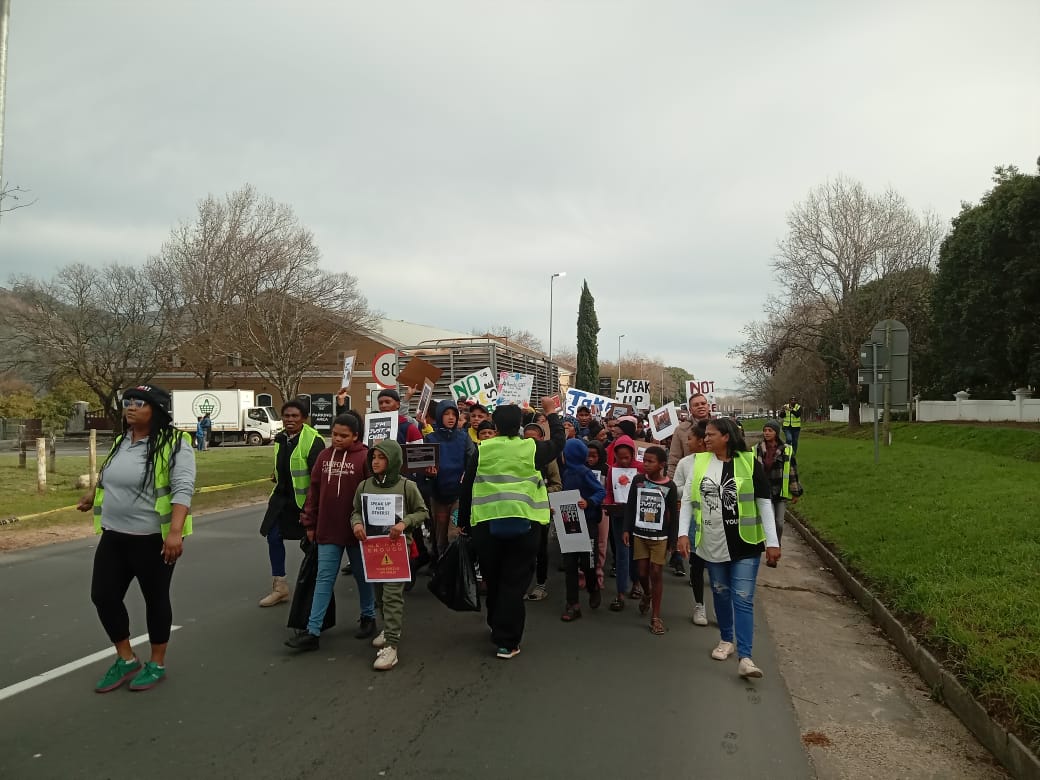
Protesters with posters during their 'no to gender-based violence and grooming' march held on Tuesday.
(The Post News)– Frustrated and heartbroken residents took to the streets on Tuesday in a powerful march against gender-based violence (GBV), with a strong focus on sexual grooming of children.
Community members, including parents and children, carried signs and chanted “We are not for sale”—a direct response to ongoing allegations that a known local man has been grooming young girls in the area. The march culminated at the Franschhoek police station, where a memorandum of demands was handed over to authorities.
Christine Loft, founder of the Safe House for Abused Women and Children and one of the march organizers, said the community could no longer stay silent.
Condemning the rise in GBV in the area, Patricia Makasi from the Baphi Abafazi Movement (BAM) said, “What’s happening in our country is horrifying. Stellenbosch used to be quiet when it came to GBV, but not anymore. We are horrified by the stories coming out of this region.”
Meanwhile, a child addressed the crowd, expressing how children suffer under abuse and sexual violence. The child also urged for a stern stand against the abuse of children while further emphasizing that “enough is enough.”
One mother recounted how, in 2017, she opened a case against a local man who had abused her daughter. She added that the man was never arrested; instead, he continued roaming free, while further molesting and grooming children.
Alfonzo McKenzie of SAFE pointed out how poverty and substance abuse fuel GBV, noting that poverty is a significant factor; in times of need, females may fall prey to men who provide assistance but have ulterior motives, and men with corrupt motives may take advantage of their weakness.
Mothers at the protest criticized both the community’s silence and the police’s inaction. They called for support and urged the justice system to stop failing victims. Their frustrations echoed the broader call for institutional accountability in the fight against GBV.
The community’s frustration was not only directed at the alleged perpetrator but also at law enforcement and the justice system, which many say have failed them repeatedly. An organizer stressed that the problem extends beyond the perpetrators. Officials who lose case dockets, delay investigations, or intimidate survivors also contribute to the injustice. “We can no longer glorify a failing system,” he said.
Loft called for the Department of Social Development (DSD) to increase its visibility in vulnerable communities. Receiving the memorandum and a petition signed by 712 residents, Major General Sizakhele William Dyantyi, District Commander of the West Coast, urged community members to speak up, as they are the ones who notice these incidents first.
About the Author