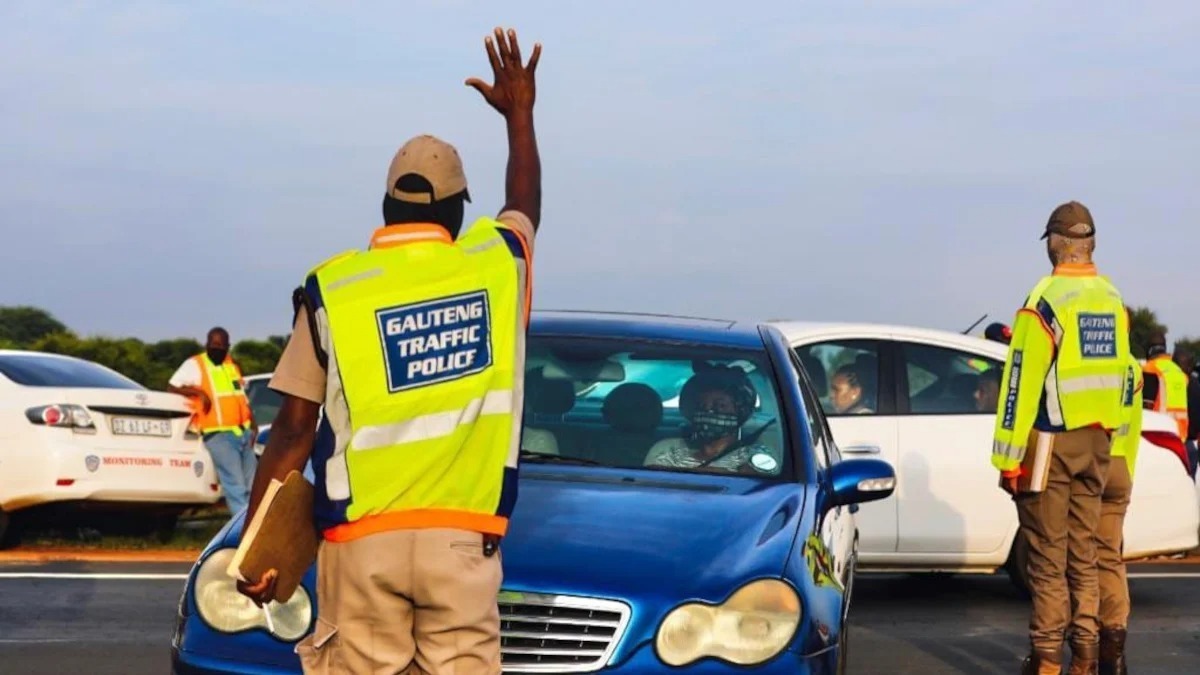
Gauteng Traffic Police officers stop a motorist during routine checks — scenes like this will become more frequent as the AARTO system rolls out nationally from December 2025. Image: BusinessTech.
This update was confirmed by Road Traffic Infringement Agency (RTIA) spokesperson Monde Mkalipi, just a week after the agency had initially said the launch would take place in October 2025. AARTO, short for the Administrative Adjudication of Road Traffic Offences Act, has been years in the making. First introduced in Johannesburg and Tshwane as a pilot, the system is designed to decriminalise minor traffic violations and shift enforcement away from the courts.
Instead of sending traffic fine defaulters to court, AARTO allows for administrative enforcement, like blocking licence renewals for unpaid fines.
According to the RTIA, 69 municipalities across all nine provinces will begin implementing AARTO in December next year, with the rest following in 2026. Despite the scale of the changes, motorists won’t have to worry about points being deducted from their licences just yet. The controversial demerit system, which forms the backbone of AARTO, will only be introduced during the final rollout phase in September 2026.
Under the system, each driver starts with zero points. Offences are assigned specific demerit values, and once a driver accumulates 15 points, their licence will be suspended. Repeat suspensions could eventually lead to a complete cancellation of the licence. For now, Johannesburg and Pretoria remain the only metros where AARTO is already running, albeit under a simplified version. RTIA says over 25,000 traffic officers are being trained to enforce the new law and that infrastructure such as service outlets is already being rolled out nationwide.
Motorists will be given 32 days to pay traffic fines at a discounted rate. If unpaid, a reminder, called a courtesy letter, will follow. A further 32 days will be given to dispute the fine or nominate another driver. After that, an enforcement order will be issued, effectively freezing licence renewals until the matter is resolved. The AARTO legislation has had its share of legal battles. It was declared unconstitutional by the Pretoria High Court in 2022 but later upheld by the Constitutional Court. Chief Justice Raymond Zondo said in a unanimous 2023 ruling that AARTO does not violate the Constitution.
Still, not everyone’s convinced. Civil groups like OUTA and the Automobile Association argue the system is more about collecting revenue than improving road safety. “There’s no proof that the pilot saved a single life,” the AA said in a statement.
About the Author