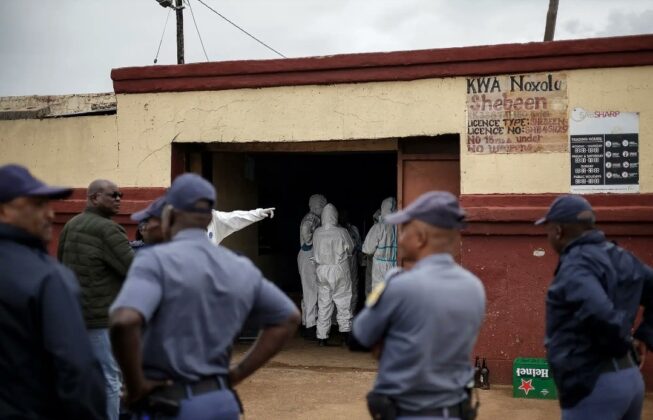
Joburg's abusive billing practices under fire. Image: News24.
(The Post News)– The Public Protector has launched an investigation into the City of Johannesburg’s debt collection practices, which are being scrutinized for being unfair. At the same time, the city is facing a significant R89-million lawsuit related to its electricity billing processes, with allegations of abusive practices.
The Public Protector’s investigation, combined with two ongoing court challenges against the City and its municipal entity City Power, has shed light on the prolonged billing crisis that has been affecting Johannesburg for over a decade. This crisis has resulted in residents and businesses experiencing financial strain due to overcharged electricity accounts, likely caused by inefficient systems.
The City’s systems mistakenly disconnected the electricity supply to Louw Geldenhuys Primary School in Randburg, relying on a meter reading from a Telkom property located across the street from the school. The Public Protector’s office has confirmed that a complaint was filed by a member of the public in February of last year. After reviewing the matter, the office decided to launch an investigation the following month. The complainant has been informed about the outcome of the internal review process, and the case is currently being handled by the Gauteng provincial office of the Public Protector.
Two cases are currently being heard in the South Gauteng High Court in Johannesburg, involving the City of Johannesburg as the defendant. The plaintiffs in these cases are Hadeco, a company that produces flower bulbs, and the Independent Institute of Education (IIE), a private education provider that operates schools and universities.
In an affidavit submitted for the court challenge, Hadeco director Stuart Barnhoorn claims that the City started rebilling the flower company’s electricity consumption on tariffs meant for large power users from 2015 to 2019 without the business’s knowledge or consent. Hadeco’s court documents show that their bills were recorded from the wrong register, with evidence provided by the business’ four-digit register.
The City of Johannesburg’s invoices reveal a seven-digit register used to charge Hadeco, which does not match the meter used by City Power for the flower firm. The alleged misuse of an incorrect register led to a significant increase in Hadeco’s electricity invoices, rising from approximately R2 million at the end of 2015 to nearly R46 million by the end of February 2019, resulting in a total of R84.3 million. Hadeco, a flower bulb producer, asserts that it has been unlawfully charged around R84.32 million since 2015.
According to Section 95 of the Municipal Systems Act, municipalities are obligated to foster positive relationships with their customers. This includes providing invoices that are both accurate and easy to understand, as well as addressing any billing concerns in a timely manner. In contrast, court evidence indicates that City Power employs an estimation method when charging its clients. Specifically, they use 80% of Hadeco’s three highest meter readings from the previous year as the basis for billing the company for the following year.
According to court records, actual municipal meter data was available but not used to invoice Hadeco. Hadeco’s director, Barnhoorn, stated in his affidavit that the company took several steps to address the issue. These steps included logging queries, lodging formal disputes in writing to remedy the steep invoices, and filing a complaint with Johannesburg’s ombudsman. This was done in accordance with the City’s Credit Control and Debt Collection Policy.
Despite these efforts, Barnhoorn’s affidavit asserts that the City failed to resolve the queries in a timely manner or at all. Hadeco has taken legal action against the City, claiming that its conduct has denied them their constitutional right to fair treatment and just administrative action. According to Hadeco, the City’s lack of action has necessitated the legal challenge. The company points out that its average monthly tariff charges increased significantly from R349,000 in 2015 to over R1.5 million between 2018 and 2019.
The IIE, which operates the exclusive Monash University, claims the City owes over R4.5 million due to erroneous overcharging of the Ruimsig-based school from March 2017 to January 2021. The university asserts it was incorrectly charged the large power consumer tariff instead of the low user tariff. The IIE’s court application includes a letter from Tebogo Hlatshwayo, the City’s general manager for key accounts, dated June 2022. This letter confirms that the private education company is owed R4 549 354.86 due to incorrect billing.
A month after the initial letter, Thami Mathiso, who was then City Power’s general manager for revenue management, sent a new letter. This letter revoked the IIE’s due payment, stating that the institution was actually correctly billed as a large power user.
Daniel Richter, the executive of IIE, stated in his founding affidavit for the court application that his institution attempted to resolve the issue with the City’s management and ombudsman but was unsuccessful. The City is now facing legal applications totaling almost R89 million, including the recent application from Hadeco.
Although City Power is named in both High Court challenges, spokesperson Isaac Mangena stated that the entity was not informed and did not receive the court documents. Mangena also declined to comment on Hadeco’s legal application. The court process will proceed as a dispute between the IIE and the City of Johannesburg.
The spokesperson stated that the matter is currently under judicial consideration and City Power will respond after the court process is complete. Regarding the Public Protector, the spokesperson clarified that any investigation would have been conducted at the City’s level, not by City Power. He emphasized that City Power did not request an investigation and is unaware of any Public Protector investigation against them.
News24 had sent questions to City spokesperson Nthatisi Modingoane and Mayor Dada Morero’s spokesperson, Chris Vondo, on 4 July, but the City did not respond at the time of publication. The City of Johannesburg is embroiled in a billing crisis, highlighted by several recent High Court judgments against it. The city has been reprimanded for inflating prices, which has exposed significant flaws in its accounting system.
In January, the South Gauteng High Court in Johannesburg criticized the City’s actions as an abuse of power. This followed the disconnection of property developer Ordicode’s electricity without proper notice, despite the company having lodged a dispute over its invoices.
The High Court’s judgment in January highlighted the City of Johannesburg’s abuse of power through its aggressive and unprincipled debt collection practices. The City of Johannesburg cut off electricity at Louw Geldenhuys Primary School on July 4, claiming the school owed over R1 million. However, documents seen by News24 revealed that the debt actually belonged to a Telkom property across the road, and the school was not warned before its power was cut.
This apparent abuse of power was observed when the City cut off electricity at Louw Geldenhuys Primary School on 4 July, saying the school owed more than R1 million. However, documents seen by News24 show that the debt belonged to a Telkom property across the road, yet the school was not warned before its power was cut.
The court criticized the City of Johannesburg’s actions as “pernicious” and unfair to ratepayers in a judgment made in January 2023. Despite previous warnings, city officials and their lawyers seemed to disregard the court’s concerns, prompting the judgment to express dismay at their actions. The court had raised similar issues in at least six previous judgments, starting with a stern warning in January 2023.
The City of Johannesburg has been ordered to restore electricity supply to Mir-Air Prop’s premises after a High Court ruling deemed the meter readings “unlawful.” The company had accumulated over R1.6 million in arrears, prompting the city to terminate the supply. However, Judge Solly van Nieuwenhuizen ruled that this action contravened Section 102 of the Municipal Systems Act, which prohibits enforcement steps when there’s a dispute on the account.
About the Author