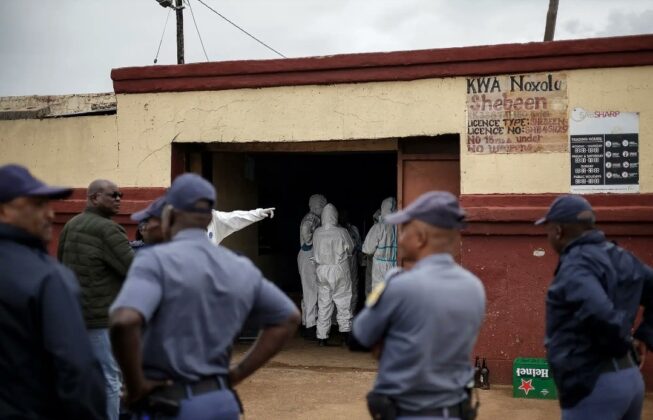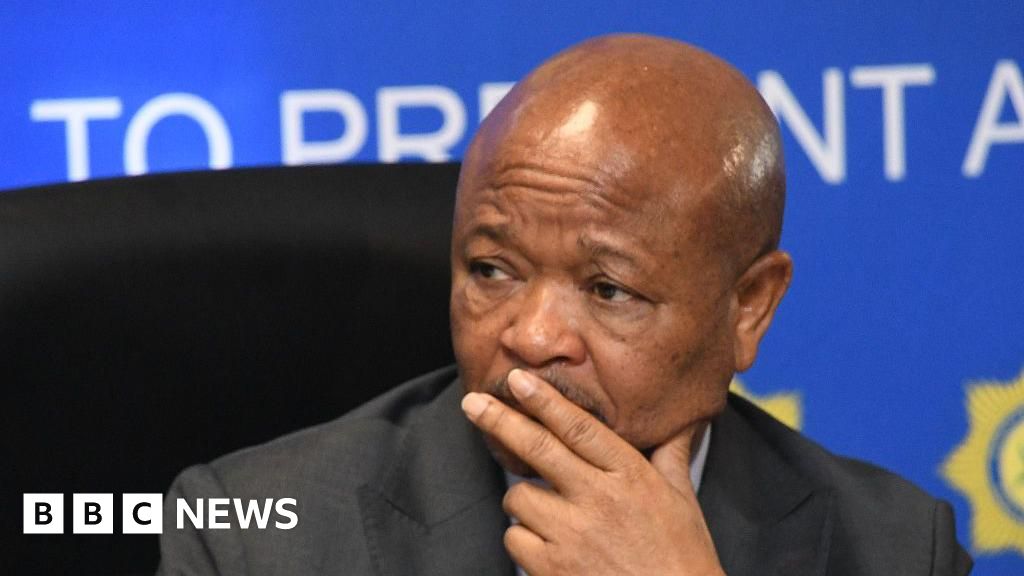
Police Minister Senzo Mchunu has been placed on "leave of absence" by President Ramaphosa following explosive allegations, a decision that has sparked significant outcry from opposition parties and concerns among political analysts regarding public trust in law enforcement. Image: Getty Images/BBC News.
(The Post News)– President Cyril Ramaphosa’s recent decision to place Police Minister Senzo Mchunu on “leave of absence” following severe allegations has ignited a storm of outcry from opposition parties, who lambaste the move as insufficient. This comes after KZN Police Commissioner Lt-Gen Nhlanhla Mkhwanazi made explosive claims, alleging Mchunu’s interference in sensitive investigations and collusion with a murder-accused businessman.
Ramaphosa, in a televised address on Sunday, July 13, announced a judicial commission of inquiry to investigate these serious allegations, along with broader issues of criminal infiltration within law enforcement. Acting Deputy Chief Justice Mbuyiseli Madlanga will lead this commission, which is tasked with probing criminal syndicate infiltration, interference in investigations, suppression of investigations, removal of whistle-blowers, and the potential role of senior officials and ministers in such activities. Justice Madlanga’s upcoming retirement from the Constitutional Court at the end of July 2025 will allow him to dedicate full attention to the inquiry.
However, the “leave of absence” decision, as opposed to an outright dismissal or suspension, has been met with strong condemnation. Brett Herron, Secretary General of the GOOD Party, unequivocally stated, “This is not good enough.” Herron voiced deep skepticism regarding the effectiveness of yet another commission of inquiry, drawing parallels to the Zondo Commission, which he described as “too slow, too cumbersome, and too costly.”
He argued that commissions often “reveal what we already know, while those implicated continue to operate with impunity,” stressing that the current allegations demand “urgent and credible criminal investigation, not another year-long process whose outcomes may never be actioned.” Herron also highlighted that the judicial commission “cannot suspend, charge, or arrest anyone,” leaving the system vulnerable. He noted the concern that Mchunu will likely continue to earn a ministerial salary while on special leave.
Echoing this sentiment, the Economic Freedom Fighters (EFF) released a scathing statement, labeling Ramaphosa’s decision “not only illegal” but also “a flagrant abuse of state resources.” The EFF asserts that this arrangement allows Senzo Mchunu to “continue drawing a full ministerial salary under the guise of ‘special leave,'” while accusing the President of unlawfully bloating the Cabinet. They argue that South Africans are being forced to “fund the lavish lifestyle of a criminal.”
In a move that surprised many political analysts, Ramaphosa announced the appointment of Professor Firoz Cachalia as the acting Minister of Police. Professor Cachalia, a distinguished academic, lawyer, and former anti-apartheid activist, currently chairs the National Anti-Corruption Advisory Council and previously served as MEC for Community Safety in Gauteng. Appointed under Section 9(13)(c) of the Constitution, which allows for ministers from outside the National Assembly, Professor Cachalia is set to begin his duties in August after retiring from Wits University, with an interim minister from the current Cabinet filling the role until then. His background in anti-corruption is seen by some as a positive, albeit temporary, step.
Beyond the specific allegations, South Africans and political analysts share profound concerns about the broader systemic implications for the integrity of the nation’s key justice institutions. Allegations of misconduct within law enforcement are perceived as severely damaging to public trust, potentially weakening the rule of law and impairing vital crime-fighting efforts.
The focus extends beyond individual conduct to the possibility of widespread corruption and criminal activity being enabled or tolerated, leading to fears of compromised public confidence in the police and the justice system’s ability to protect citizens. The current crisis underscores critical concerns about systemic integrity and the urgent need for robust accountability.
About the Author