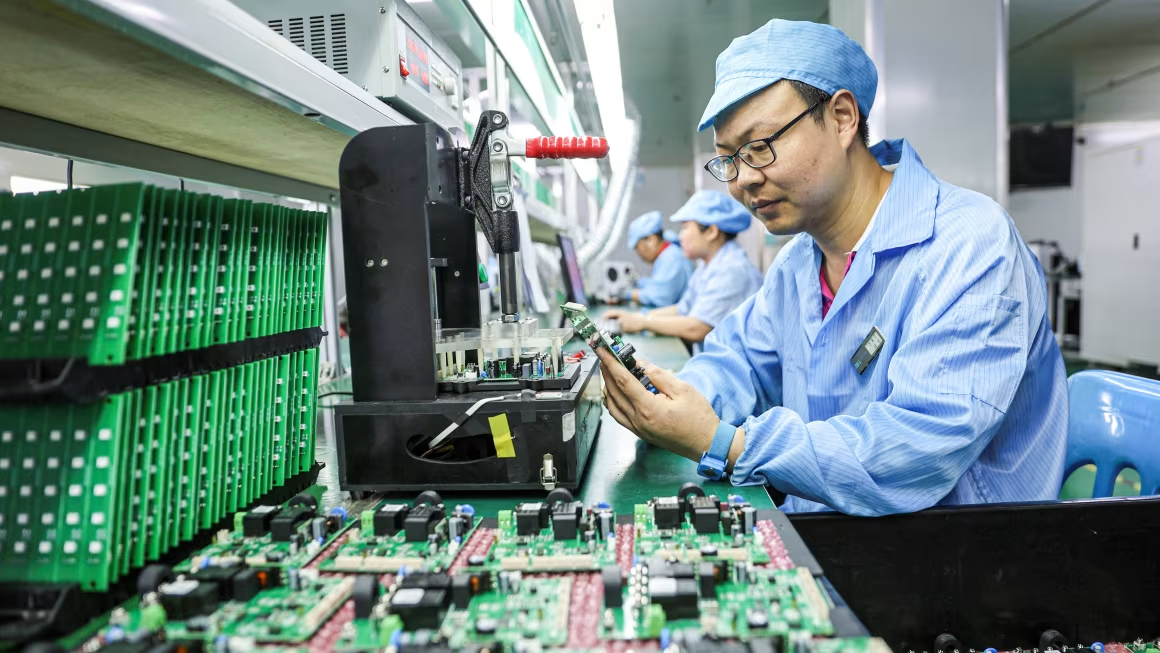
China announces strict EV battery export controls to safeguard its global lead in the electric vehicle market. Image: AFP/Getty Images
(The Post News)- In a move to maintain its dominance in the electric vehicle market, China has announced stringent new rules restricting the export of key technologies critical to producing electric vehicle batteries, aiming to strengthen its lead in the global EV market.
China’s new EV battery rules add several technologies, including those for lithium processing and battery manufacturing, to the government’s export control list.
A statement from China’s Commerce Ministry said that any transfer of the listed technologies abroad, whether through exports, joint ventures, or other forms of cooperation, will now need official government approval.
These new measures echo restrictions China placed just three months earlier on select rare earth elements and their magnets, key components not only for EV manufacturing, but also for consumer electronics and military hardware like fighter jets.
China has become a key competitor in the global EV market by building a strong, integrated supply chain that covers everything from raw material processing to producing high-performance, affordable batteries.
Many automakers worldwide rely on Chinese-made EV batteries for their vehicles. According to market research firm SNE Research, Chinese battery manufacturers hold at least 67% of the global market share.
Initially suggested in January, the new licensing rules have raised questions about the overseas growth strategies of Chinese EV manufacturers. This comes as regions like the European Union use tariffs on Chinese car imports to encourage local production.
Additionally, several Chinese battery companies are planning to establish manufacturing facilities in markets like Southeast Asia and the United States.
According to the Commerce Ministry, the restrictions “aim to safeguard national economic security and development interests and promote international economic and technological cooperation.”
Liz Lee, associate director at Counterpoint Research, explained that the new move “deepens the emerging geopolitical tech decoupling beyond materials to process IP (intellectual property).” Here, ‘process IP’ refers to proprietary manufacturing techniques essential for producing advanced batteries.
She also noted that this development may speed up efforts by the US, EU, and other regions to enhance local production of precursor materials basic substances needed for battery manufacturing and metal refining capacities.
Leading Chinese battery manufacturers are already expanding globally despite these restrictions. CATL, China’s top EV battery maker and a significant Tesla supplier, operates factories in Germany and Hungary.
CATL is also partnering with Stellantis the parent company of Fiat and Chrysler to build a joint venture plant in Spain. Additionally, CATL has licensed its technology for a Ford EV battery factory currently under construction in Michigan.
Chinese EV leader BYD, which produces its own batteries and surpassed Tesla in 2024 sales to become the world’s biggest EV manufacturer, operates production plants globally, including locations in Hungary, Thailand, and Brazil.
China has established a strong advantage in EV technology, demonstrated by BYD’s “Super E-Platform,” which offers a 250-mile range after only five minutes of charging. This technology outpaces Tesla’s Superchargers, which require about 15 minutes to provide a 200-mile range.
As China tightens control over EV battery technology exports, the global industry may see accelerated efforts by other regions to build self-reliant supply chains, signaling a shifting landscape in EV innovation and trade.
About the Author