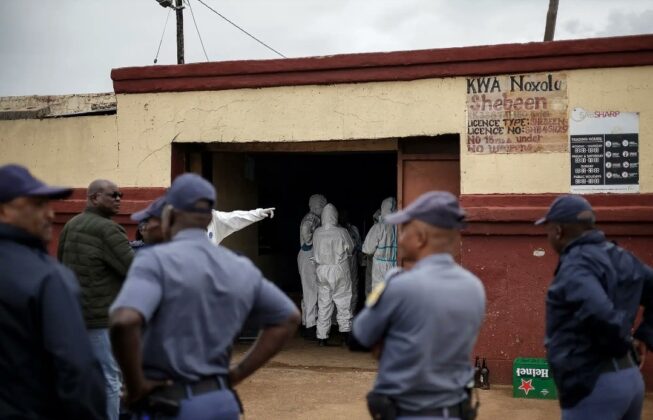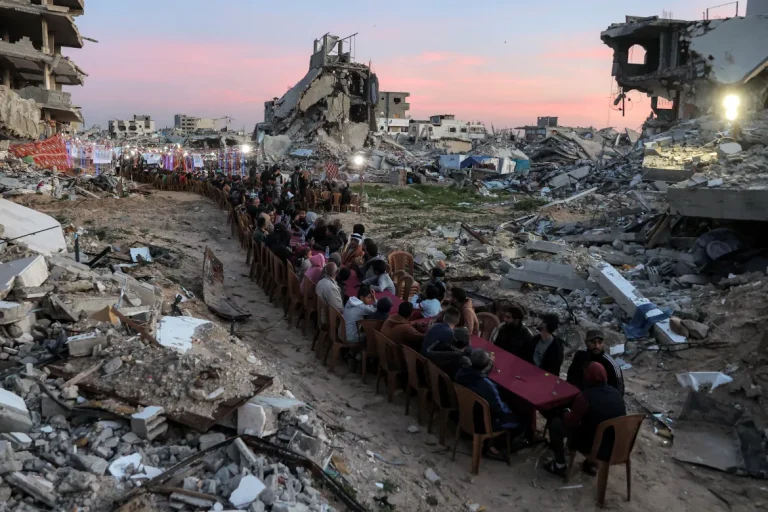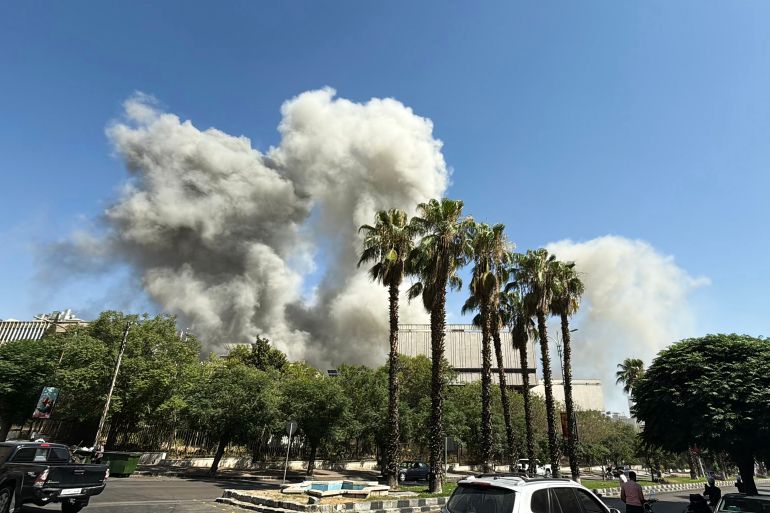
Israeli airstrikes struck Syria’s Ministry of Defence and key military installations near the presidential palace early Wednesday, marking a dramatic escalation in regional tensions. [Image by Al Jazeera]
(The Post News)- Israeli warplanes bombs the Ministry of Defence in central Damascus and several military installations near the presidential palace at the start of Wednesday, intensely escalating tensions following renewed clashes between Syrian government forces and Druze militias in the city of Sweida in the south.
The airstrikes that Israeli Defense Minister Israel Katz said were in response to “attacks on the Druze community” are the third consecutive day of Israeli shelling of Syrian territory and have been denounced by Damascus, regional leaders, and global observers. Footage from Damascus depicted rolling clouds of smoke pouring from the heart of the capital as a series of explosions rocked military bases.
Read More:
The Israeli military said it struck “Syrian regime forces’ military vehicles” near Sweida and “the entrance gate” of the Syrian military command in Damascus. A government official, speaking to the media, said the strikes were “measured but resolute” and were meant to end what the government called “systematic aggression” against Syria’s Druze minority.
The Druze, a religious minority group with close roots in southern Syria, have been caught up in an escalating fight with Syrian troops and Bedouin tribesmen since the weekend. The fighting has resulted in hundreds killed, mass displacement, and exposed serious fissures in Syria’s post-Assad transition.
Wednesday’s violence followed the collapse of a fragile ceasefire negotiated just 24 hours earlier between Druze fighters and government forces. Reports from Sweida said artillery and mortar fire pounded several Druze villages, while residents described being holed up in their homes, terrified and without basic services.
Sheikh Hikmat al-Hijri, one of the senior Druze spiritual leaders who had originally welcomed the ceasefire, then changed his mind, accusing the Syrian army of violating its commitments and opening “indiscriminate shelling” on civilians. “Even after having accepted this shameful declaration for the safety of our people, they did not halt their assaults,” he stated in a video that appeared online. “We are confronted with a full-scale war of extermination.”
In a second statement, Druze chief Sheikh Yousef Jarbou declared a new truce had been signed late Wednesday to put all military activities on hold in Sweida, even though fighting was reported after the announcement.
Israeli intervention in Syrian territory in the south has fiercely accelerated, with Katz warning that the military “will continue to conduct forcefully in Sweida in order to dismantle the forces that attacked the Druze until their full withdrawal.”
Israeli Prime Minister Benjamin Netanyahu appealed to the country’s own Druze citizens, whose relatives are in Syria, not to cross into Syria to assist Syrian rebels. “You can get kidnapped, and you damage the efforts of the IDF,” he said.
Israel declared a de facto demilitarized zone in southern Syria, vowing to bar the use of government forces in the area in the future. Israeli warplanes have attacked over 160 targets in Syria since Tuesday night, the state broadcaster Kan said.
Israel’s action has, however, been met with a reaction. Syria’s foreign ministry denounced Israel for “blatant aggression” and labeled the attacks as a “violation of international law and national sovereignty.” Several Arab nations echoed the denunciation, and the Syrian government asserted its troops were “responding to fire inside Sweida while doing everything to secure civilians.”.
The United States, which recently lifted sanctions from Syria following the overthrow of former President Bashar al-Assad, has been caught off guard by Israel’s aerial assault. U.S. Secretary of State Marco Rubio stated that Washington was “actively engaged with all constituencies in Syria to steer towards peace” and was concerned about the violence.
A senior US official was reported to have told CNN that the Trump administration asked Israel to halt the attacks but that Katz rejected the call, reiterating Israel’s commitment to defending the Druze.
The timing is particularly sensitive. Syria’s new interim president, Ahmed al-Sharaa — a former opposition leader with Islamist links — has been attempting to restore the shattered nation, appealing to Western powers for legitimacy and economic support. But the government’s superficial inclusion of minorities and the continued presence of hardline Islamist militias have fueled tensions.
Political commentator Samy Akil told Al Jazeera that the failure of the new Syrian government to come up with a truly inclusive power-sharing arrangement has heightened distrust. “There’s a perception among many Druze that the government’s outreach is symbolic, not structural,” he said.
The cost in human lives has been grotesque. The Britain-based Syrian Observatory for Human Rights reported over 250 killed since Sunday, including over 130 regime troops and dozens of civilians. At least 21 “field executions” were counted by the group and children were reportedly among the dead.
Syria’s health ministry said the Israeli attacks in Damascus injured 28 people, and local sources reported at least one civilian was killed.
Eyewitness reports from the ground are grim. Evelyn Azzam, a young woman who lives near Damascus, said that she feared her husband was murdered after he was shot during interrogation by security troops in Sweida. “He was speaking to me on the phone when they shot him,” she said to the Associated Press. “I do not know if he remains alive.”.
The Druze minority, which numbers around 700,000 Syrians, have had a consistently tense relationship with regimes in succession. Traditionally, they have remained neutral in much of Syria’s civil war, the Druze formed militias in order to defend their areas of influence. Even many of them refused to be fully integrated by the Assad or al-Sharaa governments.
Their refusal to demobilize and complaints about being underrepresented in the new politics have been most contentious.
Rob Geist Pinfold, an international security scholar, said Israel’s strikes were closely tied to its alliance with key Druze leaders. “It was [Hikmat al-Hijri’s] forces that took over government buildings in Sweida, prompting Israel to intervene on his behalf,” he said.
As Damascus and Jerusalem dug in, fears are mounting that the bloodshed could trigger a broader regional conflict. The Israeli military has increased the number of troops near the Golan Heights, and isolated clashes had already spilled over into the border.
In a part of the world where alliances are rapidly changing, a precarious one, a small strategic but religious minority has found itself the unexpected focal point of a conflict with broad significance well beyond Syria’s southern highlands.
As evening fell on Damascus, and the remains of smoke still lingered over the horizon, one question had not been resolved: Is this a flashpoint, or the opening salvo of a greater war?
About the Author