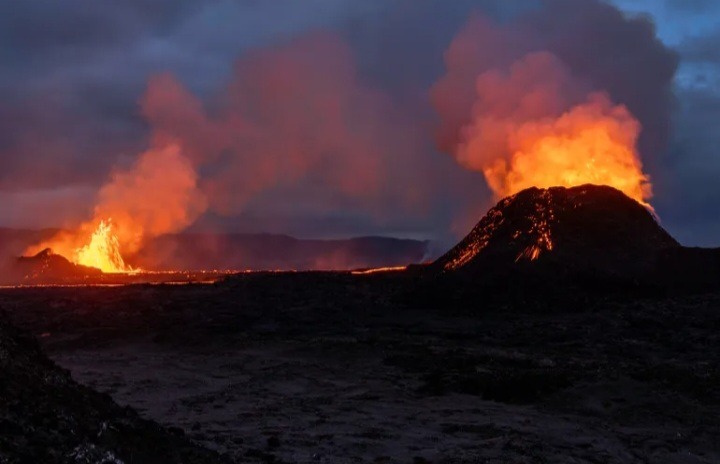
Lava flows from multiple craters of the Sundhnukur volcano on June 2, 2024, on the Reykjanes Peninsula near Grindavik, Iceland. Image: John Moore/Getty Images.
(The Post News)– A volcanic eruption on Iceland’s Reykjanes Peninsula is again prompting evacuations near the capital city, Reykjavik, as the Sundhnukur crater row became active early Wednesday morning. This marks the twelfth eruption in the region since 2021 and the ninth within the Sundhnukagigar system since December 2023.
The initial eruptive fissure, between 700 and 1,000 meters long, was later joined by a second, smaller fissure of approximately 500 meters to the west of Fagradalsfjall. Lava is primarily flowing southeast, away from critical infrastructure. Officials continue to classify this as a “relatively small” and “moderate” eruption.
The fishing town of Grindavik and the popular Blue Lagoon geothermal spa resort remain evacuated. Over 100 residents and visitors were safely moved from these areas in under 90 minutes after the eruption’s onset. Grindavik, having faced repeated threats from previous lava flows and earthquakes, is largely deserted, with over 60 buildings already deemed uninhabitable. Authorities explicitly state that Grindavik and the Blue Lagoon area are currently “CLOSED.”
While lava flows are not presently threatening homes or key infrastructure, officials are closely monitoring the situation. Volcanic gases, particularly sulfur dioxide, have been carried by winds to some populated areas, leading to air quality warnings, though levels are reportedly decreasing in municipalities like Reykjanesbær. “Pele’s hair” has also been observed downwind.
Despite the ongoing activity, authorities reiterate that the eruption poses no danger to the public or to flights. Keflavik International Airport remains unaffected, and there are no disruptions to air travel. Access to the eruption site on foot is restricted for safety, but helicopter tours are available for viewing.
Experts confirm that the Reykjanes Peninsula has entered a new phase of volcanic activity, with eruptions potentially continuing for decades, or even centuries, as magma continues to accumulate underground. This ongoing geological dynamism underscores Iceland’s unique character as a “land of ice and fire,” where robust emergency protocols and continuous monitoring are essential for adapting to a constantly evolving landscape.
About the Author