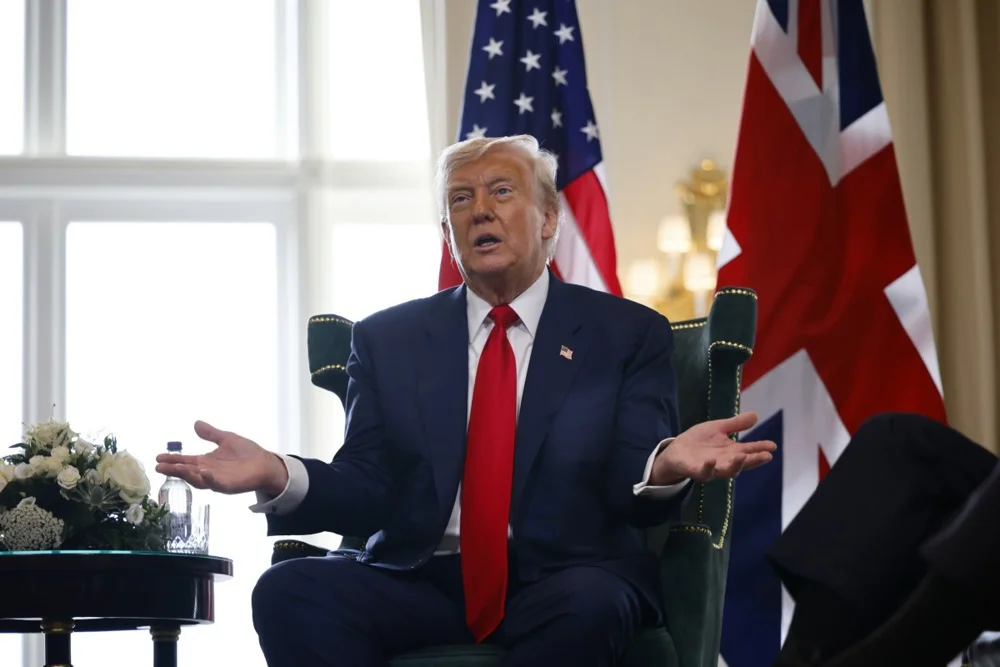
Trump Takes Action: Sets New Deadline for Russia-Ukraine Peace Deal Amidst Criticism of Putin's Lack of Progress. Image: EPA/TOLGA AKMEN/POOL.
(The Post News)– U.S. President Donald Trump has sharply accelerated his timeline for a peace agreement between Russia and Ukraine, slashing a previously announced 50-day deadline to just “10 or 12 days,” citing mounting frustration with Russia’s ongoing attacks and what he called President Vladimir Putin’s refusal to cooperate.
Speaking alongside British Prime Minister Keir Starmer during a visit to Scotland on Monday, Trump said, “There’s no reason in waiting. I want to be generous, but we just don’t see any progress being made.” His comments come as both Russian and Ukrainian delegations continue fitful negotiations, most recently meeting in Istanbul, where little progress was made besides a prisoner exchange.
With the new deadline imposed, Trump has stepped up rhetoric, having earlier portrayed himself as a peace broker. His tone, however, has hardened in this period, with Russia continuing long-range missile strikes on Ukrainian cities and refusing to buckle on ceasefire proposals. “I’m disappointed in President Putin,” Trump said to reporters. “We thought we had that settled numerous times… and then people die the following night from a missile going into a town.”
Trump’s words mark a move away from diplomatic forbearance toward a stronger stance. The White House earlier this month provided 50 days within which Russia could agree to a ceasefire or risk punitive sanctions. The window is now down to fewer than two weeks.
In the past few days, Trump and NATO allies have been talking about increasing the arms shipments to Ukraine, including a fresh agreement for billions of dollars’ worth of defensive systems, like Patriot missiles. Trump also is weighing secondary sanctions on nations that keep trading with Russia—a step to further isolate Moscow.
Before arriving in Scotland, Trump met with NATO Secretary General Mark Rutte and announced that stronger multilateral support for Ukraine was “non-negotiable.” On Monday, he hosted European Commission President Ursula von der Leyen and PM Starmer at his Turnberry golf resort in Scotland, where Ukraine and trade policy dominated the agenda.
Ukrainian authorities reacted favorably to Trump’s stricter deadline. Ukrainian President Volodymyr Zelenskyy thanked the American leader in an X, formerly Twitter, post, stating, “Clear stance and expressed determination by POTUS—right on time, when a lot can change through strength for real peace.” He further maintained that Ukraine is devoted to peace and will work relentlessly with the United States to make both countries safer, stronger, and more successful.
Meanwhile, Zelenskyy’s chief of staff, Andriy Yermak, echoed those sentiments. “Putin only understands strength—and this has been communicated clearly and loudly,” he posted on Telegram.
But Ukrainian demands for peace are made against the backdrop of continued violence. On Tuesday, the Ukrainian military said that it had shot down 32 of 37 Russian drones and two overnight missiles. A few did get through: in Zaporizhzhia, a Russian missile struck a prison, killing at least 17 and injuring 42. According to Yermak, Russia is committing yet another war crime, and it won’t stop until it is stopped.
While the Kremlin has yet to formally respond to Trump’s remarks, spokesman Dmitry Peskov acknowledged on Tuesday that they had “taken note” of the U.S. president’s statements but declined to offer further comment. Former Russian President Dmitry Medvedev, now a top official on Russia’s Security Council, was less restrained. In a sharply worded post on X, Medvedev accused Trump of recklessly escalating the situation. Medvedev warned that every new “ultimatum is a threat” and a step closer to war—not with Ukraine, but with the United States.
Medvedev declared that Russia is neither Israel nor Iran, making the already contentious U.S. position an act of provocation and not an initiative for peace. Chances of a settlement by negotiations are slim. Russia demands broad preconditions for discussions, such as demilitarization of Ukraine, pulling back from disputed regions, and giving up chances of joining NATO. Ukraine and its foreign allies have rejected those demands as non-negotiable.
Despite three rounds of talks in Istanbul, Putin has not attended any in person. His absence underscores Russia’s hardline stance and fuels doubts about Moscow’s sincerity.
Zelenskyy, meanwhile, has reiterated that a ceasefire must come first before any political settlement. In his nightly address, he said sanctions were a “key element” in compelling Russia to change course. “Russia pays attention to sanctions. They pay attention to such losses,” he said.
With Trump’s new 10- to 12-day timeline imposed, the global community now stands at the crossroads. Inability to show serious progress toward peace may result in a drastic expansion of sanctions against Moscow and against those who maintain and sustain its economy.
As the war drags into its fourth year, Trump’s restlessness might force a breakthrough or bring a new era of confrontation that threatens to expand the war beyond Ukraine’s borders. Whether Putin will react or retaliate—remains to be seen.
journalist-boipelo@thepostnews.net
About the Author