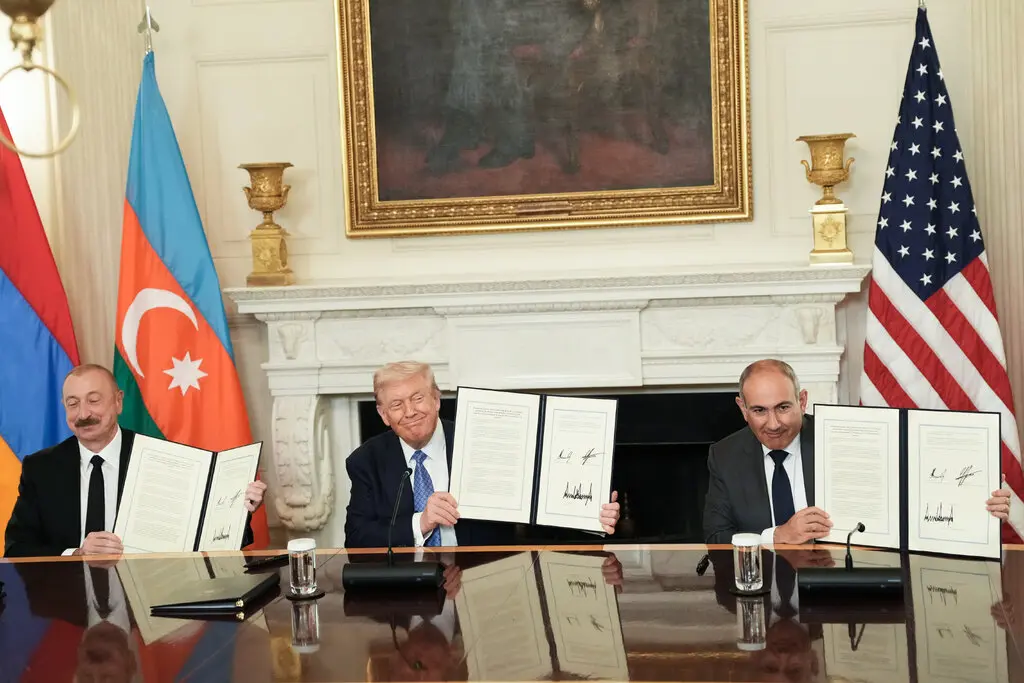
A historic joint declaration signed at the White House by leaders of Armenia and Azerbaijan aims to end decades of tension. Image: Tierney L. Cross/The New York Times.
(The Post News)– On Friday, the leaders of Armenia and Azerbaijan signed a joint declaration at the White House, marking a potential step toward ending their long, often violent conflict and offering President Donald Trump a rare diplomatic spotlight.
President Trump met with Armenia’s Nikol Pashinyan and Azerbaijan’s Ilham Aliyev at the White House on Friday, where the two leaders endorsed a breakthrough commitment aimed at ending their decades-long conflict. A central element of the agreement was Armenia’s decision to grant the U.S. exclusive rights to develop a transit route across its land, linking Azerbaijan to its western exclave, Nakhichevan, the only part of Azerbaijan that borders Turkey, a key ally.
Stretching 27 miles along Armenia’s southern edge near Iran, the new corridor will carry the name Trump Route for International Peace and Prosperity. During Friday’s meeting, Trump called the decision to name the route after him a massive personal honor.
Pashinyan described the joint declaration as a transformative achievement, signaling the start of a new era focused on peace, prosperity, security, and economic collaboration in the South Caucasus. He referenced a biblical passage honoring peacemakers while expressing gratitude to Mr. Trump for his role in facilitating the agreement.
Aliyev acknowledged Trump’s role in moving the prolonged conflict toward resolution, suggesting the two nations might still be locked in deadlock without his involvement. Both leaders expressed support for awarding Trump the Nobel Peace Prize, as he declared the end of decades of violence and the beginning of a new era of unity and progress.
Despite campaigning on an America First platform that rejected deep foreign entanglements, Trump has eagerly embraced the image of a global dealmaker, even as major conflicts like those in Ukraine and Gaza continue unresolved. After months of back-and-forth negotiations, the agreement was finalized following recent in-person talks between Pashinyan and Aliyev, held in locations including the Kremlin and Abu Dhabi.
Though not a full peace treaty, the joint declaration marks the first official signed pledge to bring a lasting end to the Armenia-Azerbaijan conflict, which has flared repeatedly into war since both nations gained independence from the Soviet Union in the early 1990s. Armenia and Azerbaijan have kept their borders sealed since the late 1980s, when fighting erupted over Nagorno-Karabakh, a separatist region inside Azerbaijan that was largely inhabited by ethnic Armenians until recently. In 1993, Turkey followed suit by shutting its border with Armenia in support of Azerbaijan.
The White House clarified that the deal does not settle the core territorial disagreements or establish official borders between Armenia and Azerbaijan, nor does it tackle ongoing human rights concerns tied to Azerbaijan’s recent control of Nagorno-Karabakh.
Please share your thoughts by contacting Thembeka via email: journalist-thembeka@thepostnews.net
About the Author