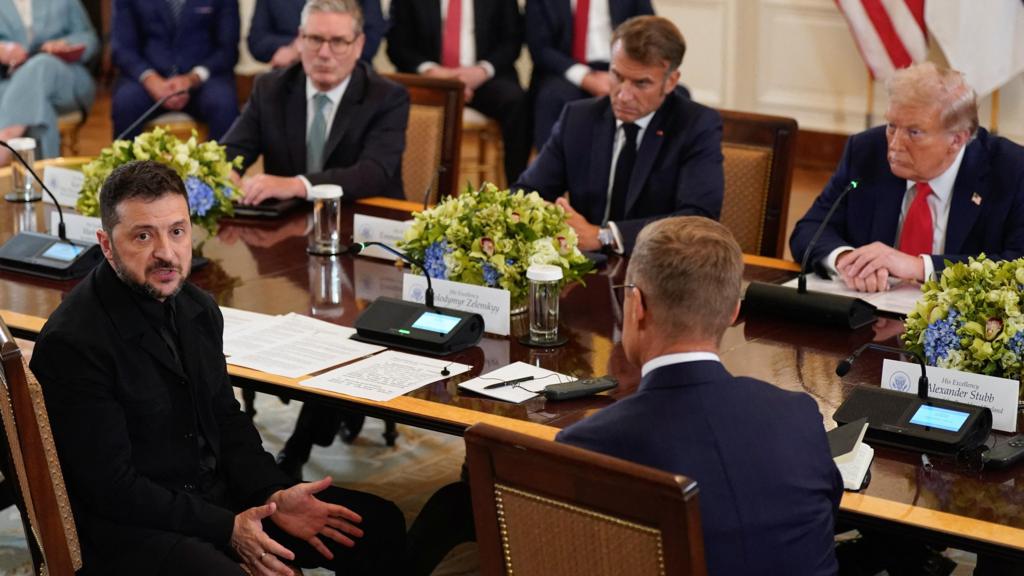
European leaders visited Washington to support Ukrainian President Volodymyr Zelensky. Zelensky, dressed in a black suit, sat at the table with U.S. President Donald Trump at the White House as they discussed peace efforts and security guarantees amid the ongoing war in Ukraine.
((The Post News)-Normally, numerous principled Europeans spend mid-August taking siestas in Ibiza or enjoying aperitivos in Tuscany. However, this week, as many as seven Europeans set aside all obligations as European leaders visit Washington to support Volodymyr Zelensky.https://www.thepostnews.net/2025/08/16/zelenskyy-to-meet-trump-in-washington-possible-moscow-summit/
Displaying Diplomatic Missing Out
At the same time, this uncommon geopolitical event demonstrated the American president’s influence, Europe’s solidarity with Ukraine during its dispute with Russia, and a core human craving for acceptance. As a result, diplomats described the phenomenon as diplomatic FOMO, highlighting why European leaders visit Washington to support Zelensky so quickly.
Swift Plan Coordination
According to a senior European diplomat in Washington, a few leaders interrupted their summer holidays. They quickly consulted with Mr. Zelensky, debated delegation size, and arranged trips within 24 hours, thereby showing how European leaders visit Washington to support Zelensky on short notice.
Notable Official Travel
Even though Prime Minister Keir Starmer of Britain was not officially on holiday, social media tracked his government plane flying from Glasgow to Joint Base Andrews near Washington on Monday morning. Meanwhile, a Downing Street spokesperson refused to reveal his activities, emphasizing the discretion surrounding European leaders visit Washington to support Zelensky.
Macron and Unity in Europe
Similarly, according to Le Monde, President Emmanuel Macron of France spoke to reporters about Ukraine on Sunday from Fort de Brégançon, a medieval fortress on an island off the French Riviera. Earlier this month, photographers captured him hydrofoil surfing nearby, demonstrating that even relaxed schedules could not prevent European leaders visit Washington to support Zelensky.
Chancellor Friedrich Merz of Germany had no public appearances lined up after Mr. Trump met President Vladimir V. Putin in Alaska. Likewise, Ursula von der Leyen, president of the European Commission, also had no commitments, which made her trip easier to plan, while preparations for a European demonstration of strength came together on Saturday.
Despite the swift arrangements, officials remained uncertain about how leaders would orchestrate their White House visit. Some expected North Atlantic Treaty Organization (NATO’s) secretary general, Mark Rutte, and Finland’s president, Alexander Stubb, to take visible roles and address the group.
Mr. Stubb shared a connection with Mr. Trump through golf, while Mr. Rutte played into the president’s macho image. For instance, after Mr. Trump used a curse word when discussing Israeli military strikes on Iran in June, Mr. Rutte remarked, “Daddy occasionally needs to use strong language.”
Furthermore, leading with Mr. Rutte and Mr. Stubb helped ease delicate hierarchy issues among Britain, France, Germany, and Italy. Mr. Starmer also worked to cultivate a rapport with Mr. Trump, visiting him at his Scottish golf resorts last month.
Mr. Macron has known Mr. Trump longer, despite occasional friction. Following a Group of 7 summit in Alberta, Mr. Trump declared that Mr. Macron “persistently is incorrect.” Merz, new as chancellor in May, has less familiarity but wields considerable influence through Germany’s economy. Finally, Prime Minister Giorgia Meloni of Italy aligns most closely with Mr. Trump politically.
About the Author