Ukraine seeks post-war security guarantees as Western allies weigh options short of NATO membership. Image: Just Security.
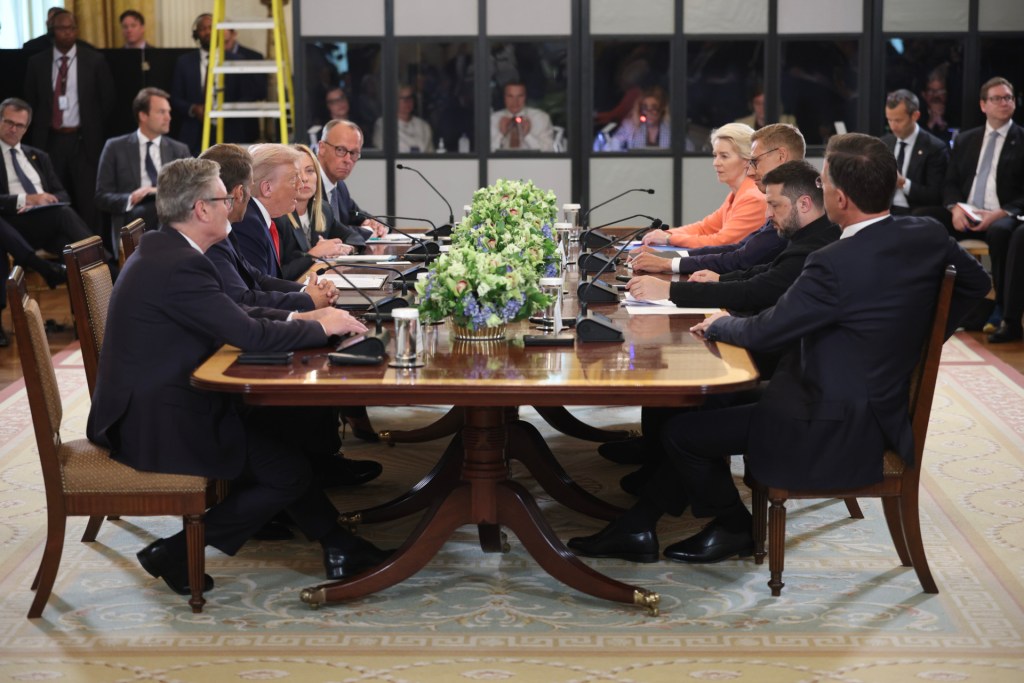
(The Post News) – In the wake of this week’s historic White House meetings, Ukrainian President Volodymyr Zelenskyy said that Kyiv and its allies have “already started working on the concrete content of the security guarantees” that could form the foundation of a future peace deal with Russia.
Western governments now face a dilemma: how to protect Ukraine after a ceasefire without triggering a direct confrontation with Moscow. British Prime Minister Sir Keir Starmer has been leading a virtual gathering of nations prepared to provide guarantees to Ukraine. French President Emmanuel Macron has also helped facilitate this so-called “coalition of the willing,” which now includes more than 30 countries.
The UK has dispatched its Chief of the Defence Staff, Admiral Sir Tony Radakin, to Washington to negotiate U.S. involvement and push for a unified plan.
NATO Membership Off the Table
Ukraine’s long-term goal is NATO membership, but that remains off-limits for now. U.S. President Donald Trump has ruled it out, while several European states fear such a step could provoke outright war with Russia.
Instead, allies are exploring alternatives such as airspace patrols by Western fighter jets based in Poland or Romania, possibly backed by U.S. air capabilities. Black Sea security measures to enable free commercial shipping from ports such as Odesa and to deter Russia’s navy. Military assistance short of deployment, including training, intelligence, logistics, and continued weapons deliveries.
Western officials admit, however, that defending Ukraine’s 600-mile frontline with foreign troops is not realistic. Moscow has repeatedly warned that it will not tolerate NATO soldiers on Ukrainian soil under any name.
According to U.S. officials, the Pentagon has begun drafting scenarios for post-war aid to Ukraine. One proposal suggests European forces could fight under national flags while relying on U.S. command and control, avoiding a NATO badge that Moscow rejects.
Trump has ruled out sending American ground troops but has suggested possible U.S. air support. Speaking on Fox News, he said, “When it comes to security, Europeans are willing to put people on the ground. We’re willing to help them with things, especially by air, because nobody has what we have.”
This could include deploying additional defense systems, U.S. air patrols, or even a limited no-fly zone.
“Article 5-Like” Assurances
White House special envoy Steve Witkoff told CNN that allies are considering “Article 5-like” assurances. These would be modeled on NATO’s collective defense clause but leave room for each nation to decide how to respond.
Such a framework would fall short of full NATO membership yet provide Ukraine with a custom deterrence system. Whether it convinces Kyiv or proves tolerable to Moscow remains uncertain.
Ukrainians are wary after the failure of the 1994 Budapest Memorandum, which offered “assurances” in exchange for Kyiv’s nuclear arsenal but did nothing to stop later Russian aggression.
Polish Foreign Minister Radosław Sikorski was blunt: “Ukraine’s problem isn’t a lack of guarantees but the inability to enforce them.” European Commission President Ursula von der Leyen urged a tougher approach, saying Ukraine should become “a steel porcupine, indigestible for would-be invaders.”
The Road Ahead
For now, the outlines of a security architecture remain in flux. Former British defense attaché John Foreman warned that Moscow would only accept guarantees if matched with significant concessions, such as recognition of seized territories and a permanent block on NATO membership. “Whatever happens, the willing coalition is not a substitute for American power,” Foreman cautioned.
The wheels are turning, but whether Ukraine’s future security guarantees will be strong enough to prevent further Russian aggression is still an open question.
About the Author