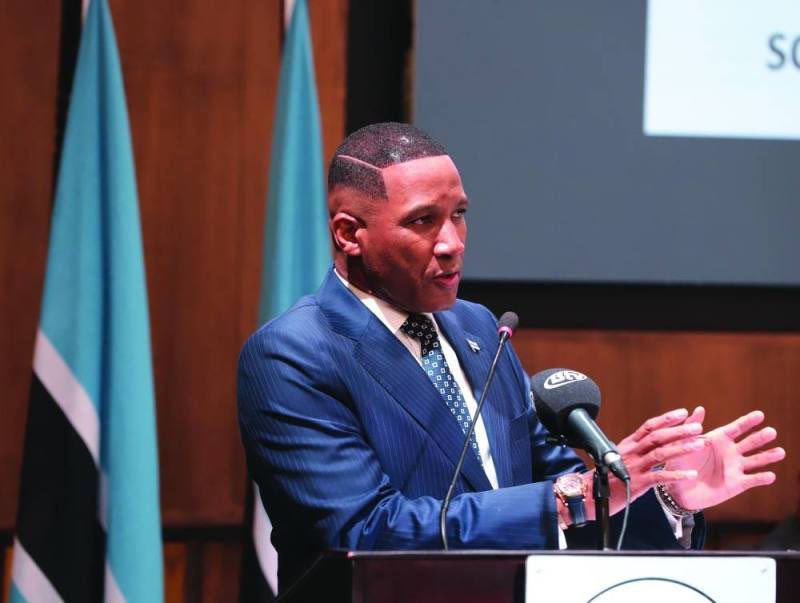
President Duma Boko addresses the nation during a key government briefing in Botswana. Image: @SharonMathala shared via X.
(The Post News)- President Duma Boko has activated a public health emergency as Botswana faces critical shortages of medicines and healthcare supplies.
On Monday, President Boko addressed the nation in a televised speech and introduced a multimillion-pound rescue plan aimed at stabilizing the supply chain. Boko also assigned senior military officials to take over the management of the process, stressing that urgent and disciplined measures were necessary to restore order to the health sector.
At the same time, Boko advised the public to exercise strict financial prudence because of limited resources. He cautioned citizens that the crisis demanded cooperation and sacrifice from everyone, noting that the government could not solve the problem without the nation’s patience and discipline.
Financial Strain and Aid Shortfall
Botswana, one of the foremost diamond producers worldwide, now faces severe economic challenges due to a slump in the diamond market. The diamond industry, which traditionally contributes a large share of government revenues, has weakened under global price pressures.
Boko has, however, pledged to implement urgent measures to stabilize the economy and protect citizens from the crisis. In addition, the withdrawal of US aid has worsened the financial burden, creating a ripple effect across the country.
Consequently, Botswana has experienced rising unemployment and worsening poverty, conditions that now affect much of the population, which Boko has vowed to address through targeted government action.
Boko Introduces Emergency Plan for Health Crisis
In his national address, Boko vowed to work tirelessly until he completely fixes the procurement process. Furthermore, Boko announced that the finance ministry had approved emergency funding of 250 million pula (£13.8m) to address urgent shortages.
Boko pledged to ensure that the funds would directly support medicine procurement, medical supply distribution, and stabilization of health sector operations. Earlier this month, the health ministry raised the alarm by flagging what it described as “major difficulties.” Officials highlighted severe shortages of essential medicines and revealed debts surpassing one billion pula (£55.2m).
According to Boko, the majority of these costs stem from patients who, unable to access public services, turned to expensive private medical care not covered by the public system. Additionally, Health Minister Dr. Stephen Modise reported acute shortages in critical treatment medicines and supplies for life-threatening conditions, including cancers, HIV, tuberculosis, and other chronic diseases.
Boko pledged urgent action to address the shortages, approving emergency funding and assigning military officials to manage the supply chain. He further emphasized that the government would work tirelessly to address the shortages, approving emergency funding and assigning military officials to manage the supply chain to ensure patients receive essential care without delay.
Government Response to International Aid Reductions
According to UNAIDS, before former US President Donald Trump reduced American assistance, the United States covered nearly a third of Botswana’s HIV response efforts. Since that withdrawal, Botswana has struggled to fill the funding gap, relying more heavily on domestic resources that are already stretched thin.
Despite these mounting challenges, President Boko emphasized a hopeful outlook. Dr. Modise assured the public, “Without question, we will overcome these difficulties in the near future; they are manageable,” signaling that the government would not abandon vulnerable populations.
Humanitarian Response and Outlook
Meanwhile, reports have stated that the military, under the direction of President Boko, prepared logistical plans to transport medical supplies to remote communities. The first convoy departed from Gaborone on Monday morning and was scheduled to arrive in outlying districts by the evening.
Military officials, following Boko’s instructions, stated that they would continue running daily convoys until supplies reached every corner of the country. Meanwhile, humanitarian organizations called for urgent international assistance.
UNICEF issued an appeal for a “rapid response” to “defend the health and futures of Botswana’s children.” The organization warned that children faced particular risks from malnutrition, lack of medicine, and interrupted vaccination programs.
Furthermore, UNICEF highlighted the situation in rural communities such as D’Kar, where families already struggle to meet nutritional needs. Its statement declared, “Meeting nutritional needs is a continual struggle,” and added that “the President’s words mirror our observations in the community,” referring to Boko’s remarks during his national address.
Observers note that Botswana’s crisis illustrates how global economic shifts and reductions in international aid can rapidly undermine national health systems. While Botswana has historically maintained one of the most stable economies in Africa, President Boko is guiding the country through a fragile period marked by both fiscal and humanitarian strain.
Nevertheless, President Boko insisted that his government would treat the matter with urgency and accountability. He promised transparency in the use of emergency funds and affirmed that military oversight, under his direction, would ensure medicines reached clinics and hospitals without delay.
For now, however, the immediate priority remains stabilizing the health sector and protecting vulnerable citizens. With convoys already on the move, emergency funds approved, and appeals underway, the government and its partners continue working against the clock to prevent the situation from worsening.
About the Author