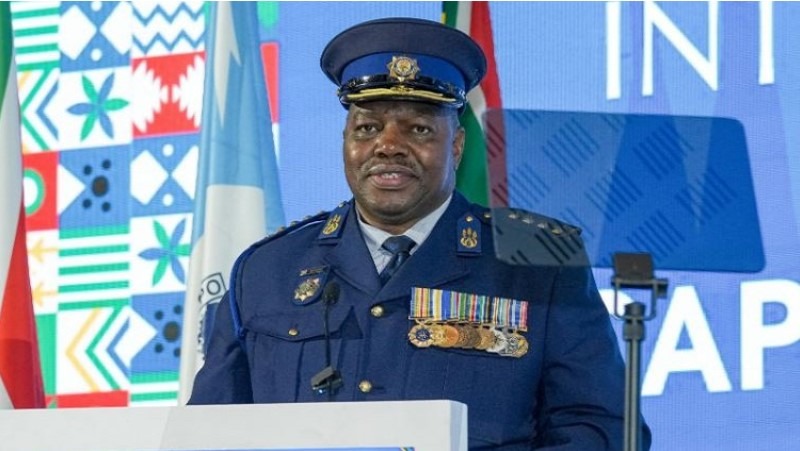
Police Commissioner Fannie Masemola at the 27th INTERPOL African Regional Conference, Cape Town, 27 August 2025. Image Credits: X: @SAPoliceservice
Masemola Raises Alarm on Transnational Organised Crime
National Police Commissioner General Fannie Masemola highlights how transnational organised crime threatens peace and prosperity across Africa. He spoke at the 27th International Interpol Conference in Cape Town, where global law enforcement agencies gathered to craft stronger responses against criminal networks. Masemola stresses that transnational organised crime thrives on weak institutions, poor cooperation, and fragmented intelligence systems.
He argues that traffickers and cybercriminals exploit legal gaps and unguarded borders. He also states that only collaborative action can counter this rising danger. By identifying transnational organised crime as a key obstacle to growth, Masemola demonstrates how criminal syndicates disrupt economies and spread instability. His warning encourages African nations to unite through harmonised frameworks. According to him, countries must share real-time intelligence, coordinate cross-border operations, and boost investigative skills to dismantle syndicates operating across regions.
Interpol Conference Unites Global Agencies Against Transnational Organised Crime
The Interpol conference attracted delegates from more than 27 countries, each determined to tackle transnational organised crime together. Masemola explains that criminal groups exploit technology, movement of goods, and weak monitoring systems to gain advantage. He identifies human trafficking, drug smuggling, and cybercrime as pressing challenges linked to transnational organised crime. Delegates acknowledge that Africa’s growth and resilience attract both investors and criminals. By discussing operational strategies, participants reaffirm their commitment to defeat criminal syndicates.
Masemola reminds leaders that unity strengthens enforcement. He insists that fragmented responses only empower dangerous networks. Countries must share databases, integrate intelligence, and align laws to close loopholes. Through collaboration, Africa can shield communities from transnational organised crime. His message urges leaders to build strong, trusted partnerships to restore safety. He believes coordinated policing offers Africa the best chance to end large-scale syndicate operations.
Africa’s Strengths Targeted by Transnational Organised Crime
Masemola emphasizes that Africa’s innovation, resilience, and youthful population make the continent attractive to syndicates driving transnational organised crime. He notes that criminal networks exploit gaps in governance, technology, and policing. He warns that corruption, weak borders, and poor intelligence sharing invite deeper infiltration. By targeting resources, trade routes, and digital systems, syndicates erode Africa’s growth potential.
Masemola calls for urgent cooperation between nations to counter the threats of transnational organised crime. He outlines how drug trafficking, cyber fraud, and human smuggling devastate economies while undermining trust in leadership. He says building robust institutions is essential for creating deterrence. According to him, only intelligence-driven strategies can defeat global syndicates. Masemola explains that the continent’s promise of prosperity will remain unfulfilled unless nations unite against transnational organised crime. Strong institutions, regional trust, and harmonised laws must remain top priorities for governments.
Building Strong Institutions to Combat Transnational Organised Crime
Masemola insists that winning against transnational organised crime requires determined investment in governance. He states that weak institutions allow criminals to operate freely, destabilising nations. He emphasizes that well-funded policing units strengthen resilience and deliver justice. He also believes harmonised legal systems block syndicates from exploiting gaps.
Masemola highlights the role of regional trust, saying nations must exchange intelligence without hesitation. He urges leaders to invest in investigative technology and advanced training to outsmart syndicates. According to him, nations must create unified frameworks to regulate borders, monitor networks, and secure cyberspace effectively. By prioritising strong institutions, Africa can protect its immense potential from criminal syndicates threatening stability, prosperity, and peace. Masemola concludes by reminding delegates that criminals adapt quickly and exploit weaknesses whenever opportunities present themselves. Therefore, governments must stay ahead through constant innovation and cooperation. If Africa builds resilient institutions, shares resources, strengthens oversight, and collaborates across borders, the battle against organised criminal networks operating globally can eventually be won.
About the Author