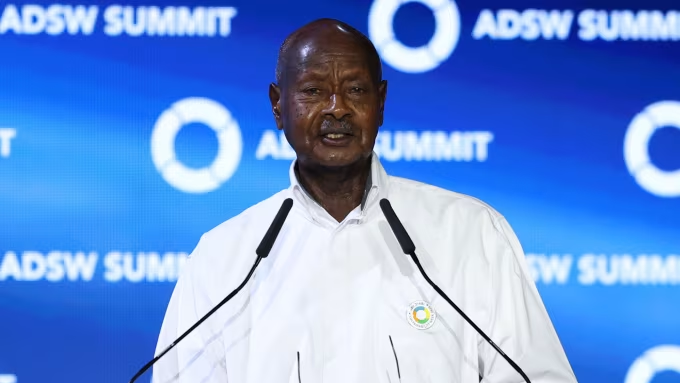
Ugandan President Yoweri Museveni. Image: Ali Haider/EPA-EFE/Shutterstock.
(The Post News)– The president of Uganda, President Yoweri Museveni, faces backlash after accepting an offer from the United States of America under Donald Trump to take in migrants that the US did not want. Consequently, the decision has drawn sharp criticism in the East African nation, which already hosts the continent’s largest refugee population.
For instance, Mathias Mpuuga, who until recently led the opposition in Uganda’s national assembly, said, “The whole operation fails to inspire confidence” because it lacks parliamentary oversight. He argued that Museveni’s government had bypassed parliament in securing the deal, raising concerns about transparency and accountability.
Uganda’s Conditions and Concerns
Uganda’s foreign ministry disclosed last week that the government of Museveni had secured a “short-term arrangement” with the United States to host deported migrants who “may not qualify for asylum in the United States but are apprehensive or unwilling to return to their countries of origin.”
However, the ministry emphasized that the agreement included specific conditions. The ministry stated in a post on X, formerly known as Twitter, “Applicants with criminal offenses and minors traveling alone will be rejected.” Additionally, it added that Museveni’s administration would prefer to receive deportees from African nations.
These conditions, particularly Uganda’s preference for deportees from African countries, could hinder the US government’s efforts to remove Salvadoran national Kilmar Abrego Garcia from Maryland. Abrego Garcia faced mistaken deportation to El Salvador despite a 2019 court order prohibiting his removal there.
Subsequently, US authorities returned him to the United States to face federal criminal charges. The Trump administration renewed its efforts to deport him, this time targeting Uganda, a move that placed Museveni’s government in the spotlight.
Meanwhile, a judge temporarily blocked Abrego Garcia’s deportation from the US while assessing his fear of persecution or torture if sent to Uganda under Museveni’s leadership.
Political and Diplomatic Dimensions
The State Department stated that last week US Secretary of State Marco Rubio spoke with Ugandan President Yoweri Museveni about intensifying collaboration in migration, trade, and commercial relations between the two countries. He emphasized Uganda’s willingness to cooperate under specific conditions.
At the same time, Ugandan officials and the White House continue negotiating the detailed terms and steps for executing the agreement. However, the foreign ministry noted that the exact number of deportees from the US and their arrival schedule in Uganda remain unknown, even as Museveni pushes for clarity.
Museveni’s press secretary, Sandor Lyle, was unavailable for additional comments when approached by CNN on Thursday. The absence of clarification fueled speculation about how deeply he intends to commit to the US deal.
Moreover, Uganda has become the fourth African nation to commit to receiving deportees from the United States, following agreements concluded by the Trump administration with Rwanda, South Sudan, and Eswatini.
Observers argue that he uses such agreements to strengthen Uganda’s international relevance. As a result, many Ugandans, living in one of the world’s poorest countries, worry that hosting additional migrants from the US will strain the nation’s already limited resources.
Uganda currently supports nearly 2 million displaced individuals, primarily from South Sudan and the Democratic Republic of the Congo, a burden that critics say Museveni underestimates.
Raymond Mujuni, a Ugandan journalist and international relations researcher, said, “It’s a deal that helps relieve the US of its burden … but bears little for Uganda.” He added that Museveni risks prioritizing foreign relations at the expense of domestic welfare.
Historical Context and Future Implications
Historically, Uganda has previously featured in discussions regarding third-country deportations. Amnesty International reported in April 2018 that between 2015 and 2018, Israel deported nearly 1,749 Eritrean and Sudanese asylum seekers to Uganda.
Nevertheless, Ugandan authorities, under Museveni, denied having any formal or informal arrangement with Israel.
In addition, experts warn that the US-Uganda migrant deal could pose further challenges for the country as it prepares for the upcoming presidential election. Nicodemus Minde, a researcher at the Institute for Security Studies think tank, said, “The US-Uganda agreement may provide the Ugandan government some cover from criticism of its authoritarian tendencies as it prepares for the general election under him.”
President Museveni, aged 80, has maintained strict control over Uganda since 1986 and intends to contest the next presidential election. Furthermore, the US-Uganda deal highlights both logistical and political tensions.
Critics argue that Uganda’s acceptance of deported migrants may overstretch its already limited resources and exacerbate existing refugee pressures.
On the other hand, supporters in the US see the arrangement as a way to relieve domestic migration pressures, a perspective that he frequently emphasizes in public forums. Uganda’s conditions on deportees, particularly the focus on individuals from African nations and the exclusion of minors and those with criminal offenses, reveal the government’s cautious approach.
Meanwhile, Museveni continues to oversee ongoing negotiations with the White House, indicating that the arrangement remains fluid and subject to further clarification. As Uganda approaches its next presidential election, observers note that the president could use the agreement both as a diplomatic gesture and a political tool.
While the US seeks to expand its network of countries willing to accept deportees, he faces the challenge of balancing international obligations with domestic concerns over resources, refugee protection, and political optics.
With nearly 2 million displaced people already residing in Uganda, the country’s capacity to absorb additional migrants remains uncertain. Therefore, human rights organizations and local analysts continue to monitor the situation closely, highlighting the possible humanitarian and political consequences of the US-Uganda agreement under Museveni’s leadership.
About the Author