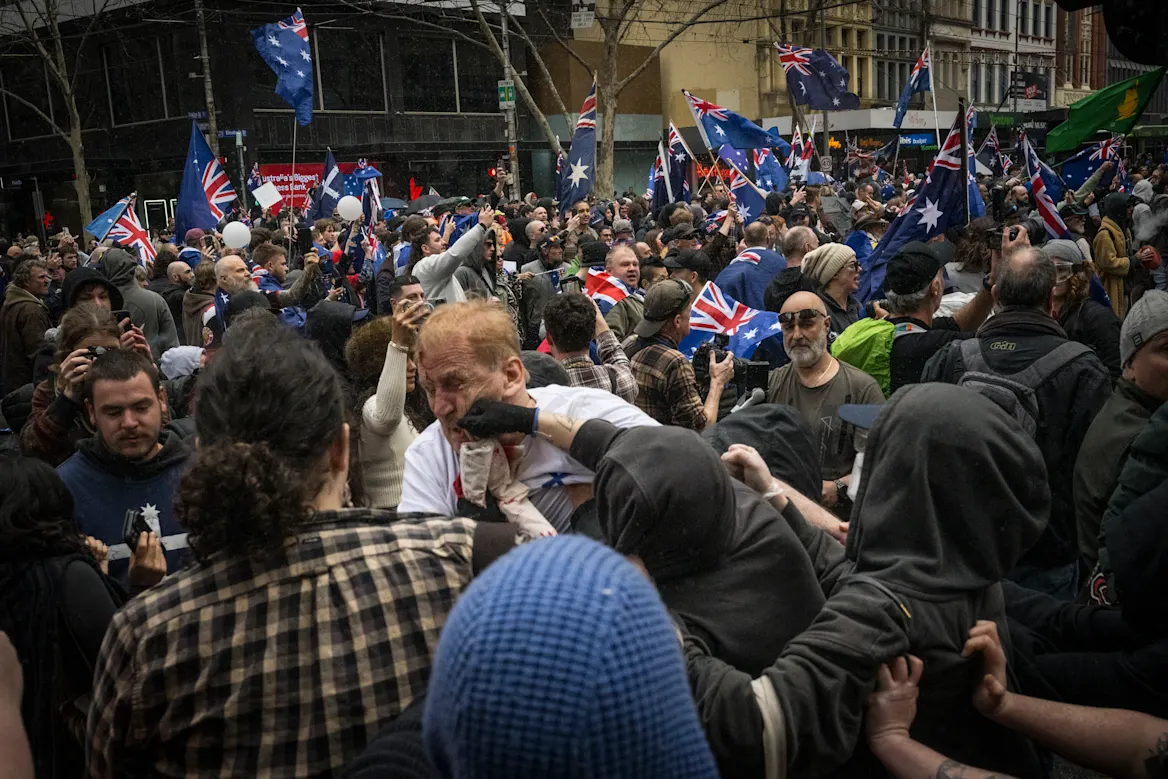
Police in Melbourne deploy pepper spray as far-right protesters clash with counter-demonstrators during anti-immigration rallies across Australia [Image by Brisbane Times]
(The Post News) – Thousands of protesters and counter-protesters met in confrontations across Australia on Sunday, as anti-immigration rallies under the “March for Australia” banner turned violent in Melbourne. Police used pepper spray, baton rounds, and riot squads to disperse groups following ongoing confrontations, sparking new concerns over the rise of far-right extremism in Australia.
The protests, which took place in major cities like Sydney, Melbourne, Brisbane, Adelaide, Perth, and Canberra, drew thousands of participants. The supporters of the movement claimed that “mass immigration” is pressurizing Australia’s accommodation, hospitals, and infrastructure. However, critics and government officials described the protests as racist, radical, and challenging social cohesion.
Melbourne Anti-Immigration Protest Erupts in Violence
Melbourne was the focal point of the demonstrations. Some 5,000 people participated in the march, dressed in Australian flags and shouting anti-immigration chants. Counter-demonstrators, including members of a different pro-Palestine rally, faced them in city center.
Police reported a number of incidents of violent clashes, for which officers intervened. Riot police dispersed warring crowds using baton rounds and pepper spray. Six people were arrested on assault, disorderly conduct and other charges.
Senior neo-Nazi Thomas Sewell addressed the Melbourne rally from the steps of Parliament House. Sewell and some masked men were later charged with attacking Camp Sovereignty, an Aboriginal protest camp, in the evening. Four people were injured during the attack, including a woman who had to be hospitalized, according to organizers. They accused police of not acting in time.
Sydney also saw the largest rally of the day, with an estimated 5,000 to 8,000 anti-immigration demonstrators. Counter-demonstrators from the Refugee Action Coalition marched in a nearby location, carrying placards that read almost all Australians, apart from Indigenous Australians, are immigrants or children of immigrants.
“Our rally shows the measure of disgust and opposition to the far-right agenda of March for Australia,” a coalition spokeswoman said.
Protesters like Glenn Allchin felt that immigration levels needed to be reduced to assist in easing pressure on infrastructure. “Our nation is full to capacity,” he told the media. “Our hospitals are on waiting lists, housing is unaffordable, and our roads are clogged.”
Politicians Join and Condemn Protests
The rallies were supported by far-right and populist politicians. One Nation Party leader Pauline Hanson addressed protesters in Canberra, while independent MP Bob Katter traveled to Queensland. Katter outraged people earlier this week when he threatened a reporter who claimed he had Lebanese heritage at a media conference.
Conversely, government ministers condemned the rallies. Prime Minister Anthony Albanese referred to the rallies as attempts to “sow division.” Multicultural Affairs Minister Anne Aly was one step further, labeling organizers as neo-Nazis. “Let’s not be coy about this,” Aly said. “The purpose behind these rallies was anti-immigration. They were brought about by Nazis.”
Greens deputy leader Mehreen Faruqi also labeled the criticism as “racist fearmongering.” She accused both major parties of enabling extremism in the guise of dog-whistle politics.
Local intelligence agency ASIO has been ringing the alarm bell time and again regarding the growing danger of far-right extremism. According to ASIO, nationalist and racist groups have grown more organized and influential, often employing public resentment over shortfalls in housing supply and rising living costs to advance their agendas.
Experts like Dr. Kaz Ross, who studies extremist groups, state that neo-Nazi groups are using mainstream problems to bring mainstream extremist rhetoric into everyday discourse. “They’ve been able to converge publicly with thousands of Australians,” Ross said. “That’s an ominous crossover point.”
The protests also came months after Australia made it a crime to use the Nazi salute and banned the display of extremist symbols, following an increase in anti-Semitic attacks related to Israel’s Gaza war.
While individuals driving “March for Australia” say they only want an immigration “slowdown,” critics say the movement is an arena for extremist ideas. The government highlighted that these rallies erode Australia’s multicultural composition, where a half of the population either has overseas-born parents or was born overseas.
“There is no place in our country for those trying to divide and weaken our social cohesion,” Home Affairs Minister Tony Burke said. “We are with modern Australia in standing against these rallies, nothing could be less Australian.”
With far-right movements under the limelight, Australia has a test to pass: being multicultural and hearing the legitimate grudges of the citizens who are under cost-of-living stresses. For now, the violent Melbourne weekend is a somber reminder of what is in store.
About the Author