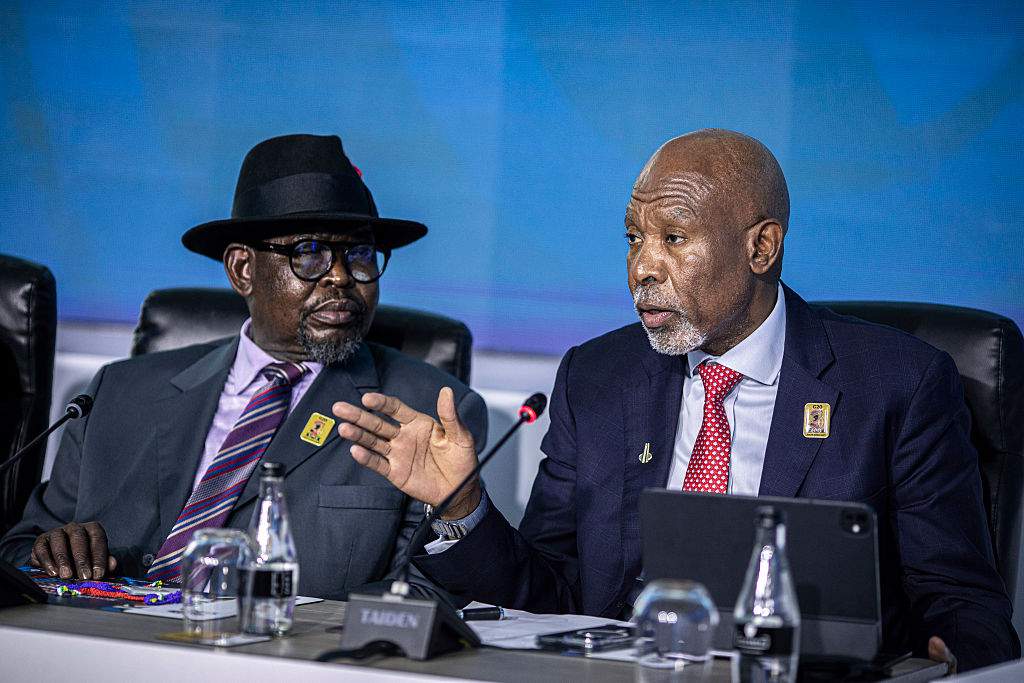
The South African Reserve Bank, pushing for a lower 3% inflation target while treasury weighs fiscal risks [Image by News24]
(The Post News) – South Africa’s National Treasury said on Monday it will decide soon whether the nation’s inflation target would be changed, following a protracted standoff with the South African Reserve Bank (SARB). This is as inflation slows to multi-year lows, which gives space to policymakers to consider a new framework.
The Macroeconomic Standing Committee, which is co-chaired by Treasury and the SARB, has completed technical input on the issue and will soon make recommendations to Finance Minister Enoch Godongwana and Reserve Bank Governor Lesetja Kganyago.
The SARB has historically advocated for a tighter target, and Governor Kganyago and his Monetary Policy Committee (MPC) have invited inflation to move closer to 3%, the lower bound of the existing 3%–6% band. The SARB has been targeting policy since 2017 at the 4.5% mid-point, but in July, Kganyago suggested that the bank would be happy with the lower end of the band.
“The economy cannot wait,” Kganyago stressed at the MPC meeting last month. “To target 3% would anchor expectations more solidly and bring us in line with our trading partners.”
The Reserve Bank’s contention is that curbing inflation would stabilize prices, increase household purchasing power, lower the cost of credit, and make South Africa more competitive.
South African Treasury Pushes Back
Treasury did caution the central bank, however, that the target can only formally be changed by the Finance Minister. Godongwana also cautioned against sudden shifts, saying they would disrupt fiscal planning. Treasury’s own medium-term budget forecasts inflation plateauing at 4.5%, not 3%.
The policymakers are concerned that when monetary and fiscal policy goals clash, revenue forecast errors or South African overspending could take place. This conflict is the age-old battle between monetary tightening and fiscal prudence, a common South African economic policy tug-of-war.
Economists are divided over the virtues of lowering the inflation target. Momentum Investments Chief Economist Sanisha Packirisamy said a lower band would be credibility-enhancing and investment-stimulating but warned against short-term trade-offs.
“Lowering the target would anchor expectations better,” Packirisamy said. “But tighter conditions in the near term could compress growth, especially when the economy is already reeling.”.
Proponents of a 3% target argue that lower inflation would: Increase the purchasing power of consumers. Reduce the government’s debt-servicing cost. Improve business and home affordability. Promote greater investor stability.
Critics caution that tighter monetary policy could strangle already weak growth, hasten unemployment, and limit the flexibility of government spending.
Credit Ratings Agencies Sound Alarm
Foreign ratings agencies also sounded warning bells. S&P Global warned that Treasury’s budget forecast presumes inflation at the midpoint of the recent range. Targeting low may expose fiscal imbalances to risk if economic shocks push inflation upwards.
The mismatch between Treasury’s forecast and the SARB’s preference has therefore posed risks to South Africa’s funding costs and fiscal credibility.
Inflation in South Africa has slowed steadily in 2025. The most recent data sees consumer price growth slowing from 4.1% in January to 3.4% in August. This has given policymakers a window of opportunity to consider reform.
But the threat of surprise shocks remains. South Africa’s National Energy Regulator (NERSA) recently approved sharp electricity tariff hikes for 2026 and 2027. Specialists note that this can further complicate achieving a 3% goal in the near future.
“The threat of a supply-side shock in South Africa is real,” Packirisamy said. “Food prices, energy prices, and the rand exchange rate can all de-rail a low target.”
Treasury and the Reserve Bank both agreed in their joint statement that they must act together. “The Governor and Minister of Finance will determine any adjustment of the target band. The Minister will make a formal announcement as soon as is practicable,” the statement said.
Though Treasury interprets SARB’s recent utterances as “preference” rather than policy, the two institutions agree that inflation must be curbed to protect growth and stability.
The discussion papers will be tabled before Minister Godongwana and Governor Kganyago in due course. If accepted, South Africa will witness its first major overhaul of the inflation targeting framework since 2000.
That decision would reshape the nexus between monetary policy and fiscal policy, from housing affordability to government borrowing cost.
In the meantime, South Africa is still within the 3%–6% inflation band, and the SARB is pushing towards the middle but stress-testing scenarios off a 3% anchor. The ultimate decision, later this year, will be whether policymakers make a dramatic leap or stick with the status quo compromise.
About the Author