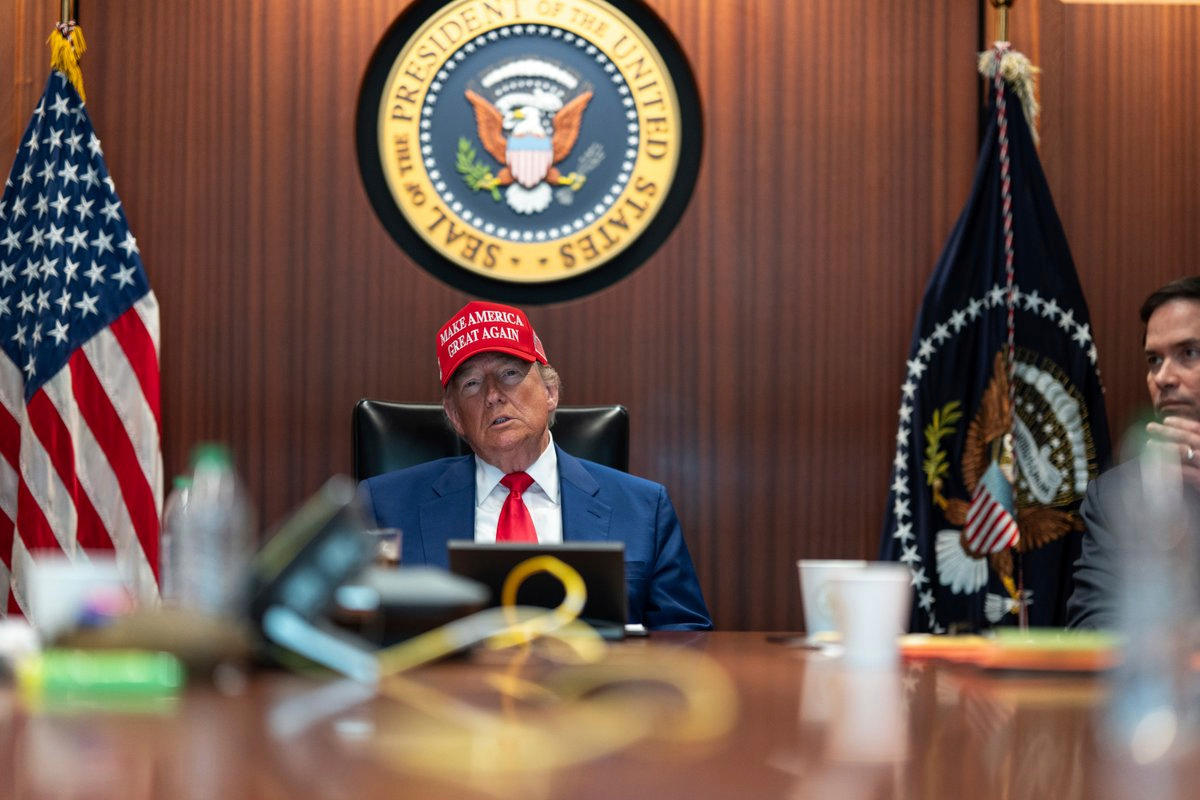
US President Donald Trump announces a “complete and total ceasefire” agreement between Israel and Iran amid ongoing tensions, although neither nation has officially confirmed the deal. Image: The White House via AP.
(The Post News) – A federal appeals court has halted President Donald Trump’s bid to use an 18th-century wartime law to deport Venezuelan migrants, ruling that the administration overstepped its authority. The decision is a major blow to Trump’s immigration policy and paves the way for an eventual Supreme Court battle.
In a 2-1 ruling, the Fifth U.S. Circuit Court of Appeals in New Orleans blocked the government from deporting Venezuelans using the Alien Enemies Act of 1798. Trump invoked the law on March 14, citing the Venezuelan gang Tren de Aragua as having “made a predatory incursion into the territory of the United States.”
Judge Leslie Southwick, a Bush appointee, wrote the majority opinion. He said the administration failed to demonstrate that an invasion or incursion had occurred, and they are the sole terms on which the law can be applied. “Evidence does not show that an invasion or a predatory incursion occurred,” Southwick said. “The petitioners are most likely to establish that the Alien Enemies Act was wrongly applied.”
Southwick was joined by President Joe Biden-appointed Judge Irma Carrillo Ramirez. Trump appointee Judge Andrew Oldham dissented. The ruling bars Trump from enforcing the law in Texas, Louisiana, and Mississippi, the three Fifth Circuit-jurisdiction states.
Rarely Used Law
The Alien Enemies Act dates back to 1798, when Congress passed it when there was a heightened sense of tension in the war with France. The act gives wide discretion to the government to arrest and deport citizens of an enemy country but only during times of declared war, invasions, or recorded incursions.
The law was only used sparingly in modern times. It gave legality to World War II internments of Japanese, German, and Italian citizens but was never used for peacetime enforcement of immigration until Trump’s candidacy. Legal experts say that the Fifth Circuit decision represents the strongest rebuke to date of Trump’s unprecedented effort to broaden the meaning of the law beyond its intended purposes.
The case involves Venezuelan detainees at the Bluebonnet Detention Center in Anson, Texas. Trump’s administration charged the men with being members of Tren de Aragua, a Venezuelan-based gang that spread all over South America. The American Civil Liberties Union (ACLU), who are representing the migrants, dispute the allegations and argue that Trump used the gang as a cover to circumvent standard immigration law.
The Trump administration’s attempt to use a wartime statute in times of peace to govern immigration was rightly stayed,” said ACLU attorney Lee Gelernt. “This is a significant decision to limit executive overreach.” The appeals court also looked at how much notice detainees receive before being deported under the law. The Trump administration put in place a seven-day notice period, citing that it complied with a prior Supreme Court requirement.
Southwick and Oldham agreed that seven days’ notice would be adequate. Judge Ramirez differed on that assumption, based on the requirement of at least 21 days to give detainees, many of whom are not represented by attorneys, adequate time to object to their deportation. “Seven days’ notice is not reasonably calculated, under all the circumstances, to afford detainees due process,” Ramirez said.
Trump’s Claims
The White House didn’t have an immediate comment on the move. Trump, however, has continued to depict Tren de Aragua as a national security threat. On Tuesday, he claimed that the U.S. military killed 11 Venezuelan drug traffickers in a “kinetic strike” in the Caribbean.
“We just launched a narco-trafficking boat literally just a few minutes ago,” Trump told White House reporters. He linked the attack to his overall argument that Venezuelan traffickers and gangs threaten an “invasion” of American territory.
The ruling is widely anticipated to be the vehicle for Supreme Court review. Trump’s lawyers may ask the full Fifth Circuit to rehear the case before appealing to the justices.
Earlier this year, the Supreme Court temporarily suspended deportations under the Alien Enemies Act in a narrow Texas case, but it refused to reach the constitutionality of the law. The broader ruling by the Fifth Circuit now puts that question directly before the courts.
Immigration and constitutional law experts state that the high court will have to determine whether or not presidents have the authority to invoke the Alien Enemies Act unilaterally during peacetime, a decision that would redefine executive authority over immigration for decades.
The repercussions are enormous,” said Tulane University legal analyst Maria Chavez. “If the courts will allow the Alien Enemies Act to be enforced in times of peace, future presidents would have complete authority to declare any foreign group an invading force and deport them without due process.”
Broader Political Impact
The ruling is Trump’s newest broadside in keeping his 2024 re-election strategy on hard-line immigration. He has promised mass deportations and threatened to deploy other emergency powers should he be re-elected.
For immigrant rights advocates, Tuesday’s ruling is a major victory in the fight to check executive overreach. To Trump backers, it sparks fear that the judiciary is blocking weapons necessary to confront foreign gangs and narcotics smuggling.
As the case finds its way to the Supreme Court, the dilemma between liberties and security and between presidential power and judicial review will remain at the forefront of America’s immigration debate.
About the Author