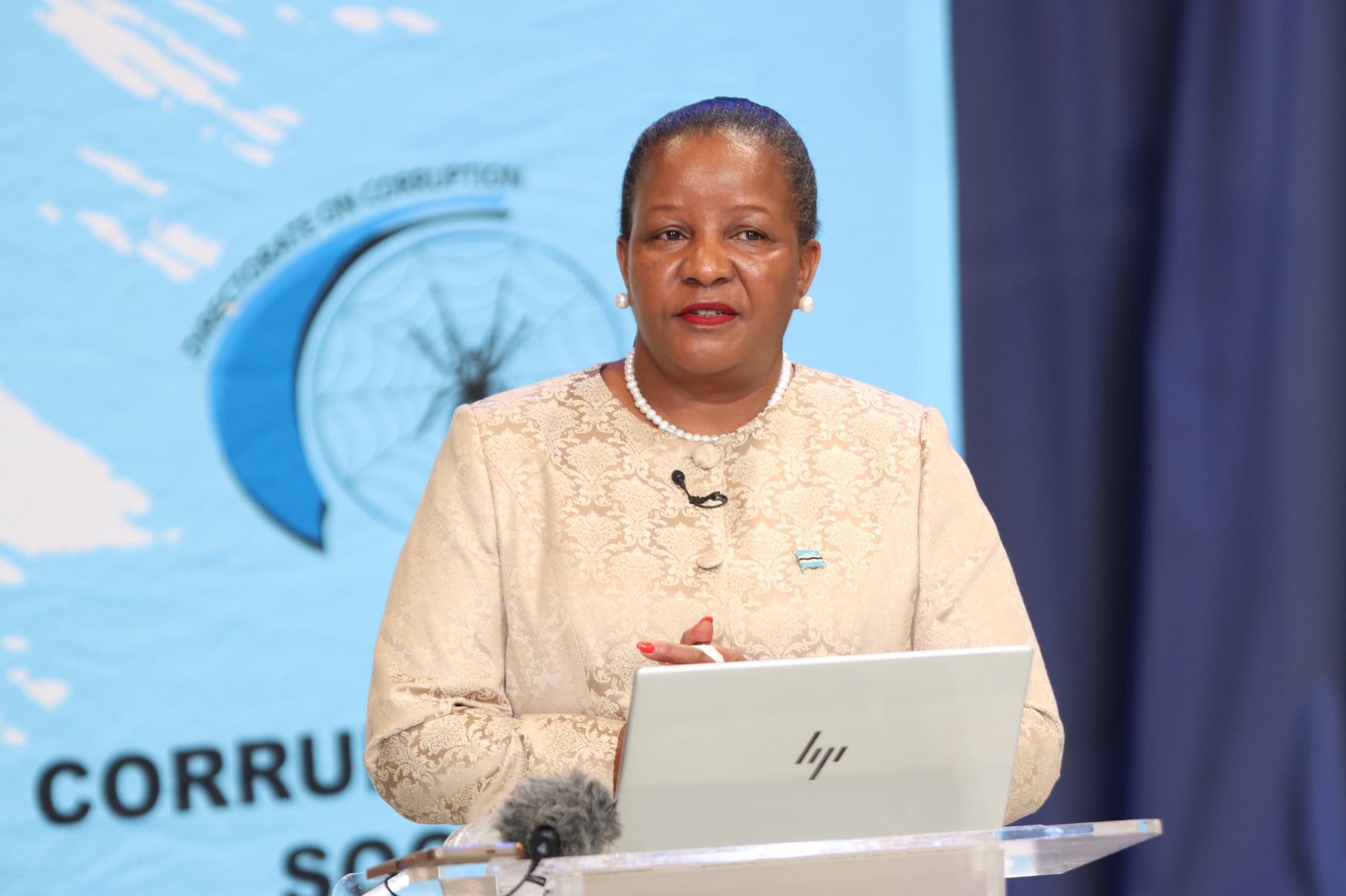
Chief Executive Officer of the Directorate on Corruption and Economic Offenses (DCEO), Botlhale Makgekgenene. Image: X@MmegiOnline
(The Post News)- A revision of the Corruption and Economic Offenses Act (CEOA) of 2013 was announced by Chief Executive Officer of the Directorate on Corruption and Economic Offenses (DCEO), Botlhale Makgekgenene, at a recent press conference in Gaborone.
The update aims to strengthen the agency’s statutory framework, guarantee its autonomy, and give it stronger authority to fight corruption. The revised CEOA will be submitted to the legislature in November.
Makgekgenene stressed that the revision is essential. The amended statutes in the CEOA must promote a transparent system that safeguards public assets.
This review comes amid mounting demands for more stringent anti-corruption initiatives. It aims to propose modifications that align the legislation with contemporary economic and technological realities.
Enhancing Investigative and Prosecution Powers Through CEOA
The initial law was enacted in 1994 to facilitate the establishment of DCEO and was last amended in 2013.
The anti-corruption entity explained that the updated legislation will boost its capacity. It will enable the agency to probe and prosecute cases of financial crimes and corruption more effectively.
Makgekgenene remarked, “The primary objective of this exercise is to fortify our legislative framework. We need to enhance our legal provisions. This will allow us to confront the evolving and intricate nature of present-day corruption effectively.”
He added, “Through this revision, we anticipate the law will fill institutional and operational deficiencies we presently encounter. Our intention is to have it presented to Parliament during its November session.”
Between January and August 21, 2025, DCEO received more than 650 leads concerning suspected corruption. Nine government officials from previous and current administrations were implicated in certain cases.
Concerning 2024, Makgekgenene noted that DCEO traced and identified illicit gains in the form of assets and funds. The agency referred properties valued at P144 million to the Directorate of Public Prosecutions (DPP) to commence asset recovery processes.
This figure represents a significant rise compared to the P1.8 million in unlawfully acquired assets identified previously.
About the Author