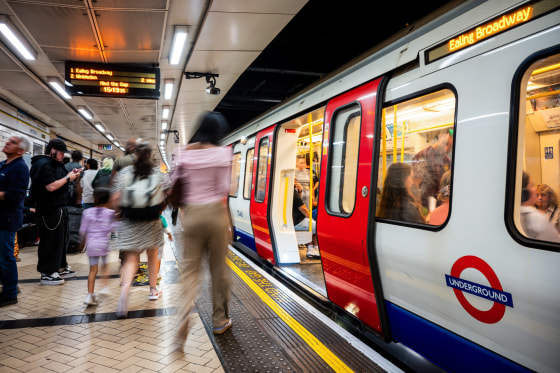
London Underground workers stage a series of strikes over pay and working conditions. Image: NBC News.
(The Post News)– Millions of London citizens are preparing for a week of travel chaos as thousands of workers on the London Underground are staging a series of strikes in protest at pay and conditions. The action, which commenced on Sunday, will close most of the Tube system by Friday, forcing passengers to use packed trains, buses, and other forms of transport.
The Rail, Maritime and Transport Union (RMT) has confirmed that up to 10,000 members, who are drivers, signalers, engineers, and maintenance workers, are striking at intervals throughout Thursday. The strikes will bring the Tube to a standstill, with Transport for London (TfL) warning commuters that “little to no service” can be anticipated on the Underground until the morning of Friday, 12 September.
Dispute Over Pay and Hours
At the heart of the dispute is TfL’s 3.4% pay offer, which the union says is inadequate. The RMT is nevertheless demanding a reduction in the working week from 35 to 32 hours in the face of criticism over staff fatigue and irregular shift patterns.
“Relentless change and fatigue are damaging the health and well-being of our members,” RMT General Secretary Eddie Dempsey said. “It’s not a king’s ransom; it’s about fairness and protecting our workforce. TfL, however, insists that contracted hours cannot be reduced. TfL Chief Operating Officer Claire Mann said, “We welcome further conversation with unions around how to deal with fatigue, but reducing the 35-hour working week is not feasible or cost-effective.”
The RMT claims that numbers have been cut by more than 2,000 jobs since 2018, with the remaining staff stretched to breaking point.
Impact on Landon’s Transport Network
Walkouts on the Tube are already wreaking havoc across the capital. Customers have been urged to complete journeys by 5 p.m. every day, with most stations closing early.
While the Elizabeth Line, London Overground, National Rail, and buses will run, they should be fuller than usual. The Docklands Light Railway (DLR), which runs between the City of London and Canary Wharf, will also shut on Tuesday and Thursday in a linked dispute. A number of inner rail stations with Tube interchanges will shut outright, and this has made commuters furious. The Centre for Economics and Business Research contends that the strikes could cost the UK economy more than £230 million in lost output, travel disruption, and repressed consumer spending.
The disruption also reached London’s arts scene. British rock band Coldplay said that it would be delaying two sold-out concerts at Wembley Stadium, while American superstar Post Malone delayed his scheduled London shows until the latter part of the month.
Calls for Political Intervention
The RMT has called on London Mayor Sadiq Khan to step in and sort out the row, as he did back in early 2024 when a last-minute £30m funding injection avoided like-for-like walkouts. As of now, however, Khan hasn’t intervened, and negotiations remain at an impasse.
While TfL reported a budget surplus of £166m last year, it insists that it cannot afford to meet the union’s demand for a shorter working week. The organization says the suggested pay raise is consistent with other inflation and rail industry agreements.
The walkouts will roll through the week as different groups of RMT members walk out on alternate days. The Tube is unlikely to open before Friday morning, when services are scheduled to resume at 8 a.m. Meanwhile, bus drivers who operate for First Bus in west London are preparing for a three-day strike from Friday, pledging to cause more mayhem around the city.
Londoners are instead being told to expect longer trips, fuller trains, and more congestion on the streets. And with no new negotiations in the offing, the standoff between TfL and the RMT will likely last for a while.
About the Author