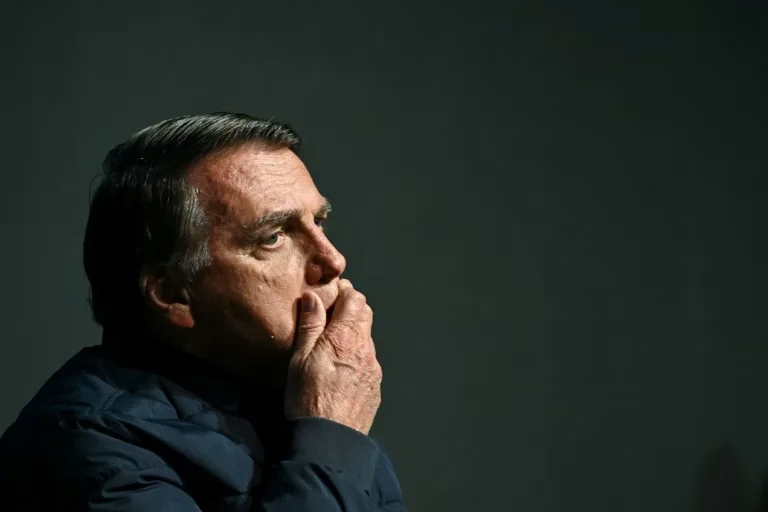
Bolsonaro guilty verdict sparks historic trial, reshaping Brazil’s political future and testing the strength of its democracy. Image: Evaristo Sa/AFP.
(The Post News) – Bolsonaro’s guilty verdict has now taken a dramatic step forward after the first of five Supreme Court justices declared the former Brazilian president guilty of planning a coup. However, the outcome is still uncertain because at least three of the five judges must reach the same conclusion for a conviction to stand.
Bolsonaro Verdict Raises Stakes for Brazil’s Democracy
From the start, Justice Alexandre de Moraes emphasized that the events following Bolsonaro’s 2022 election defeat were no accident. Instead, according to him, they were the result of a calculated attempt to block the transfer of power to Luiz Inácio Lula da Silva. Moreover, he directly linked the ex-leader to organizing the strategy.
If three or more judges side with Moraes, the Bolsonaro verdict could result in a punishment exceeding 40 years in prison. This would be one of the most significant rulings in Brazil’s democratic history. Furthermore, the case extends beyond Bolsonaro himself, as seven co-defendants, many with military backgrounds, also stand accused of supporting the coup plan.
Verdict Deepens National Political Divide
During the proceedings, Moraes described evidence that detailed assassination plots targeting Lula, his running mate, and Moraes himself. In addition, documents revealed that the conspiracy was drafted within government headquarters and even printed inside the presidential palace while Bolsonaro was in power. Although the group failed to gain sufficient backing from the armed forces, their efforts escalated into the violent storming of Brazil’s Congress, the Supreme Court, and the presidential palace on January 8, 2023.
The riots shocked the world. Yet, security forces quickly regained control, arresting more than 1,500 people. Even so, Moraes warned that Brazil had narrowly avoided sliding back into authoritarianism, stressing that the attempted coup nearly reversed decades of progress since the dictatorship ended in 1985.
At the time of Moraes’ ruling, Bolsonaro was not present in court. Instead, he remained under house arrest in Brasília, reportedly due to ongoing health issues stemming from a 2018 stabbing incident. His legal team insists he is innocent, maintaining that the trial is politically motivated. In fact, Bolsonaro argues that the case is designed to block him from returning in the 2026 presidential race, even though he is already barred from seeking office until 2030 for undermining Brazil’s electoral system.
The Bolsonaro guilty verdict debate has deepened divisions across the country. On one hand, supporters of the former president believe the five-judge panel cannot be impartial, noting ties between some justices and President Lula. On the other hand, critics stress that Brazil’s institutions must act firmly when threatened, especially since its democracy was restored less than four decades ago.
Therefore, the trial’s outcome carries weight far beyond Bolsonaro himself. It symbolizes a test of Brazil’s ability to defend its democratic framework under immense pressure. As the remaining justices prepare to cast their votes, the nation and the world await the next step in this unprecedented case.
In conclusion, the unfolding Bolsonaro verdict is not just about one leader’s fate. Rather, it is about whether Brazil’s democratic institutions can withstand attempts to overturn the will of the people. The final decision will determine not only Bolsonaro’s future but also the resilience of Brazilian democracy.
Please share your thoughts contact Thembeka via email: Journalist-thembeka@thepostnews.net
About the Author