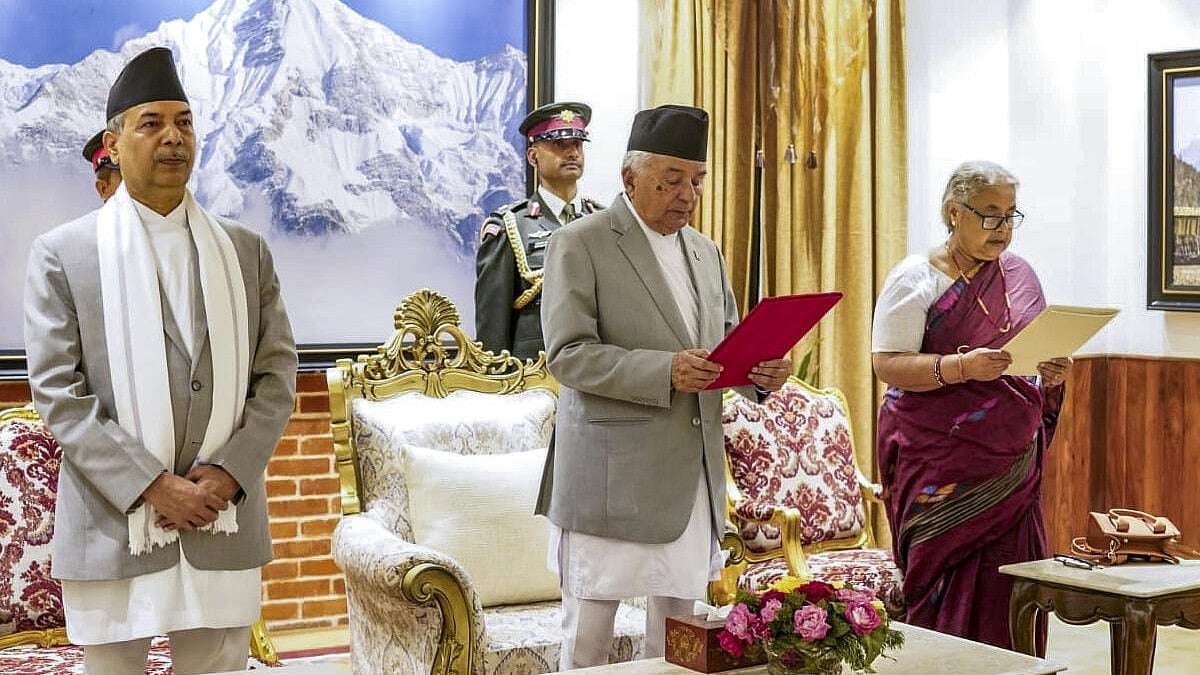
Sushila Karki takes the oath of office as the new Prime Minister of Nepal after youth-led protests toppled the government. Image: Deccan Herald.
(The Post News) – Nepal has announced its first woman prime minister, Sushila Karki, after a week of historic turmoil in which deadly youth-led demonstrations compelled Prime Minister K.P. Sharma Oli to step down and parliament to dissolve.
Karki, 73, a retired chief justice of the Supreme Court of Nepal and a woman admired across the country for her unrelenting battle against corruption, was sworn in late Friday. She will lead an interim government under a deal between President Ram Chandra Paudel, leading protest figures, and senior military leaders.
The appointment follows a week of unprecedented unrest. What began as protests against a government ban on social media quickly escalated into a nationwide revolt founded on anger against corruption, nepotism, and growing inequality. Tens of thousands of young Nepali people, most of them under 30, demonstrated on the streets of Kathmandu and other towns, demanding change.
Deadly Crackdown Sparks Outrage
The police responded with lethal force on Monday, firing live bullets into the crowds. At least 21 civilians died that day, in the most violent protest in Nepal’s recent history. A total of 51 people lost their lives, including protesters, police personnel, and passersby, in accordance with official records. More than 1,700 people sustained injuries.
Anger reached a boiling point by Tuesday. Protesters torched the parliament, the Supreme Court, and homes of the top officials. Prime Minister Oli, rescued to safety by the army in a helicopter, resigned by evening.
The 73-year-old president, who was serving his fourth term, had for years been accused of corruption, authoritarianism, and being out of touch with the country’s youths. His resignation was met with jubilation among demonstrators, who had turned him into a symbol of the country’s entrenched political corruption.
In the days following Oli’s departure, the largely leaderless “Gen Z” protest movement faced a challenge: deciding who should guide Nepal out of crisis. Representatives chosen from among the protesters put forward Sushila Karki as their candidate to head an interim administration.
Karki, Nepal’s first chief justice in 2016, had earned a reputation for integrity after delivering landmark judgments against corrupt ministers and senior police officers. Though she faced political retaliation, including an effort to impeach her, her public image as a fearless reformer has endured.
“She is the one individual the entire nation can rely on,” declared Biraj Aryal, a 28-year-old budding chartered accountant. “Since she has been a judge, she knows the country’s laws and systems. We are confident she can guide us out of this crisis.”
Young protesters also expressed hope that a woman leader would be a turning point in Nepal’s deeply patriarchal political culture. “She has shown she has a spine,” said law student Anjali Sah, 24. “We hope she will reduce corruption and get things organized.”
The political parties agreed on Friday evening to dissolve parliament after days of strained talks, hours after the army chief, Ashok Raj Sigdel, warned that the military might impose emergency rule if there was no progress.
Karki to Lead Interim Government Until 2026 Elections
President Paudel confirmed that parliament had been dissolved on Karki’s recommendation and that new elections are scheduled for March 5, 2026. In the meantime, Karki will lead a council of ministers tasked with stabilizing the nation. Many protesters are already demanding she investigate corruption allegations against Oli and his cabinet, as well as launch an independent inquiry into the killings of demonstrators.
“This is the beginning of construction after destruction,” Dheeraj Joshi, 25, a young leader who took part in negotiations, said. “We need to know who compromised the country the most and then uproot corruption. It is only then that one could construct a better future.”
The dramatic rise of Karki is a testament to both the weakness and the robustness of Nepal’s democracy. While her appointment is a milestone for women in leadership, it also highlights the urgent aspirations of an impatient generation that will no longer tolerate corruption and injustice.
As soldiers continue to patrol the streets of Kathmandu, Nepal teeters on a risky but perhaps revolutionary course under its first female prime minister.
About the Author