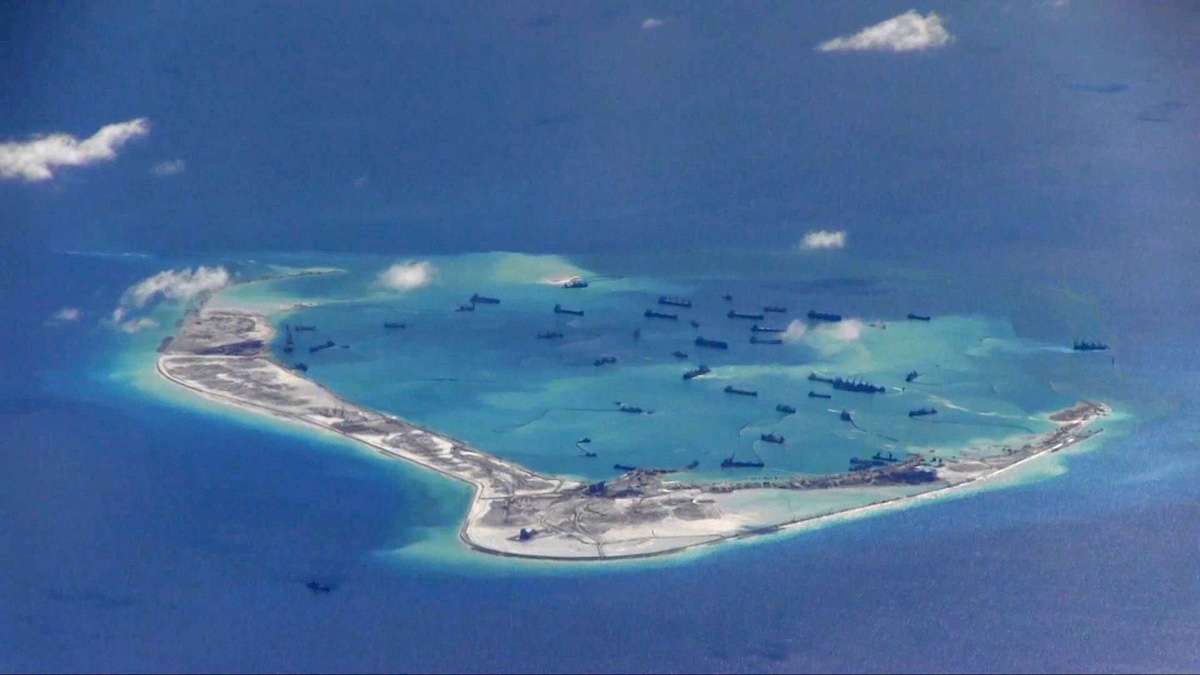
China declared Scarborough Shoal as a "nature reserve" as chines coast guard vessels patrol near it: Image: Asia Times.
(The Post News) – Scarborough Shoal has become the newest flashpoint in the South China Sea as Beijing announces a wide 3,500-hectare “nature reserve” over contested waters. Manila has vowed fierce diplomatic reprisals, calling the move illegal and a step toward occupation.
China‘s State Council approved on Wednesday setting up the Huangyan Island National Nature Reserve on Scarborough Shoal, a disputed reef 200 km off the Philippines’ island of Luzon. The reserve will encompass more than 3,500 hectares and be based on the conservation of coral reef ecosystems, Beijing said.
China’s National Forestry and Grassland Administration called the project an “important guarantee for maintaining diversity, stability, and sustainability” in the South China Sea. Chinese officials’ maps outline a “core zone” that will be entirely off-limits and “experimental zones” for research, education, and tourism.
Beijing insists Scarborough Shoal is its “inherent territory.” Chinese foreign ministry spokesman Lin Jian said the reserve was a matter of sovereignty and that “the establishment of a national-level nature reserve on Huangyan Island is within China’s sovereignty. We hope the Philippines stops its provocations.”
Manalia Pushes Back
The Philippines branded the statement as “illegitimate and unlawful.” Foreign Affairs officials said a diplomatic protest will be lodged in diplomatic style. Philippine National Security Adviser Eduardo Año accused Beijing of hiding behind its territorial claims in environmental propaganda.
“This move is not so much about protecting the environment but more about justifying its claim over a maritime feature that lies within the Philippines’ territory and waters. It is a transparent subterfuge towards eventual occupation,” Año said.
Manila refers to the 2016 Permanent Court of Arbitration ruling, which dismissed Beijing’s provocative nine-dash line claims and found the nation’s blockade of Scarborough Shoal in violation of international law. The ruling confirmed that the reef lies within the exclusive economic zone (EEZ) of the Philippines, even though sovereignty was not settled.
Scarborough Shoal, or Bajo de Masinloc in the Philippines, is valued for its fishery resources, turquoise lagoon, and position in a corridor where $4.5 trillion of trade passes annually. China occupied the shoal in 2012 in a standoff, maintaining coast guard and militia vessels there since.
The environmental framing has raised some eyebrows. In 2023, the Centre for Strategic and International Studies (CSIS) report found China’s island building and clam fishing across the South China Sea destroyed over 20,000 acres of coral reef. Manila officials say it is ironic that Beijing now comes out as a protector of the sea environment.
The United States strongly stood by the Manila side. Secretary of State Marco Rubio condemned China’s move as “another coercive attempt to pursue China’s interests at the expense of its neighbors and regional stability.” Washington reaffirmed its defense obligations to the Philippines under their mutual defense treaty.
Regional analysts assert that China is well beyond likely to test how much it can get away with. Julio Amador III of Amador Research Services stated, “If there is no real pushback, Beijing may use this playbook elsewhere.”
Security analyst Jennifer Parker called the move an example of “lawfare,” invoking domestic law to validate contested maritime claims. She warned China might soon escalate coast guard harassment of Filipino fishermen in the guise of “enforcing” the reserve.
Rising Tensions in the South China Sea
The statement coincides with the nation boosting naval presence in the region. Beijing had recently sent its latest aircraft carrier, the Fujian, through the Taiwan Strait and into the South China Sea last week. The Philippines, meanwhile, has also ramped up joint naval exercises with allies such as the U.S., Australia, and Canada. Although Scarborough Shoal remains unarmed with bases or missile systems like China’s artificial islands in the Spratlys, onlookers are cautious that the reserve label could be the opening move.
As Parker explained, “China has been deterred, to a point. But this latest move signals it is willing to push boundaries again. Countries, including Australia, must reject this reserve as incompatible with international law.” For Manila, the shoal is still a test of sovereignty in its standing with Washington. Whether the “nature reserve” is really for conservation or geopolitical unification may well determine the next page of the South China Sea drama.
About the Author