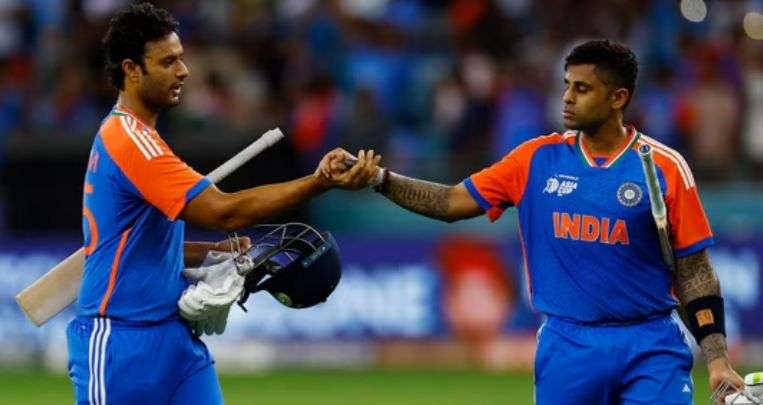
India vs Pakistan, Asia Cup 2025. Image: Kartikay Dutta/ Hindustan Times.
(The Post News)– The ongoing political standoff between India and Pakistan had far-reaching effects on the 2025 Asia Cup, culminating in a tense and controversial conclusion to their cricket match in Dubai.
After India’s dominant seven-wicket victory, captain Suryakumar Yadav confirmed that his team deliberately chose not to shake hands with their Pakistani counterparts as a symbolic act of protest.
The Indian government approved Sunday’s Group A match only after extended deliberations. Many fans and analysts hoped the on-field contest would ease the rising political tensions. Instead, Yadav firmly shut down those expectations, calling the win a “perfect reply” to Pakistan following a recent four-day military standoff that nearly escalated into war in May.
“Our government and the BCCI agreed that we should play this match,” Yadav told reporters post-match. “We came here to do our job and gave them [Pakistan] a fitting response.” Yadav, who scored the winning runs, left the field with batting partner Shivam Dube without greeting the Pakistani players for the customary handshake.
India Skips Handshake After Beating Pakistan
As Pakistan’s players grouped together and waited near the pitch for the traditional exchange, the Indian team and staff instead congratulated one another and quietly retreated to their dressing room, closing the door behind them. The scene left the Pakistani players standing awkwardly, expecting a gesture that never came.
When asked whether this gesture went against the spirit of the game, Yadav replied sharply, “Some things in life go beyond sportsmanship.” He dedicated the win to the victims of the recent Pahalgam terror attack and praised the Indian armed forces involved in Operation Sindoor, a coordinated missile strike targeting six sites inside Pakistan.
India launched the attack in response to the April 22 assault in Pahalgam, Indian-administered Kashmir, where 26 tourists were killed. Although a group called The Resistance Front (TRF), which supports Kashmir’s independence, claimed responsibility, India blamed Pakistan for supporting the attackers.
Pakistan retaliated two days later, targeting Indian military installations across the Line of Control, hitting four key facilities. The escalation lasted four days before an internationally brokered ceasefire halted the conflict.
Despite the end of hostilities, diplomatic relations remained frozen. The decision to schedule an India-Pakistan match in such a charged atmosphere reignited tensions, especially when both captains skipped the pre-match handshake at the toss, an act that drew immediate attention.
However, sources later revealed that match referee Andy Pycroft had instructed both captains, Yadav and Pakistan’s Agha, to skip the pre-toss handshake. A Pakistan Cricket Board (PCB) official, speaking anonymously to Al Jazeera, confirmed this directive. Match officials also reportedly gave India the green light to avoid post-match handshakes but failed to communicate this to the Pakistani team.
As a result, the Pakistani players followed the Indian team off the pitch, waiting for a post-match interaction that never occurred. The Indian squad stayed inside their dressing room, leaving Pakistan’s players visibly surprised. Pakistan team manager Naveed Akram Cheema lodged an official protest with Pycroft, who serves as an ICC-accredited match referee.
Cricket tradition typically requires the two batters from the winning side to shake hands with the fielding team and the umpires before leaving the field. The rest of the winning team usually follows suit, creating an opportunity for both sides to end the game on a respectful and sportsmanlike note.
Pre-match handshakes are also standard, typically occurring 30 minutes before the start, during the toss conducted by the match referee. Captains often use this time to exchange pleasantries and discuss final preparations. Referees also meet with team managers or coaches to clarify match regulations or address any concerns.
In this match, however, political tensions clearly overshadowed sporting norms, leaving a lasting impression far beyond the scoreboard.
About the Author