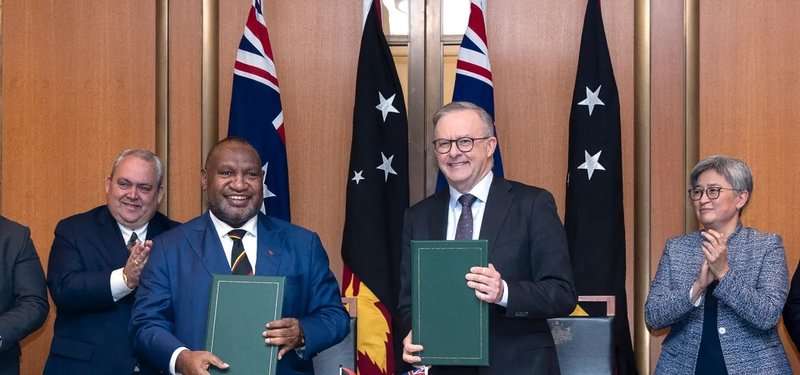
Australian Prime Minister Anthony Albanese and Papua New Guinea Prime Minister James Marape in Port Moresby after signing a communique instead of the delayed mutual defence treaty. Image: A News.
(The Post News) –Prime Minister Anthony Albanese’s strategy of resisting China’s expanding influence in the Pacific was dealt another blow as Papua New Guinea delayed the signing of a milestone mutual defense agreement.
Albanese had hoped to finalize the Pukpuk mutual defence treaty with PNG Prime Minister James Marape during his visit this week. Instead, the two leaders signed merely a joint statement agreeing to resume talks after PNG’s cabinet rejected the agreement.
The delay is Canberra’s second diplomatic blunder in two weeks, following Vanuatu putting on hold a $500 million security and climate agreement with Australia due to Chinese encroachment on crucial minerals.
Treaty Stalls Amid Sovereignty Concerns
The treaty would bind Australia and PNG into a mutual defensedefense agreement, allow citizens to fight in each other’s military forces, and enhance cybersecurity and exercise cooperation. However, sovereignty and constitutional issues have obstructed PNG cabinet approval.
PNG ex-defense chief Jerry Singirok charged Albanese with trying to “ambush” Marape and warned the treaty could violate PNG’s constitution. Opposition MPs from both countries labelled the delay as an embarrassment to Albanese, with Liberal deputy leader Sussan Ley saying the prime minister had “failed to prepare for the threat in our region.”
Albanese dismissed such criticism. “The language of the treaty has been agreed upon. There’s no downside to this, only positives for Papua New Guinea and Australia,” he told Reuters in Port Moresby. Marape made it a point to stress that the treaty was PNG’s idea and maintained that it would not undermine sovereignty. “Threats that face Australia are brought naked before Papua New Guinea, and threats that face PNG are brought naked before Australia,” he added.
China’s Shadow in the Pacific
Beijing’s growing stature eclipses both disappointments. China has charged aggressively into Pacific nations with loans, infrastructure arrangements, and strategic mineral deals, putting pressure on Australia’s traditional role as the region’s premier partner.
While China asserted that China had “no hand” in prolonging the treaty, PNG Defence Minister Billy Joseph will soon travel to Beijing, Indonesia, and other regional leaders to explain the agreement. China, meanwhile, is holding its biennial Xiangshan security forum in Beijing this week with more than 100 countries represented.
For Australia, the delays threaten to undermine its bid to counter China’s influence after Beijing signed a contentious security agreement with the Solomon Islands in 2022. Albanese has relied on cultural diplomacy to deepen relations, supporting PNG’s entry into the National Rugby League by 2028 as part of a $600 million package. The prime minister stated that the project was still on track despite the defense setback.
But analysts say sporting diplomacy will not offset China’s multi-billion-dollar penetration of Pacific economies through critical minerals financing and lending for infrastructure.
Looking Ahead
Both leaders confirmed that the treaty remains on course, with cabinet approval in “coming weeks.” But analysts warn that the longer it takes, the better China will be at speeding up relations with Australia’s Pacific neighbors. “Until the treaty is signed, either party can still make alterations,” noted ANU professor Don Rothwell. “That leaves Australia vulnerable to shifting political tides in Port Moresby.”
As Vanuatu and PNG also went into hiatus, Albanese is now under growing pressure to generate concrete deliverables. China, in the meantime, continues to grow its footprint in the Pacific, both in diplomacy and in the ownership of key minerals, an industry central to the transition of the world’s energy.
About the Author