KwaZulu-Natal Police Commissioner Lieutenant General Nhlanhla Mkhwanazi says Mchunu has big questions to answer as Mkhwanazi starts spilling the beans. Image creditor: SABC News.
(The Post News) – KwaZulu-Natal police commissioner Lieutenant-General Nhlanhla Mkhwanazi has warned that South Africa’s criminal justice system faces a “risk of total collapse” if deep rooted political interference and corruption are not urgently addressed.
Mkhwanazi Testifies First
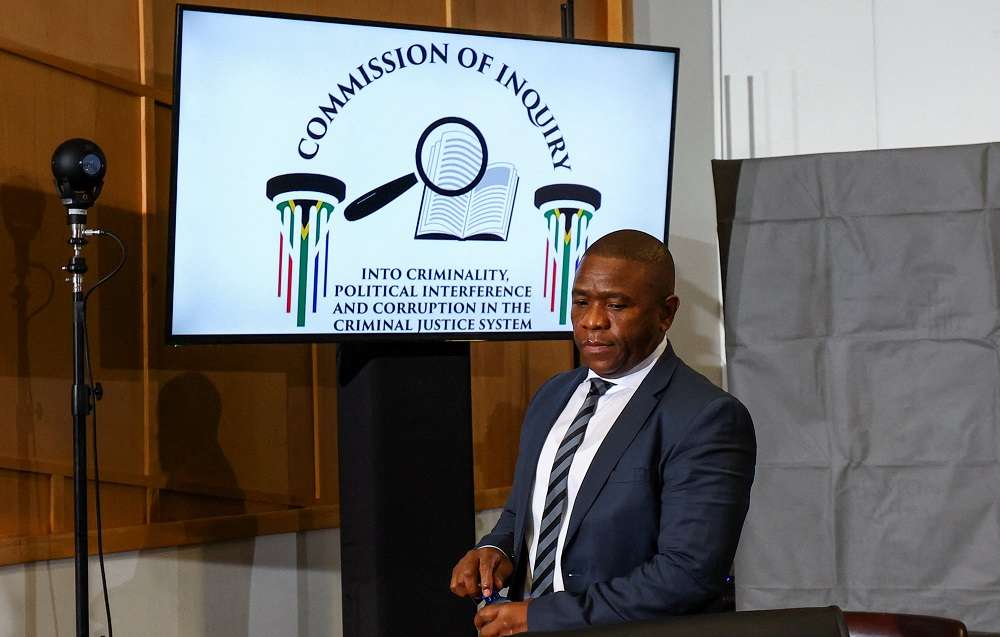
Mkhwanazi was the first witness to testify on Wednesday, 17 September 2025 before the judicial commission of inquiry chaired by retired Constitutional Court justice Mbuyiseli Madlanga. The inquiry was established by President Cyril Ramaphosa in response to explosive allegations Mkhwanazi made in July, which implicated suspended Police Minister Senzo Mchunu in the alleged infiltration of law enforcement by criminal syndicates.
“It has been my aim that I want to demonstrate that the criminal justice system has been subject to a continuous threat as well as sabotage … to a point where we believe it is a real risk of a total collapse. Nothing is done,” Mkhwanazi told the commission.
The commissioner said in his July media briefing, where he went public with the allegations, was not a personal act of defiance but a collective decision by senior colleagues within the South African Police Service (SAPS).
“It is therefore a reflection of the common concerns that we share as colleagues in different ranks within the service, which made our common desire for these problems to be resolved in order to enable members to serve with honour and dignity,” he explained.
At that briefing, Mkhwanazi alleged that political leaders and senior police officials had been “captured” by criminal syndicates. He claimed Mchunu had ordered the disbanding of a task team probing political killings in KwaZulu-Natal because it was closing in on politicians linked to these networks.
Madlanga Commission Proccedings
On Wednesday, Mkhwanazi reiterated that his testimony would focus heavily on the task team, as well as broader corruption within SAPS. He also thanked the media for highlighting his concerns, saying their reporting prompted Ramaphosa to act.
Mkhwanazi said he was surprised when he saw a letter confirming the disbandment of the provincial Political Killings Task Team, signed off by Police Minister Senzo Mchunu. According to Mkhwanazi the letter was shown to him on the 2nd of January this year by a person who is not in the police force.
Mchunu, who has been placed on special leave with Firoz Cachalia appointed as acting police minister, has rejected the allegations as “wild” and denied interfering in police investigations.
Mkhwanazi posed some questions to Mchunu during the Madlanga Commission.
1. Who did he consult before deciding to dissolve the Political Killings Task Team?
2. Why did he not raise concerns with Police Commissioner Fannie Masemola or KZN Commissioner Mkhwanazi?
3. Why did he not consult the Inter-Ministerial Committee before disbanding the task team that set it up.
4. What due diligence was applied in moving 121 dockets from the task team to Wachthuis — police HQ.
5. Whose advice did he take in disbanding the team?
Madlanga Welcomed The Claims Made By Mkhwanazi
Opening the inquiry, Madlanga underscored the gravity of the claims. “If the allegations are proved to be true, that spells doom for South Africa’s criminal justice system. A healthy criminal justice system is key to the rule of law and in turn to a functioning constitutional democracy,” he said.
He warned that corruption, malleability and dysfunction “are a cancer to what a proper criminal justice system should be.”
Chief evidence leader advocate Terry Motau stressed that the inquiry would proceed with neutrality. “The commission does not move from the premise that the allegations by General Mkhwanazi are indeed correct. It also does not move from the premise that they are not,” he said.
Motau noted that a central line of inquiry would be whether the minister interfered in politically sensitive investigations, including the disbanding of the political killings task team and another probing alleged corruption in housing projects.
“And it should not escape any of us that if those allegations are true, they will erode and damage public trust in these very vital and crucial institutions,” Motau said.
About the Author