BBC faces lawsuit over allegedly defamatory edit of Trump's speech, sparking PR crisis. Image credit: Telegraph India
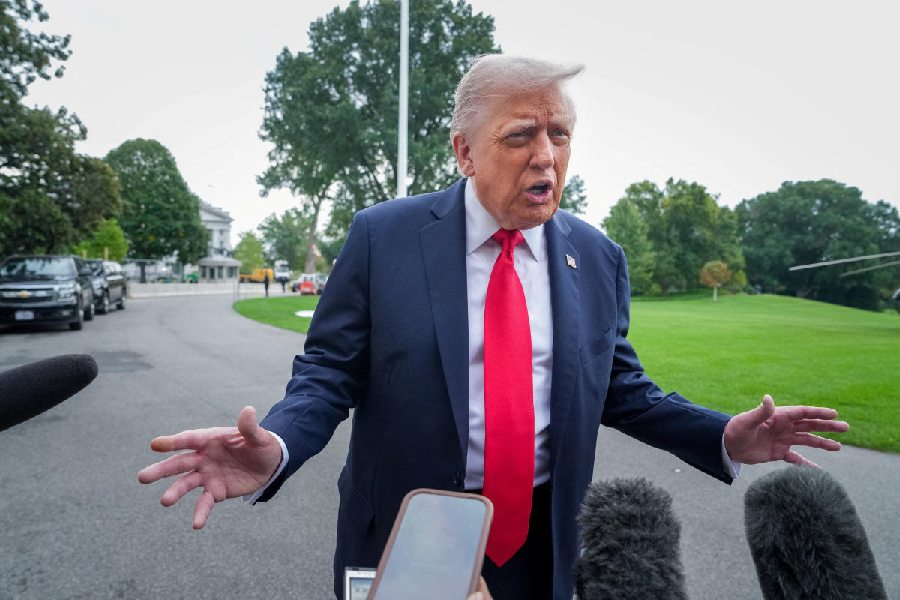
(The Post News) – In a fiery exchange on the White House lawn Wednesday morning, US President Donald Trump clashed with Australian journalist John Lyons, who was accused of ruining bilateral relations after he asked questions about his commercial activities while in office.
Trump, under growing public scrutiny of his cryptocurrency-linked real estate and business empire since returning to the Oval Office in January, fumed when ABC’s Americas editor asked if it was appropriate for an incumbent president to persist in being devoted to private financial interests.
“I think you are hurting Australia a great deal right now,” Trump snapped. “They want to get along with me. You know, your leader is coming over to see me very soon. I’m going to tell him about you. You set a very bad tone.”.
The tense confrontation happened as Prime Minister Anthony Albanese prepared for a visit to New York for the United Nations General Assembly (UNGA), during which he will officially meet Trump in person for the first time. The encounter also shed light on the US president’s increasingly combative attitude towards the media, including foreign correspondents.
Trump Confronts ABC Journalist
Lyons began by asking Trump how much wealthier he had become since returning to the White House for a second term. Trump responded that his children handled the family business through the Trump Organization and insisted most deals predated his presidency.
“This is what I’ve done for a life. I’ve built buildings,” Trump said, pointing to a planned White House ballroom project. When Lyons pressed further about whether a president should be running a private business while in office, Trump dismissed the concern, saying, “I’m really not. My kids are running the business.”
Trump then turned his focus to where Lyons was from and started his berating: “In my opinion, you are hurting Australia very much right now. They want to get along with me.” He put his finger to his lips and told Lyons to remain “quiet” before proceeding.
Lyons later told the president was in a “pretty feisty mood,” laughing on ABC Radio National Breakfast that he would have to “brace himself” when Albanese hears about it. “From my point of view, it was entirely normal to ask questions that I don’t think were provocative,” Lyons said. “If we’ve reached a point where asking those types of questions stops you from getting into the White House, then I think it’s a very dark day.”
Lyons is currently examining Trump’s business ties, including his cryptocurrency dealings, for an upcoming Four Corners investigation.
Meanwhile, in Canberra, Treasurer Jim Chalmers defended Lyons’ questioning by saying: “I respect the ABC and its independence, and that includes not second-guessing the questions asked legitimately by journalists, whether it is in DC or otherwise.” Meanwhile, Independent Senator David Pocock called Trump’s threat to “tell on” Lyons ridiculous, stating: “That is on top of the leader of a foreign nation assuming he is able to send our journalists to our PM for asking him difficult questions.”.
Greens Senator Sarah Hanson-Young accused Trump of trying to “bully the media and Australia” and urged Albanese to stand strong in defence of Australian journalists. Nationals frontbencher Bridget McKenzie also defended Lyons, saying: “There’s nothing wrong with journalists asking tough questions.” But Liberal Senator Sarah Henderson questioned whether the ABC’s tactics endangered trade, defence, and security ties with Washington.
Prime Minister Albanese is set to meet with Trump next week in New York, where officials are still ironing out the timing. The leaders last spoke by phone at the beginning of this month, a call that Albanese described as “really warm.” Trump himself called the prime minister a “good man.” Their first planned face-to-face encounter at June’s G7 summit in Canada collapsed after Trump cut short his trip to address the Iran-Israel crisis.
During the UNGA, the negotiations will also touch upon tense bilateral relations. Trump ordered a 10% tariff on all exports from Australia in April, which Albanese described as “not the act of a friend.” Washington is also calling on Canberra to boost defence expenditures to 3.5% of GDP, approximately $30 billion more annually, to meet security obligations under the AUKUS submarine pact.
The Pentagon’s AUKUS review, led by skeptical Undersecretary of Defence Elbridge Colby, is due to be released in November. Australia has since invested approximately $1.6 billion in the deal, but concerns remain that Trump’s administration could dial it back.
Expanding Crypto Empire Raises Questions
The White House feud occurs as Trump’s commercial interests attract growing scrutiny. Investigations reveal that his family members have profited substantially from investments such as World Liberty Financial (WLF), a token-based decentralized financial platform, and American Bitcoin Corp. (ABTC), a mining company listed on the Nasdaq stock exchange.
Together, the ventures are estimated to have generated paper profits of more than $5 billion since January. Critics argue that the ventures offer foreign governments or individuals an opportunity to buy influence with Trump simply by making purchases of tokens.
Ross Delston, a US attorney and financial crime specialist, told DW: “This is another route to allow the President to accept money from anyone, including foreign nationals and states that would be barred under US campaign finance regulation.” Despite such reservations, Trump has aggressively pushed pro-crypto policies since returning to office, including signing the Genius Act last summer, which introduced the first federal stablecoin regime.
Lyons explained the bristling exchange said a lot about Trump’s political style: “He’s sort of at war at the moment with big chunks of the media. That plays very well with his MAGA base.” Experts have, however, argued the confrontation will complicate Albanese’s meeting this week, requiring him to navigate Australia’s strategic dependence on the US while protecting local press freedoms.
As one Canberra commentator described: “The prime minister is entering a room with a president who uses each interaction, even with the media, as a power play. How Albanese gets through it will set the tone for Australia-US relations in Trump’s second term.”
About the Author