President, Donald Trump, has once again voiced criticism of filmmaker Rob Reiner. Image credit: Al Jazeera
(The Post News) – President Donald Trump issued a proclamation on Friday requiring companies to pay an annual $100,000 fee for each foreign worker that they sponsor under the H-1B visa program. The move, framed by the White House as a way to protect American workers, would potentially revolutionize the U.S. tech industry, which relies heavily on foreign experts from India and China.
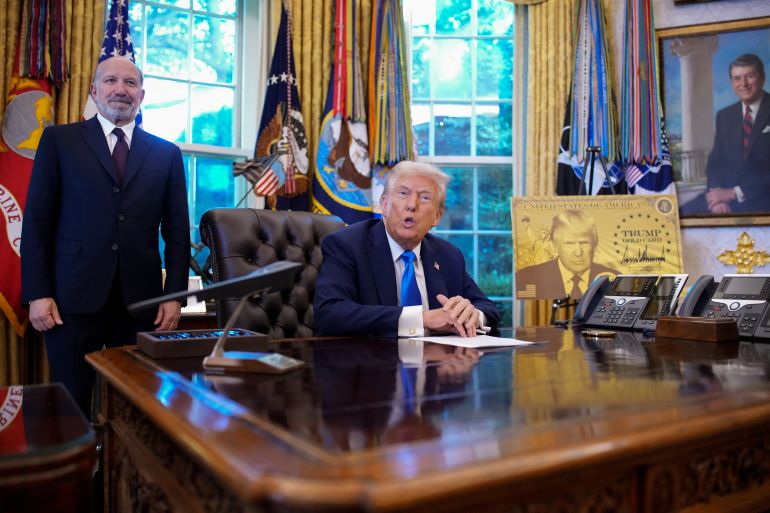
Commerce Secretary, Howard Lutnick said the measure is designed to push companies to prioritize hiring American graduates.
“If you’re going to train somebody, train one of the recent graduates from one of the great universities across our land. Train Americans. Stop bringing in people to take our jobs,” Lutnick said during the Oval Office ceremony.
Impact on the Tech Industry
The H-1B program, which was created in 1990, imports 85,000 high-skilled foreign workers into the U.S. annually. It has been a saviour for companies seeking skilled professionals in engineering, computer science, and health care.
Amazon alone received more than 10,000 visas in 2025, with thousands of approvals each going to Microsoft, Meta, Apple, and Google. Industry leaders warn that the new fee, hundreds of millions of dollars for large corporations, would choke small and startup companies that could not afford the extra cost.
“Most everyone’s going to be priced out,” said immigration attorney Tahmina Watson. “For many small- and medium-sized businesses, this is a death knell.”
The administration has overstepped, critics argue.
“The president literally has no legal authority to charge a $100,000 visa fee,” American Immigration Council’s Aaron Reichlin-Melnick said. “Congress only authorized fees to pay for the processing of the application, not a new tax on employers.”
Employers already shell out $215 to enter the H-1B lottery, and several thousand dollars in compliance and filing fees. The new proclamation hikes those fees over thirty times.
Trump also floated a new “Trump Gold Card” visa, offering residency to immigrants who spend $1 million or whose employers spend $2 million. A “Platinum Card,” said to be being considered, would cost $5 million and would give foreigners the right to spend most of the year in America without having to pay taxes on overseas income.
“These programs will raise more than $100 billion,” Trump said. “We’ll use that money to cut taxes and pay down debt.”
Industry Leaders Responce
Silicon Valley leaders immediately pushed back. Elon Musk, who once held an H-1B visa, warned that the U.S. risks losing top global talent.
“If the U.S. ceases to attract the best talent, it drastically reduces its ability to innovate and grow the economy,” wrote Deedy Das of Menlo Ventures.
Analysts went on to note the order may force companies to offshore high-value work to other nations, particularly in artificial intelligence, where the U.S. confronts stiff competition from China.
“In the short term, Washington will benefit from a windfall. In the long term, the U.S. will tax away its innovation edge,” eMarketer’s Jeremy Goldman added.
India, with 71% of the H-1B recipients in 2024, will be hit the hardest. China, the second largest visa holder source at 11.7%, will also be hit hard.
The Indian IT industry association Nasscom said the sudden introduction created “considerable uncertainty for businesses, professionals, and students worldwide.”
The directive takes effect on September 21, 2025 and only for new petitions and renewals. Existing H-1B workers who are already inside the country will not be required to repay fees.
The Trump government is already expecting lawsuits in a matter of days, with detractors saying the proclamation is against federal immigration law. Meanwhile, American companies have to decide to pay out or rethink their reliance on foreign labour.
About the Author